A. E. Waite · Pamela Colman Smith · 1911
타로 그림 열쇠
도감이 계속 참조하는 원전입니다. 웨이트가 실제로 뭐라고 썼는지 직접 보면, 도감의 해석과 원문을 구분할 수 있습니다. 라이더-웨이트-스미스 78장 도판을 원문이 놓인 자리에 그대로 실었습니다.
본문(서문·1부·2부·3부) 번역 100% (453/453 문단). 참고문헌은 웨이트가 붙인 서지 목록이라 원문 그대로 두었습니다. 번역이 안 된 곳은 번역 모드에서도 원문을 보여줍니다 — 빈 자리로 두면 읽는 흐름이 끊깁니다.
서문Preface
Preface
서문
It seems rather of necessity than predilection in the sense of apologia that I should put on record in the first place a plain statement of my personal position, as one who for many years of literary life has been, subject to his spiritual and other limitations, an exponent of the higher mystic schools. It will be thought that I am acting strangely in concerning myself at this day with what appears at first sight and simply a well-known method of fortune-telling. Now, the opinions of Mr. Smith, even in the literary reviews, are of no importance unless they happen to agree with our own, but in order to sanctify this doctrine we must take care that our opinions, and the subjects out of which they arise, are concerned only with the highest. Yet it is just this which may seem doubtful, in the present instance, not only to Mr. Smith, whom I respect within the proper measures of detachment, but to some of more real consequence, seeing that their dedications are mine. To these and to any I would say that after the most illuminated Frater Christian Rosy Cross had beheld the Chemical Marriage in the Secret Palace of Transmutation, his story breaks off abruptly, with an intimation that he expected next morning to be door-keeper. After the same manner, it happens more often than might seem likely that those who have seen the King of Heaven through the most clearest veils of the sacraments are those who assume thereafter the humblest offices of all about the House of God. By such simple devices also are the Adepts and Great Masters in the secret orders distinguished from the cohort of Neophytes as servi servorum mysterii. So also, or in a way which is not entirely unlike, we meet with the Tarot cards at the outermost gates—amidst the fritterings and débris of the so-called occult arts, about which no one in their senses has suffered the smallest deception; and yet these cards belong in themselves to another region, for they contain a very high symbolism, which is interpreted according to the Laws of Grace rather than by the pretexts and intuitions of that which passes for divination. The fact that the wisdom of God is foolishness with men does not create a presumption that the foolishness of this world makes in any sense for Divine Wisdom; so neither the scholars in the ordinary classes nor the pedagogues in the seats of the mighty will be quick to perceive the likelihood or even the possibility of this proposition. The subject has been in the hands of cartomancists as part of the stock-in-trade of their industry; I do not seek to persuade any one outside my own circles that this is of much or of no consequence; but on the historical and interpretative sides it has not fared better; it has been there in the hands of exponents who have brought it into utter contempt for those people who possess philosophical insight or faculties for the appreciation of evidence. It is time that it should be rescued, and this I propose to undertake once and for all, that I may have done with the side issues which distract from the term. As poetry is the most beautiful expression of the things that are of all most beautiful, so is symbolism the most catholic expression in concealment of things that are most profound in the Sanctuary and that have not been declared outside it with the same fulness by means of the spoken word. The justification of the rule of silence is no part of my present concern, but I have put on record elsewhere, and quite recently, what it is possible to say on this subject.
내 개인적인 입장을 먼저 밝혀 두는 일은 취향이라기보다 필요에 가까워 보인다. 일종의 해명(apologia)인 셈이다. 나는 오랜 문필 생활 동안 — 영적인 한계를 비롯한 여러 한계 안에서 — 더 높은 신비 학파를 대변해 온 사람이다. 그런 사람이 이제 와서 언뜻 보기에는 그저 널리 알려진 점치기 방법에 지나지 않는 것을 붙들고 있으니, 내가 이상하게 처신한다고들 여길 것이다. 문학 비평에서든 어디서든 스미스 씨의 견해는 마침 우리 견해와 일치할 때가 아니면 중요하지 않다. 다만 이 교의를 신성하게 지키려면 우리의 견해도, 그 견해가 나온 주제도 오직 가장 높은 것에만 관계하도록 조심해야 한다. 그런데 지금 이 경우에는 바로 그 점이 의심스러워 보일 수 있다. 적절한 거리를 두고 존중하는 스미스 씨에게만이 아니라, 나와 같은 것에 몸 바쳤기에 더 실질적인 무게를 지닌 이들에게도 그렇다. 그런 이들에게, 그리고 누구에게든 나는 이렇게 말하고 싶다. 가장 밝게 깨우친 형제 크리스티안 로젠크로이츠가 변환의 비밀 궁전에서 화학적 혼례를 본 뒤, 그의 이야기는 다음 날 아침 자신이 문지기가 되리라는 예감을 남긴 채 돌연 끊긴다. 이와 같은 방식으로, 성사(聖事)의 가장 맑은 베일 너머로 하늘의 왕을 본 이들이 그 뒤로 하느님의 집에서 가장 낮은 직무를 맡는 일은 그럴 법해 보이는 것보다 자주 일어난다. 비밀 결사의 아뎁트와 대사(大師)들이 신참의 무리와 구별되는 것도 이런 단순한 장치를 통해서다 — servi servorum mysterii(신비의 종들의 종)로서 말이다. 그와 같이, 혹은 그와 아주 다르지 않은 방식으로, 우리는 가장 바깥쪽 문간에서 타로 카드를 만난다. 이른바 오컬트 기예라는 것들의 부스러기와 잔해 한가운데, 제정신인 사람이라면 아무도 조금도 속지 않았을 그런 것들 틈에서 말이다. 그럼에도 이 카드들은 그 자체로 다른 영역에 속한다. 매우 높은 상징을 담고 있고, 그 상징은 점술로 통하는 것의 구실이나 직관이 아니라 은총의 법에 따라 해석되기 때문이다. 하느님의 지혜가 사람에게는 어리석음이라는 사실이, 이 세상의 어리석음은 어떤 의미로든 신적 지혜에 이바지한다는 추정까지 만들어 주지는 않는다. 그러니 보통 교실의 학자들도, 권세 있는 자리의 교육자들도 이 명제가 그럴듯하기는커녕 가능하기라도 한지 선뜻 알아보지 못할 것이다. 이 주제는 카드점 술사들의 손에서 그들 장사의 밑천 노릇을 해 왔다. 그것이 대단한 일인지 대단찮은 일인지 내 울타리 밖의 누구에게도 설득할 생각은 없다. 그러나 역사의 면에서도 해석의 면에서도 사정이 나았던 것은 아니다. 철학적 통찰이나 증거를 가릴 능력을 지닌 사람들에게 이 주제를 완전한 경멸의 대상으로 만들어 버린 해설자들의 손에 있었기 때문이다. 이제는 이것을 구해 낼 때이고, 나는 그 일을 단번에 끝내려 한다. 그래야 본론에서 자꾸 눈을 돌리게 하는 곁가지들을 정리할 수 있다. 시가 가장 아름다운 것들 가운데서도 가장 아름다운 것의 표현이듯, 상징은 성소(聖所)에서 가장 깊은 것들 — 곧 말로는 그만한 충만함으로 바깥에 선포된 적 없는 것들 — 을 감춤의 형태로 담아내는 가장 보편적인 표현이다. 침묵의 규칙을 정당화하는 일은 지금 내가 할 일이 아니다. 다만 이 주제에 관해 할 수 있는 말은 다른 곳에, 그것도 아주 최근에 적어 두었다.
The little treatise which follows is divided into three parts, in the first of which I have dealt with the antiquities of the subject and a few things that arise from and connect therewith. It should be understood that it is not put forward as a contribution to the history of playing cards, about which I know and care nothing; it is a consideration dedicated and addressed to a certain school of occultism, more especially in France, as to the source and centre of all the phantasmagoria which has entered into expression during the last fifty years under the pretence of considering Tarot cards historically. In the second part, I have dealt with the symbolism according to some of its higher aspects, and this also serves to introduce the complete and rectified Tarot, which is available separately, in the form of coloured cards, the designs of which are added to the present text in black and white. They have been prepared under my supervision—in respect of the attributions and meanings—by a lady who has high claims as an artist. Regarding the divinatory part, by which my thesis is terminated, I consider it personally as a fact in the history of the Tarot; as such, I have drawn, from all published sources, a harmony of the meanings which have been attached to the various cards, and I have given prominence to one method of working that has not been published previously; having the merit of simplicity, while it is also of universal application, it may be held to replace the cumbrous and involved systems of the larger hand-books.
이어지는 이 작은 논고는 세 부분으로 나뉜다. 첫째 부분에서는 이 주제의 옛 내력과, 거기서 비롯되어 서로 얽히는 몇 가지를 다루었다. 이것이 카드놀이의 역사에 보태려고 쓴 글이 아니라는 점은 분명히 해 두어야겠다 — 나는 그쪽에 대해 아는 바도 없고 관심도 없다. 이 글은 어떤 오컬트 학파, 특히 프랑스 쪽을 향해 바치고 겨눈 고찰이다. 지난 오십 년 동안 타로 카드를 역사적으로 다룬다는 명분 아래 쏟아져 나온 온갖 허깨비 같은 이야기의 근원이자 중심이 그쪽이기 때문이다. 둘째 부분에서는 상징을 그 높은 측면 몇 가지에 따라 다루었고, 이 부분은 완전하게 교정된 타로를 소개하는 구실도 한다. 그 타로는 채색 카드 형태로 따로 구할 수 있으며, 그 도안을 흑백으로 이 본문에 실었다. 도안은 — 배정과 의미에 관한 한 — 나의 감수 아래, 예술가로서 높은 자격을 갖춘 한 여성이 준비한 것이다. 내 논지를 맺는 점술 부분에 대해 말하자면, 나는 그것을 개인적으로 타로 역사 속의 한 사실로 여긴다. 그런 것으로서, 출간된 모든 자료에서 여러 카드에 붙어 온 의미들을 조화롭게 추려 냈고, 이제까지 출간된 적 없는 운용 방법 하나를 앞세워 실었다. 그 방법은 단순하다는 장점이 있으면서도 두루 적용되므로, 더 두꺼운 안내서들의 번거롭고 뒤엉킨 체계를 대신할 만하다고 볼 수 있다.
1부 — 베일과 그 상징Part I. The Veil and its Symbols
PART I
1부
The Veil and its Symbols
베일과 그 상징
§ 1
§ 1
INTRODUCTORY AND GENERAL
들어가며, 그리고 전반에 관하여
The pathology of the poet says that "the undevout astronomer is mad"; the pathology of the very plain man says that genius is mad; and between these extremes, which stand for ten thousand analogous excesses, the sovereign reason takes the part of a moderator and does what it can. I do not think that there is a pathology of the occult dedications, but about their extravagances no one can question, and it is not less difficult than thankless to act as a moderator regarding them. Moreover, the pathology, if it existed, would probably be an empiricism rather than a diagnosis, and would offer no criterion. Now, occultism is not like mystic faculty, and it very seldom works in harmony either with business aptitude in the things of ordinary life or with a knowledge of the canons of evidence in its own sphere. I know that for the high art of ribaldry there are few things more dull than the criticism which maintains that a thesis is untrue, and cannot understand that it is decorative. I know also that after long dealing with doubtful doctrine or with difficult research it is always refreshing, in the domain of this art, to meet with what is obviously of fraud or at least of complete unreason. But the aspects of history, as seen through the lens of occultism, are not as a rule decorative, and have few gifts of refreshment to heal the lacerations which they inflict on the logical understanding. It almost requires a Frater Sapiens dominabitur astris in the Fellowship of the Rosy Cross to have the patience which is not lost amidst clouds of folly when the consideration of the Tarot is undertaken in accordance with the higher law of symbolism. The true Tarot is symbolism; it speaks no other language and offers no other signs. Given the inward meaning of its emblems, they do become a kind of alphabet which is capable of indefinite combinations and makes true sense in all. On the highest plane it offers a key to the Mysteries, in a manner which is not arbitrary and has not been read in. But the wrong symbolical stories have been told concerning it, and the wrong history has been given in every published work which so far has dealt with the subject. It has been intimated by two or three writers that, at least in respect of the meanings, this is unavoidably the case, because few are acquainted with them, while these few hold by transmission under pledges and cannot betray their trust. The suggestion is fantastic on the surface, for there seems a certain anti-climax in the proposition that a particular interpretation of fortune-telling—l'art de tirer les cartes—can be reserved for Sons of the Doctrine. The fact remains, notwithstanding, that a Secret Tradition exists regarding the Tarot, and as there is always the possibility that some minor arcana of the Mysteries may be made public with a flourish of trumpets, it will be as well to go before the event and to warn those who are curious in such matters that any revelation will contain only a third part of the earth and sea and a third part of the stars of heaven in respect of the symbolism. This is for the simple reason that neither in root-matter nor in development has more been put into writing, so that much will remain to be said after any pretended unveiling. The guardians of certain temples of initiation who keep watch over mysteries of this order have therefore no cause for alarm.
시인이 내리는 광기의 진단에 따르면 "신앙 없는 천문학자는 미친 사람"이고, 아주 평범한 사람이 내리는 진단에 따르면 천재가 미친 사람이다. 만 가지 비슷한 지나침을 대표하는 이 두 극단 사이에서, 지고의 이성이 중재자 노릇을 맡아 할 수 있는 일을 한다. 오컬트에 몸 바치는 일을 두고 따로 광기의 진단법이 있다고는 생각하지 않는다. 다만 그들의 터무니없는 과장만은 아무도 부정할 수 없으며, 그에 관해 중재자 노릇을 하는 일은 어려운 만큼이나 고맙다는 말도 듣지 못한다. 게다가 그런 진단법이 있다 한들, 그것은 제대로 된 진단이라기보다 경험적인 분류에 가까울 터라 아무 판별 기준도 내놓지 못할 것이다. 그런데 오컬티즘은 신비의 능력과 같은 것이 아니며, 일상을 꾸려 가는 실무 능력과도, 제 영역 안에서 증거를 가리는 원칙에 대한 이해와도 좀처럼 조화를 이루지 못한다. 익살을 고급 기예로 삼는 이들이 보기에, 어떤 논제가 참이 아니라고 따지면서 그것이 장식이라는 점은 이해하지 못하는 비평만큼 따분한 것도 드물다는 걸 나는 안다. 또 미심쩍은 교설이나 까다로운 연구를 오래 상대한 뒤에는, 이 기예의 영역에서 명백한 사기이거나 적어도 철저히 비합리적인 것을 만나는 일이 늘 상쾌하다는 것도 안다. 그러나 오컬티즘의 렌즈로 본 역사의 국면들은 대개 장식조차 되지 못하며, 그것이 논리적 이해에 입히는 상처를 아물게 할 상쾌함도 거의 주지 못한다. 상징의 더 높은 법에 따라 타로를 고찰하려 들 때, 어리석음의 구름 한가운데서도 잃지 않을 인내를 지니려면 장미십자 형제단의 현자는 별을 다스리리라(Frater Sapiens dominabitur astris) 쯤은 되어야 할 지경이다. 참된 타로는 상징이다. 그것은 상징 말고 다른 언어를 말하지 않고, 상징 말고 다른 표징을 내놓지 않는다. 그 표장들의 내적인 뜻이 주어지고 나면, 그것들은 끝없는 조합이 가능하면서도 어느 조합에서나 참된 뜻을 이루는 일종의 알파벳이 된다. 가장 높은 층위에서 그것은 신비들로 들어가는 열쇠를 내놓는데, 그 방식은 자의적이지 않으며 해석자가 밖에서 밀어 넣은 것도 아니다. 그러나 타로를 두고 잘못된 상징 이야기가 전해져 왔고, 지금까지 이 주제를 다룬 모든 출간물이 잘못된 역사를 제시해 왔다. 두세 저술가는 적어도 그 뜻에 관한 한 이것이 어쩔 수 없는 일이라고 넌지시 말해 왔다. 그 뜻을 아는 이가 드물고, 그 드문 이들은 서약 아래 전승으로 지니고 있어 맡겨진 신뢰를 저버릴 수 없다는 것이다. 이 시사는 겉보기에 터무니없다. 카드점 — 카드를 뽑는 기예(l'art de tirer les cartes) — 의 특정한 해석을 교의의 아들들에게만 남겨 둔다는 명제에는 어딘가 맥이 빠지는 데가 있기 때문이다. 그럼에도 타로에 관해 비밀 전승이 존재한다는 사실은 남는다. 그리고 신비들의 작은 아르카나 몇 가지가 나팔을 불며 공개될 가능성은 언제나 있으니, 그 일이 벌어지기 전에 미리 나서서 이런 일에 호기심을 품은 이들에게 일러두는 편이 좋겠다. 어떤 폭로가 나오든 상징에 관해 드러낼 수 있는 것은 땅과 바다의 삼분의 일, 하늘의 별의 삼분의 일에 지나지 않으리라고 말이다. 이유는 단순하다. 뿌리가 되는 문제에서든 그 전개에서든 그 이상은 글로 옮겨진 적이 없어서, 누가 모든 것을 벗겨냈다고 자처한 뒤에도 말해질 것이 많이 남기 때문이다. 그러니 이런 갈래의 신비를 지키는 입문 신전의 수호자들은 놀랄 까닭이 조금도 없다.
In my preface to The Tarot of the Bohemians, which, rather by an accident of things, has recently come to be re-issued after a long period, I have said what was then possible or seemed most necessary. The present work is designed more especially—as I have intimated—to introduce a rectified set of the cards themselves and to tell the unadorned truth concerning them, so far as this is possible in the outer circles. As regards the sequence of greater symbols, their ultimate and highest meaning lies deeper than the common language of picture or hieroglyph. This will be understood by those who have received some part of the Secret Tradition. As regards the verbal meanings allocated here to the more important Trump Cards, they are designed to set aside the follies and impostures of past attributions, to put those who have the gift of insight on the right track, and to take care, within the limits of my possibilities, that they are the truth so far as they go.
사정이 어찌하다 보니 오랜 기간이 지나 최근에 다시 나오게 된 『보헤미안의 타로』의 서문에서, 나는 그때 할 수 있었던 말, 또는 가장 필요해 보였던 말을 했다. 이 책은 — 앞서 넌지시 말했듯 — 특히 교정된 카드 한 벌 자체를 소개하고, 입문 조직의 바깥 동아리에서 말할 수 있는 한도까지 그에 관한 꾸밈없는 진실을 말하려고 마련되었다. 더 큰 상징들의 계열로 말하자면, 그 궁극적이고 가장 높은 뜻은 그림이나 상형문자라는 통상의 언어보다 깊은 곳에 놓여 있다. 비밀 전승의 일부를 받은 이들이라면 이 말을 알아들을 것이다. 여기서 더 중요한 대아르카나 카드들에 붙인 말뜻으로 말하자면, 그것은 지난 배정들의 어리석음과 협잡을 걷어 내고 통찰의 재능을 지닌 이들을 옳은 길에 올려놓기 위한 것이다. 또한 내 능력이 닿는 한도 안에서, 그 말뜻이 미치는 범위까지는 진실이도록 하려는 것이다.
It is regrettable in several respects that I must confess to certain reservations, but there is a question of honour at issue. Furthermore, between the follies on the one side of those who know nothing of the tradition, yet are in their own opinion the exponents of something called occult science and philosophy, and on the other side between the make-believe of a few writers who have received part of the tradition and think that it constitutes a legal title to scatter dust in the eyes of the world without, I feel that the time has come to say what it is possible to say, so that the effect of current charlatanism and unintelligence may be reduced to a minimum.
몇 가지 점에서 유감스럽게도 나는 어떤 유보가 있음을 고백해야 한다. 다만 여기에는 명예의 문제가 걸려 있다. 나아가 한쪽에는 전승에 대해 아무것도 모르면서 스스로는 오컬트 과학이니 철학이니 하는 것의 대변자라고 여기는 이들의 어리석음이 있다. 다른 쪽에는 전승의 일부를 받고서 그것이 바깥세상의 눈을 가릴 법적 자격이라도 되는 줄 아는 몇몇 저술가의 시늉이 있다. 그 둘 사이에서 나는 이제 말할 수 있는 것을 말할 때가 되었다고 느낀다. 지금의 협잡과 무지가 미치는 영향이 최소한으로 줄어들도록 말이다.
We shall see in due course that the history of Tarot cards is largely of a negative kind, and that, when the issues are cleared by the dissipation of reveries and gratuitous speculations expressed in the terms of certitude, there is in fact no history prior to the fourteenth century. The deception and self-deception regarding their origin in Egypt, India or China put a lying spirit into the mouths of the first expositors, and the later occult writers have done little more than reproduce the first false testimony in the good faith of an intelligence unawakened to the issues of research. As it so happens, all expositions have worked within a very narrow range, and owe, comparatively speaking, little to the inventive faculty. One brilliant opportunity has at least been missed, for it has not so far occurred to any one that the Tarot might perhaps have done duty and even originated as a secret symbolical language of the Albigensian sects. I commend this suggestion to the lineal descendants in the spirit of Gabriele Rossetti and Eugène Aroux, to Mr. Harold Bayley as another New Light on the Renaissance, and as a taper at least in the darkness which, with great respect, might be serviceable to the zealous and all-searching mind of Mrs. Cooper-Oakley. Think only what the supposed testimony of watermarks on paper might gain from the Tarot card of the Pope or Hierophant, in connexion with the notion of a secret Albigensian patriarch, of which Mr. Bayley has found in these same watermarks so much material to his purpose. Think only for a moment about the card of the High Priestess as representing the Albigensian church itself; and think of the Tower struck by Lightning as typifying the desired destruction of Papal Rome, the city on the seven hills, with the pontiff and his temporal power cast down from the spiritual edifice when it is riven by the wrath of God. The possibilities are so numerous and persuasive that they almost deceive in their expression one of the elect who has invented them. But there is more even than this, though I scarcely dare to cite it. When the time came for the Tarot cards to be the subject of their first formal explanation, the archæologist Court de Gebelin reproduced some of their most important emblems, and—if I may so term it—the codex which he used has served—by means of his engraved plates—as a basis of reference for many sets that have been issued subsequently. The figures are very primitive and differ as such from the cards of Etteilla, the Marseilles Tarot, and others still current in France. I am not a good judge in such matters, but the fact that every one of the Trumps Major might have answered for watermark purposes is shewn by the cases which I have quoted and by one most remarkable example of the Ace of Cups.
타로 카드의 역사가 대체로 부정적인 성격의 것이라는 점은 차차 보게 될 것이다. 확신에 찬 어투로 표명된 몽상과 근거 없는 사변을 걷어 내고 논점을 정리하고 나면, 실은 14세기 이전에는 아무 역사도 없다. 타로가 이집트나 인도나 중국에서 기원했다는 기만과 자기기만은 최초 해설자들의 입에 거짓말하는 영을 넣었다. 후대의 오컬트 저술가들은 연구의 논점에 깨어나지 못한 지성의 선의로 그 첫 거짓 증언을 되풀이했을 뿐, 그 이상 한 일이 별로 없다. 어쩌다 보니 모든 해설이 매우 좁은 범위 안에서만 움직여 왔고, 견주어 말하자면 새로 지어낸 것에 빚진 바도 적다. 적어도 눈부신 기회 하나는 놓쳤다. 타로가 어쩌면 알비파 종파들의 비밀 상징 언어 노릇을 했고 심지어 거기서 비롯되었을지도 모른다는 생각이, 지금까지 아무에게도 떠오르지 않았기 때문이다. 나는 이 착상을 세 사람에게 바친다. 가브리엘레 로세티와 외젠 아루의 정신적 직계 후손들에게, 또 하나의 『르네상스에 비추는 새 빛』으로서 해럴드 베일리 씨에게, 그리고 — 크게 존경을 담아 말하건대 — 쿠퍼오클리 부인의 열성적이고 무엇이든 뒤지는 정신에 쓸모가 있을 법한, 어둠 속의 촛불 하나로서 말이다. 종이 워터마크의 이른바 증언이 교황(Pope 또는 Hierophant) 카드에서 무엇을 얻을 수 있을지 생각만 해 보라. 비밀 알비파 총대주교라는 착상과 이어 놓고 보면 말이다. 베일리 씨는 바로 그 워터마크들에서 자기 목적에 맞는 자료를 그토록 많이 찾아냈으니 더욱 그렇다. 여사제 카드가 알비파 교회 자체를 나타낸다고 잠깐 생각해 보라. 벼락 맞은 탑이 일곱 언덕 위의 도시, 곧 교황의 로마가 무너지기를 바라는 마음을 표상한다고 생각해 보라. 그 영적 건물이 하느님의 진노로 쪼개질 때 교황과 그의 세속 권력이 거기서 내던져지는 것이라고 말이다. 가능성이 너무 많고 그럴듯해서, 그것을 지어낸 택함받은 자 자신조차 제 표현에 속아 넘어갈 지경이다. 그러나 이보다 더한 것도 있다. 감히 인용하기가 망설여지지만 말이다. 타로 카드가 처음으로 정식 설명의 대상이 될 때가 왔을 때, 고고학자 쿠르 드 제블랭은 그중 가장 중요한 표장 몇 가지를 복제했다. 그리고 — 이렇게 불러도 된다면 — 그가 쓴 판본(codex)은 그의 판각 도판을 통해, 그 뒤에 나온 여러 카드 벌의 준거 노릇을 해 왔다. 그 도상들은 매우 원시적이어서, 그 점에서 에틸라의 카드나 마르세유 타로, 그 밖에 프랑스에서 아직 통용되는 것들과 다르다. 나는 이런 문제를 판정할 만한 사람이 못 된다. 그러나 대아르카나 하나하나가 워터마크 용도로 쓰였을 법하다는 점은, 내가 인용한 사례들과 컵 에이스의 가장 주목할 만한 한 예가 보여준다.
I should call it an eucharistic emblem after the manner of a ciborium, but this does not signify at the moment. The point is that Mr. Harold Bayley gives six analogous devices in his New Light on the Renaissance, being watermarks on paper of the seventeenth century, which he claims to be of Albigensian origin and to represent sacramental and Graal emblems. Had he only heard of the Tarot, had he known that these cards of
나라면 그것을 성합(聖盒) 비슷한 성찬 표장이라 부르겠지만, 지금 그 점은 중요하지 않다. 요점은 해럴드 베일리 씨가 『르네상스에 비추는 새 빛』에서 그와 비슷한 도안 여섯 가지를 제시한다는 것이다. 17세기 종이의 워터마크인 그것들을 그는 알비파에서 기원했으며 성사와 성배의 표장을 나타낸다고 주장한다. 그가 타로에 대해 들어 보기만 했더라면, 이 카드들이 —
divination, cards of fortune, cards of all vagrant arts, were perhaps current at the period in the South of France, I think that his enchanting but all too fantastic hypothesis might have dilated still more largely in the atmosphere of his dream. We should no doubt have had a vision of Christian Gnosticism, Manichæanism, and all that he understands by pure primitive Gospel, shining behind the pictures.
점의 카드, 운수의 카드, 온갖 떠돌이 기예의 카드가 그 시기 남프랑스에서 통용되고 있었을지 모른다는 것을 알기만 했더라면, 그의 매혹적이지만 너무나도 공상적인 가설이 제 꿈의 대기 속에서 한층 더 크게 부풀었으리라고 나는 생각한다. 그랬다면 우리는 필시 그림 뒤에서 빛나는 그리스도교 영지주의와 마니교, 그리고 그가 순수한 원시 복음이라 이해하는 모든 것의 환시를 보게 되었을 것이다.
I do not look through such glasses, and I can only commend the subject to his attention at a later period; it is mentioned here that I may introduce with an unheard-of wonder the marvels of arbitrary speculation as to the history of the cards.
나는 그런 안경으로 들여다보지 않으며, 이 주제는 훗날 그의 주의에 맡길 수 있을 뿐이다. 여기서 이를 언급하는 것은 카드의 역사에 관한 자의적 사변의 경이로움을, 일찍이 들어 본 적 없는 놀라움과 함께 소개하기 위해서다.
With reference to their form and number, it should scarcely be necessary to enumerate them, for they must be almost commonly familiar, but as it is precarious to assume anything, and as there are also other reasons, I will tabulate them briefly as follows:—
그 형태와 수에 관해서는 굳이 열거할 필요가 거의 없을 것이다. 거의 누구에게나 익숙할 터이기 때문이다. 그러나 무엇이든 당연하다고 여기는 것은 위태로운 일이고 다른 이유들도 있으므로, 아래와 같이 간략히 정리해 두겠다 —
CLASS I
제1분류
§ 2
§ 2
TRUMPS MAJOR
대아르카나
Otherwise, Greater Arcana
달리 말해 큰 비의(祕義)
1. The Magus, Magician, or Juggler, the caster of the dice and mountebank, in the world of vulgar trickery. This is the colportage interpretation, and it has the same correspondence with the real symbolical meaning that the use of the Tarot in fortune-telling has with its mystic construction according to the secret science of symbolism. I should add that many independent students of the subject, following their own lights, have produced individual sequences of meaning in respect of the Trumps Major, and their lights are sometimes suggestive, but they are not the true lights. For example, Éliphas Lévi says that the Magus signifies that unity which is the mother of numbers; others say that it is the Divine Unity; and one of the latest French commentators considers that in its general sense it is the will.
1. 마구스, 마법사, 또는 요술쟁이. 저속한 속임수의 세계에서 주사위를 던지는 자이자 약장수다. 이것은 행상판(colportage) 의 해석이며, 이것이 참된 상징적 뜻과 맺는 관계는 카드점에서의 타로 사용이 상징의 비밀 학문에 따른 그 신비적 짜임과 맺는 관계와 같다. 덧붙이자면 이 주제를 홀로 파고든 많은 이들이 저마다의 빛을 좇아 대아르카나에 관한 개별적인 뜻의 계열을 내놓았고, 그 빛이 때로는 시사하는 바가 있으나 참된 빛은 아니다. 이를테면 엘리파스 레비는 마구스가 수(數)의 어머니인 그 하나를 뜻한다고 말하고, 다른 이들은 그것이 신적 하나라 하며, 가장 최근의 프랑스 주석가 하나는 그것이 일반적인 뜻에서 의지라고 본다.
2. The High Priestess, the Pope Joan, or Female Pontiff; early expositors have sought to term this card the Mother, or Pope's Wife, which is opposed to the symbolism. It is sometimes held to represent the Divine Law and the Gnosis, in which case the Priestess corresponds to the idea of the Shekinah. She is the Secret Tradition and the higher sense of the instituted Mysteries.
2. 여사제, 여교황 요안나, 또는 여성 교황. 초기 해설자들은 이 카드를 어머니 또는 교황의 아내라 부르려 했는데, 이는 상징에 어긋난다. 때로는 신적 율법과 그노시스를 나타낸다고 여겨지며, 그 경우 여사제는 셰키나 의 관념에 대응한다. 그녀는 비밀 전승이자 제정된 신비들의 더 높은 뜻이다.
3. The Empress, who is sometimes represented with full face, while her correspondence, the Emperor, is in profile. As there has been some tendency to ascribe a symbolical significance to this distinction, it seems desirable to say that it carries no inner meaning. The Empress has been connected with the ideas of universal fecundity and in a general sense with activity.
3. 여황제. 때로는 정면으로 그려지는 반면 그 짝인 황제는 옆모습으로 그려진다. 이 구별에 상징적 뜻을 붙이려는 경향이 얼마간 있어 왔으므로, 거기에 내적인 뜻은 없다고 말해 두는 편이 좋겠다. 여황제 는 보편적 다산의 관념과, 그리고 일반적인 뜻에서 활동과 이어져 왔다.
4. The Emperor, by imputation the spouse of the former. He is occasionally represented as wearing, in addition to his personal insignia, the stars or ribbons of some order of chivalry. I mention this to shew that the cards are a medley of old and new emblems. Those who insist upon the evidence of the one may deal, if they can, with the other. No effectual argument for the antiquity of a particular design can be drawn from the fact that it incorporates old material; but there is also none which can be based on sporadic novelties, the intervention of which may signify only the unintelligent hand of an editor or of a late draughtsman.
4. 황제. 앞의 인물의 배우자로 여겨진다. 그는 이따금 자기 개인 표장에 더해 어떤 기사단의 별이나 수장(綬章)을 두른 모습으로 그려진다. 이를 언급하는 것은 이 카드들이 옛 표장과 새 표장의 뒤섞임임을 보이기 위해서다. 한쪽의 증거를 고집하는 이들은 할 수 있다면 다른 쪽도 다뤄 보시라. 어떤 도안이 옛 재료를 담고 있다는 사실에서 그 도안이 오래되었다는 유효한 논증을 끌어낼 수는 없다. 그러나 산발적인 새것에 기댈 수 있는 논증도 없기는 마찬가지인데, 그런 것의 개입은 편집자나 후대 도안공의 지각없는 손을 뜻할 뿐일 수도 있기 때문이다.
5. The High Priest or Hierophant, called also Spiritual Father, and more commonly and obviously the Pope. It seems even to have been named the Abbot, and then its correspondence, the High Priestess, was the Abbess or Mother of the Convent. Both are arbitrary names. The insignia of the figures are papal, and in such case the High Priestess is and can be only the Church, to whom Pope and priests are married by the spiritual rite of ordination. I think, however, that in its primitive form this card did not represent the Roman Pontiff.
5. 대사제 또는 교황. 영적 아버지라고도 불리며, 더 흔하고 뻔하게는 교황이라 불린다. 심지어 수도원장이라 이름 붙여진 적도 있는 듯하고, 그때 그 짝인 여사제는 수녀원장 또는 수도원의 어머니였다. 둘 다 자의적인 이름이다. 이 인물들의 표장은 교황의 것이며, 그렇다면 여사제는 교회일 수밖에 없다. 교황과 사제들이 서품이라는 영적 예식으로 혼인하는 그 교회 말이다. 다만 나는 이 카드가 본래 형태에서는 로마 교황을 나타내지 않았다고 생각한다.
6. The Lovers or Marriage. This symbol has undergone many variations, as might be expected from its subject. In the eighteenth century form, by which it first became known to the world of archæological research, it is really a card of married life, shewing father and mother, with their child placed between them; and the pagan Cupid above, in the act of flying his shaft, is, of course, a misapplied emblem. The Cupid is of love beginning rather than of love in its fulness, guarding the fruit thereof. The card is said to have been entitled Simulacrum fidei, the symbol of conjugal faith, for which the rainbow as a sign of the covenant would have been a more appropriate concomitant. The figures are also held to have signified Truth, Honour and Love, but I suspect that this was, so to speak, the gloss of a commentator moralizing. It has these, but it has other and higher aspects.
6. 연인 또는 결혼. 이 상징은 그 주제로 보아 예상할 만하게도 여러 변형을 겪었다. 고고학 연구의 세계에 처음 알려진 18세기 형태에서 그것은 실은 결혼 생활의 카드로, 아버지와 어머니 사이에 아이를 세워 그린다. 그리고 그 위에서 화살을 날리는 이교의 큐피드는 물론 잘못 갖다 붙인 표장이다. 큐피드는 열매를 지키는 충만한 사랑이라기보다 시작되는 사랑의 것이다. 이 카드는 신의(信義)의 표상(Simulacrum fidei), 곧 부부의 신의를 나타내는 표징이라 이름 붙여졌다고 하는데, 그런 뜻이라면 계약의 표징인 무지개가 더 어울리는 동반물이었을 것이다. 이 인물들이 진리와 명예와 사랑을 뜻했다고도 하나, 나는 이것이 말하자면 도덕론을 펴는 주석가의 덧칠이었으리라 짐작한다. 이 카드에 그런 뜻이 있기는 하지만, 다른 그리고 더 높은 측면들도 있다.
7. The Chariot. This is represented in some extant codices as being drawn by two sphinxes, and the device is in consonance with the symbolism, but it must not be supposed that such was its original form; the variation was invented to support a particular historical hypothesis. In the eighteenth century white horses were yoked to the car. As regards its usual name, the lesser stands for the greater; it is really the King in his triumph, typifying, however, the victory which creates kingship as its natural consequence and not the vested royalty of the fourth card. M. Court de Gebelin said that it was Osiris Triumphing, the conquering sun in spring-time having vanquished the obstacles of winter. We know now that Osiris rising from the dead is not represented by such obvious symbolism. Other animals than horses have also been used to draw the currus triumphalis, as, for example, a lion and a leopard.
7. 전차. 남아 있는 몇몇 사본에서는 두 마리 스핑크스가 끄는 것으로 그려지며, 그 고안은 상징과 어울린다. 그러나 그것이 본래 형태였다고 여겨서는 안 된다. 그 변형은 특정한 역사적 가설을 뒷받침하려고 고안된 것이다. 18세기에는 흰 말들이 수레에 매여 있었다. 통상적인 이름에 관해 말하자면, 작은 것이 큰 것을 대신하고 있다. 그것은 실은 개선하는 왕이되, 네 번째 카드의 기정 왕권이 아니라 그 자연스러운 결과로서 왕권을 만들어 내는 승리를 표상한다. 쿠르 드 제블랭 씨는 그것이 개선하는 오시리스, 곧 겨울의 장애를 이겨 낸 봄철의 정복하는 태양이라고 말했다. 죽음에서 일어나는 오시리스가 그런 뻔한 상징으로 나타나지 않는다는 것을 우리는 이제 안다. 말이 아닌 다른 짐승들이 개선 수레(currus triumphalis) 를 끄는 데 쓰이기도 했다. 이를테면 사자와 표범이 그렇다.
8. Fortitude. This is one of the cardinal virtues, of which I shall speak later. The female figure is usually represented as closing the mouth of a lion. In the earlier form which is printed by Court de Gebelin, she is obviously opening it. The first alternative is better symbolically, but either is an instance of strength in its conventional understanding, and conveys the idea of mastery. It has been said that the figure represents organic force, moral force and the principle of all force.
8. 불굴. 이는 사추덕(四樞德) 가운데 하나로, 뒤에 다시 말하겠다. 여성 인물은 대개 사자의 입을 다물리는 모습으로 그려진다. 쿠르 드 제블랭이 판각해 실은 더 이른 형태에서는 그녀가 분명 그 입을 벌리고 있다. 상징으로는 첫째 쪽이 낫지만, 어느 쪽이든 관례적으로 이해되는 힘의 한 사례이며 제압이라는 관념을 전한다. 이 인물이 유기적 힘, 도덕적 힘, 그리고 모든 힘의 원리를 나타낸다고들 해 왔다.
9. The Hermit, as he is termed in common parlance, stands next on the list; he is also the Capuchin, and in more philosophical language the Sage. He is said to be in search of that Truth which is located far off in the sequence, and of Justice which has preceded him on the way. But this is a card of attainment, as we shall see later, rather than a card of quest. It is said also that his lantern contains the Light of Occult Science and that his staff is a Magic Wand. These interpretations are comparable in every respect to the divinatory and fortune-telling meanings with which I shall have to deal in their turn. The diabolism of both is that they are true after their own manner, but that they miss all the high things to which the Greater Arcana should be allocated. It is as if a man who knows in his heart that all roads lead to the heights, and that God is at the great height of all, should choose the way of perdition or the way of folly as the path of his own attainment. Éliphas Lévi has allocated this card to Prudence, but in so doing he has been actuated by the wish to fill a gap which would otherwise occur in the symbolism. The four cardinal virtues are necessary to an idealogical sequence like the Trumps Major, but they must not be taken only in that first sense which exists for the use and consolation of him who in these days of halfpenny journalism is called the man in the street. In their proper understanding they are the correlatives of the counsels of perfection when these have been similarly re-expressed, and they read as follows: (a) Transcendental Justice, the counter-equilibrium of the scales, when they have been overweighted so that they dip heavily on the side of God. The corresponding counsel is to use loaded dice when you play for high stakes with Diabolus. The axiom is Aut Deus, aut nihil. (b) Divine Ecstacy, as a counterpoise to something called Temperance, the sign of which is, I believe, the extinction of lights in the tavern. The corresponding counsel is to drink only of new wine in the Kingdom of the Father, because God is all in all. The axiom is that man being a reasonable being must get intoxicated with God; the imputed case in point is Spinoza. (c) The state of Royal Fortitude, which is the state of a Tower of Ivory and a House of Gold, but it is God and not the man who has become Turris fortitudinis a facie inimici, and out of that House the enemy has been cast. The corresponding counsel is that a man must not spare himself even in the presence of death, but he must be certain that his sacrifice shall be—of any open course—the best that will ensure his end. The axiom is that the strength which is raised to such a degree that a man dares lose himself shall shew him how God is found, and as to such refuge—dare therefore and learn. (d) Prudence is the economy which follows the line of least resistance, that the soul may get back whence it came. It is a doctrine of divine parsimony and conservation of energy, because of the stress, the terror and the manifest impertinences of this life. The corresponding counsel is that true prudence is concerned with the one thing needful, and the axiom is: Waste not, want not. The conclusion of the whole matter is a business proposition founded on the law of exchange: You cannot help getting what you seek in respect of the things that are Divine: it is the law of supply and demand. I have mentioned these few matters at this point for two simple reasons: (a) because in proportion to the impartiality of the mind it seems sometimes more difficult to determine whether it is vice or vulgarity which lays waste the present world more piteously; (b) because in order to remedy the imperfections of the old notions it is highly needful, on occasion, to empty terms and phrases of their accepted significance, that they may receive a new and more adequate meaning.
9. 흔히 부르는 대로 은둔자 가 다음 차례에 온다. 그는 카푸친 수도사이기도 하고, 더 철학적인 말로는 현자다. 그는 이 계열에서 한참 뒤에 놓인 진리를, 그리고 길에서 그보다 앞서간 정의를 찾고 있다고들 한다. 그러나 이것은 뒤에 보게 되듯 탐구의 카드라기보다 도달의 카드다. 그의 초롱에는 오컬트 학문의 빛이 들어 있고 그의 지팡이는 마법 지팡이라고도 한다. 이런 해석들은 내가 차례가 되면 다뤄야 할 점술과 카드점의 뜻들과 모든 점에서 견줄 만하다. 둘 다의 악마성은 그것들이 제 나름의 방식으로는 참이면서도, 대아르카나에 배정되어야 할 높은 것들을 죄다 놓친다는 데 있다. 마치 모든 길이 높은 데로 이어지며 하느님이 그 모든 높이의 정점에 계심을 마음속으로 아는 사람이, 제 도달의 길로 멸망의 길이나 어리석음의 길을 고르는 것과 같다. 엘리파스 레비는 이 카드를 신중에 배정했는데, 그렇게 하면서 그는 그러지 않으면 상징에 생길 빈자리를 메우려는 바람에 이끌렸다. 사추덕은 대아르카나 같은 관념의 계열에 꼭 필요하지만, 반 푼짜리 신문의 시대에 길거리 사람이라 불리는 이의 쓰임과 위안을 위해 존재하는 저 첫 번째 뜻으로만 받아들여서는 안 된다. 제대로 이해하면 그것들은 완덕(完德)의 권고가 그와 비슷하게 다시 표현되었을 때 그것들과 짝을 이루며, 다음과 같이 읽힌다. (a) 초월적 정의. 저울이 하느님 쪽으로 무겁게 기울도록 한쪽에 무게가 실렸을 때의 그 균형의 되잡음이다. 이에 대응하는 권고는 디아볼루스 와 큰 판돈을 걸고 놀 때는 속임수 주사위를 쓰라는 것이다. 그 격률은 하느님이냐, 아니면 아무것도 아니냐(Aut Deus, aut nihil) 다. (b) 신적 황홀. 절제라 불리는 무언가에 대한 맞저울이며, 그 표징은 내가 알기로 주막의 불을 끄는 일이다. 이에 대응하는 권고는 아버지의 나라에서 새 포도주만을 마시라는 것이다. 하느님이 모든 것 안의 모든 것이시기 때문이다. 그 격률은 사람이 이성적 존재인 이상 하느님에 취해야 한다는 것이고, 그 사례로 꼽히는 이는 스피노자다. (c) 왕다운 불굴의 상태. 이는 상아탑이자 금으로 된 집의 상태이지만, 원수 앞에서 견고한 탑(Turris fortitudinis a facie inimici) 이 되신 분은 사람이 아니라 하느님이시며, 그 집에서 원수는 내쫓겼다. 이에 대응하는 권고는 사람이 죽음 앞에서조차 제 몸을 아끼지 말아야 하되, 자기 희생이 — 열려 있는 어떤 길에서든 — 제 목적을 확실히 이루어 줄 최선의 것이 되도록 해야 한다는 것이다. 그 격률은, 사람이 감히 자기를 잃을 만큼 드높여진 힘이야말로 하느님이 어떻게 발견되는지를 그에게 보여 주리라는 것이다. 그런 피난처에 관해서는 — 그러니 감행하고 배우라. (d) 신중은 최소 저항의 선을 따르는 절약이니, 영혼이 온 곳으로 되돌아갈 수 있게 하는 것이다. 이는 신적 검약과 힘의 아낌에 관한 교의인데, 이 삶의 짓누름과 두려움과 명백한 무례함 때문이다. 이에 대응하는 권고는 참된 신중이 꼭 필요한 한 가지에 관계한다는 것이고, 그 격률은 이렇다. 헤프게 쓰지 않으면 아쉬울 일도 없다. 이 모든 문제의 결론은 교환의 법칙에 선 장사의 제안이다. 신적인 것들에 관한 한 당신은 구하는 것을 얻지 않을 수 없다. 그것이 수요와 공급의 법칙이다. 이 자리에서 이 몇 가지를 언급한 데는 단순한 두 가지 이유가 있다. (a) 정신이 공평해질수록, 지금 이 세상을 더 딱하게 망치는 것이 악덕인지 저속함인지 가려내기가 때로 더 어려워 보이기 때문이고, (b) 옛 관념들의 결함을 바로잡으려면 때로 낱말과 어구에서 받아들여진 뜻을 비워 내어 새롭고 더 알맞은 뜻을 받아들이게 하는 일이 몹시 필요하기 때문이다.
10. The Wheel of Fortune. There is a current Manual of Cartomancy which has obtained a considerable vogue in England, and amidst a great scattermeal of curious things to no purpose has intersected a few serious subjects. In its last and largest edition it treats in one section of the Tarot; which—if I interpret the author rightly—it regards from beginning to end as the Wheel of Fortune, this expression being understood in my own sense. I have no objection to such an inclusive though conventional description; it obtains in all the worlds, and I wonder that it has not been adopted previously as the most appropriate name on the side of common fortune-telling. It is also the title of one of the Trumps Major—that indeed of our concern at the moment, as my sub-title shews. Of recent years this has suffered many fantastic presentations and one hypothetical reconstruction which is suggestive in its symbolism. The wheel has seven radii; in the eighteenth century the ascending and descending animals were really of nondescript character, one of them having a human head. At the summit was another monster with the body of an indeterminate beast, wings on shoulders and a crown on head. It carried two wands in its claws. These are replaced in the reconstruction by a Hermanubis rising with the wheel, a Sphinx couchant at the summit and a Typhon on the descending side. Here is another instance of an invention in support of a hypothesis; but if the latter be set aside the grouping is symbolically correct and can pass as such.
10. 운명의 수레바퀴. 잉글랜드에서 상당한 인기를 얻은 『카드점 편람』이라는 책이 나와 있는데, 아무 목적 없이 흩어 놓은 진기한 것들 한복판에 진지한 주제 몇 가지를 끼워 넣었다. 가장 최근의 가장 큰 판에서 그 책은 한 절에서 타로를 다루는데 — 내가 저자를 옳게 새겼다면 — 처음부터 끝까지 그것을 운명의 수레바퀴로 여긴다. 이 표현은 내가 쓰는 뜻으로 이해된 것이다. 관례적이기는 해도 그처럼 아우르는 서술에 나는 이의가 없다. 그것은 모든 세계에서 통하며, 흔한 카드점 쪽에서 가장 알맞은 이름으로 그것이 진작 채택되지 않은 것이 오히려 이상하다. 그것은 또한 대아르카나 가운데 하나의 이름이기도 한데 — 내 소제목이 보여주듯 지금 우리가 다루는 바로 그 카드다. 근래에 이 카드는 여러 공상적인 제시와, 상징에서 시사하는 바가 있는 하나의 가설적 재구성을 겪었다. 수레바퀴에는 살이 일곱 개다. 18세기에는 오르내리는 짐승들이 실은 정체 모를 성격이었고 그중 하나는 사람 머리를 하고 있었다. 꼭대기에는 또 다른 괴물이 있었는데, 몸은 무슨 짐승인지 알 수 없고 어깨에는 날개가, 머리에는 왕관이 있었다. 그것은 발톱에 지팡이 둘을 쥐고 있었다. 재구성에서는 이것들이 수레바퀴와 함께 올라가는 헤르마누비스, 꼭대기에 웅크린 스핑크스, 내려가는 쪽의 티폰으로 바뀌었다. 여기 또 하나, 가설을 뒷받침하려는 발명의 사례가 있다. 다만 그 가설을 제쳐 둔다면 이 배치는 상징으로 옳으며 그런 것으로 통할 수 있다.
11. Justice. That the Tarot, though it is of all reasonable antiquity, is not of time immemorial, is shewn by this card, which could have been presented in a much more archaic manner. Those, however, who have gifts of discernment in matters of this kind will not need to be told that age is in no sense of the essence of the consideration; the Rite of Closing the Lodge in the Third Craft Grade of Masonry may belong to the late eighteenth century, but the fact signifies nothing; it is still the summary of all the instituted and official Mysteries. The female figure of the eleventh card is said to be Astræa, who personified the same virtue and is represented by the same symbols. This goddess notwithstanding, and notwithstanding the vulgarian Cupid, the Tarot is not of Roman mythology, or of Greek either. Its presentation of Justice is supposed to be one of the four cardinal virtues included in the sequence of Greater Arcana; but, as it so happens, the fourth emblem is wanting, and it became necessary for the commentators to discover it at all costs. They did what it was possible to do, and yet the laws of research have never succeeded in extricating the missing Persephone under the form of Prudence. Court de Gebelin attempted to solve the difficulty by a tour de force, and believed that he had extracted what he wanted from the symbol of the Hanged Man—wherein he deceived himself. The Tarot has, therefore, its Justice, its Temperance also and its Fortitude, but—owing to a curious omission—it does not offer us any type of Prudence, though it may be admitted that, in some respects, the isolation of the Hermit, pursuing a solitary path by the light of his own lamp, gives, to those who can receive it, a certain high counsel in respect of the via prudentiæ.
11. 정의. 타로가 웬만큼 오래되기는 했어도 아득한 옛날의 것은 아니라는 점은 이 카드가 보여준다. 훨씬 더 예스러운 방식으로 제시될 수 있었을 카드이기 때문이다. 다만 이런 문제에 분별의 재능이 있는 이들이라면, 나이란 고찰의 본질과 아무 상관이 없다는 말을 들을 필요가 없을 것이다. 프리메이슨 세 번째 등급의 집회 폐회 예식은 18세기 후반의 것일지 모르나 그 사실은 아무 뜻도 없다. 그것은 여전히 제정되고 공인된 모든 신비의 요약이다. 열한 번째 카드의 여성 인물은 아스트라이아라고들 하는데, 그녀는 같은 덕을 인격화했고 같은 상징으로 나타난다. 이 여신에도 불구하고, 그리고 저 상스러운 큐피드에도 불구하고, 타로는 로마 신화의 것도 그리스 신화의 것도 아니다. 이 카드가 제시하는 정의는 대아르카나 계열에 들어 있는 사추덕 가운데 하나로 여겨진다. 그런데 어쩌다 보니 네 번째 표장이 빠져 있어, 주석가들은 무슨 수를 써서라도 그것을 찾아내야 했다. 그들은 할 수 있는 일을 다 했지만, 연구의 법칙은 신중이라는 형태로 사라진 페르세포네를 끝내 끄집어내지 못했다. 쿠르 드 제블랭은 묘수(tour de force) 로 이 곤란을 풀어 보려 했고 매달린 남자의 상징에서 원하는 것을 뽑아냈다고 믿었으나 — 그 점에서 스스로를 속였다. 그러므로 타로에는 정의가 있고 절제도 있고 불굴도 있으나, 기이한 누락 탓에 신중의 어떤 유형도 우리에게 내놓지 않는다. 다만 어떤 점에서는 은둔자의 고립이, 제 등불 빛으로 홀로 길을 걷는 그 모습이, 받아들일 수 있는 이들에게 신중의 길(via prudentiæ) 에 관한 어떤 높은 권고를 준다는 것은 인정할 만하다.
12. The Hanged Man. This is the symbol which is supposed to represent Prudence, and Éliphas Lévi says, in his most shallow and plausible manner, that it is the adept bound by his engagements. The figure of a man is suspended head-downwards from a gibbet, to which he is attached by a rope about one of his ankles. The arms are bound behind him, and one leg is crossed over the other. According to another, and indeed the prevailing interpretation, he signifies sacrifice, but all current meanings attributed to this card are cartomancists' intuitions, apart from any real value on the symbolical side. The fortune-tellers of the eighteenth century who circulated Tarots, depict a semi-feminine youth in jerkin, poised erect on one foot and loosely attached to a short stake driven into the ground.
12. 매달린 남자. 신중을 나타낸다고 여겨지는 상징이며, 엘리파스 레비는 더없이 얄팍하고 그럴듯한 투로 이것이 제 서약에 묶인 아뎁트라고 말한다. 한 남자의 형상이 교수대에 머리를 아래로 하고 매달려 있는데, 한쪽 발목에 감긴 밧줄로 거기 매여 있다. 두 팔은 등 뒤로 묶였고 한쪽 다리는 다른 쪽 위로 엇걸려 있다. 다른, 그리고 실은 널리 퍼진 해석에 따르면 그는 희생을 뜻한다. 그러나 이 카드에 붙은 지금의 뜻들은 죄다 카드점 술사들의 직관일 뿐, 상징의 쪽에서 실질적인 값어치와는 무관하다. 타로를 퍼뜨린 18세기 카드점 술사들은 짧은 웃옷을 입은 반쯤 여성스러운 젊은이가 한 발로 꼿꼿이 선 채 땅에 박힌 짧은 말뚝에 느슨히 매인 모습으로 그린다.
13. Death. The method of presentation is almost invariable, and embodies a bourgeois form of symbolism. The scene is the field of life, and amidst ordinary rank vegetation there are living arms and heads protruding from the ground. One of the heads is crowned, and a skeleton with a great scythe is in the act of mowing it. The transparent and unescapable meaning is death, but the alternatives allocated to the symbol are change and transformation. Other heads have been swept from their place previously, but it is, in its current and patent meaning, more especially a card of the death of Kings. In the exotic sense it has been said to signify the ascent of the spirit in the divine spheres, creation and destruction, perpetual movement, and so forth.
13. 죽음. 제시 방식이 거의 변함없으며, 소시민적인 형태의 상징을 담고 있다. 장면은 삶의 들판이고, 흔하게 무성한 초목 사이로 살아 있는 팔과 머리들이 땅에서 솟아 있다. 머리 하나에는 왕관이 씌워져 있고, 큰 낫을 든 해골이 그것을 베고 있는 참이다. 훤히 들여다보이고 피할 수 없는 뜻은 죽음이지만, 이 상징에 배정된 대안적 뜻은 변화와 변형이다. 다른 머리들은 앞서 이미 제자리에서 쓸려 나갔지만, 지금 통용되는 뻔한 뜻으로 이것은 특히 왕들의 죽음을 담은 카드다. 이국적인 뜻으로는 신적 영역에서의 영의 상승, 창조와 파괴, 끊임없는 움직임 따위를 뜻한다고들 해 왔다.
14. Temperance. The winged figure of a female—who, in opposition to all doctrine concerning the hierarchy of angels, is usually allocated to this order of ministering spirits—is pouring liquid from one pitcher to another. In his last work on the Tarot, Dr. Papus abandons the traditional form and depicts a woman wearing an Egyptian head-dress. The first thing which seems clear on the surface is that the entire symbol has no especial connexion with Temperance, and the fact that this designation has always obtained for the card offers a very obvious instance of a meaning behind meaning, which is the title in chief to consideration in respect of the Tarot as a whole.
14. 절제. 날개 달린 여성 형상이 액체를 한 주전자에서 다른 주전자로 붓고 있다. 이 형상은 흔히 섬기는 영들의 부류에 배정되는데, 이는 천사의 위계에 관한 모든 교설에 어긋나는 일이다. 타로에 관한 마지막 저작에서 파퓌스 박사는 전통적 형태를 버리고 이집트풍 머리쓰개를 쓴 여인을 그린다. 표면에서 분명해 보이는 첫 번째 사실은 이 상징 전체가 절제와 특별한 연관이 없다는 점이다. 그럼에도 이 이름이 이 카드에 늘 붙어 왔다는 사실은 뜻 뒤의 뜻이라는 것의 아주 뻔한 사례를 보여주며, 그것이야말로 타로 전체를 고찰할 첫째가는 이유다.
15. The Devil. In the eighteenth century this card seems to have been rather a symbol of merely animal impudicity. Except for a fantastic head-dress, the chief figure is entirely naked; it has bat-like wings, and the hands and feet are represented by the claws of a bird. In the right hand there is a sceptre terminating in a sign which has been thought to represent fire. The figure as a whole is not particularly evil; it has no tail, and the commentators who have said that the claws are those of a harpy have spoken at random. There is no better ground for the alternative suggestion that they are eagle's claws. Attached, by a cord depending from their collars, to the pedestal on which the figure is mounted, are two small demons, presumably male and female. These are tailed, but not winged. Since 1856 the influence of Éliphas Lévi and his doctrine of occultism has changed the face of this card, and it now appears as a pseudo-Baphometic figure with the head of a goat and a great torch between the horns; it is seated instead of erect, and in place of the generative organs there is the Hermetic caduceus. In Le Tarot Divinatoire of Papus the small demons are replaced by naked human beings, male and female, who are yoked only to each other. The author may be felicitated on this improved symbolism.
15. 악마. 18세기에 이 카드는 그저 동물적인 음란의 상징이었던 듯하다. 공상적인 머리쓰개를 빼면 주된 형상은 완전히 벌거벗었다. 박쥐 같은 날개가 있고 손발은 새의 발톱으로 그려진다. 오른손에는 불을 나타낸다고 여겨져 온 표징으로 끝나는 홀이 있다. 형상 전체가 딱히 악하지는 않다. 꼬리가 없으며, 그 발톱이 하르피이아의 것이라고 말한 주석가들은 아무렇게나 말한 것이다. 그것이 독수리 발톱이라는 대안적 제안에도 나을 것 없는 근거뿐이다. 그 형상이 올라선 받침대에는 목걸이에서 내려온 끈으로 작은 악마 둘이 매여 있는데, 아마도 남성과 여성일 것이다. 이들에게는 꼬리가 있으나 날개는 없다. 1856년 이래 엘리파스 레비와 그의 오컬티즘 교설의 영향으로 이 카드의 모습이 바뀌어, 이제 그것은 염소 머리에 뿔 사이로 큰 횃불이 있는 유사 바포메트 형상으로 나타난다. 서 있는 대신 앉아 있고, 생식기 자리에는 헤르메스의 카두케우스가 있다. 파퓌스의 『점치는 타로』에서는 작은 악마들이 벌거벗은 남녀로 대체되었는데, 그들은 오직 서로에게만 매여 있다. 이 개선된 상징에 대해 저자에게 축하를 보낼 만하다.
16. The Tower struck by Lightning. Its alternative titles are: Castle of Plutus, God's House and the Tower of Babel. In the last case, the figures falling therefrom are held to be Nimrod and his minister. It is assuredly a card of confusion, and the design corresponds, broadly speaking, to any of the designations except Maison Dieu, unless we are to understand that the House of God has been abandoned and the veil of the temple rent. It is a little surprising that the device has not so far been allocated to the destruction of Solomon's Temple, when the lightning would symbolize the fire and sword with which that edifice was visited by the King of the Chaldees.
16. 벼락 맞은 탑. 다른 이름으로는 플루토스의 성, 신의 집, 바벨탑이 있다. 마지막 경우에 거기서 떨어지는 인물들은 니므롯과 그의 신하로 여겨진다. 이것은 분명 혼란의 카드이며, 그 도안은 대체로 신의 집(Maison Dieu) 을 뺀 어느 이름과도 들어맞는다 — 하느님의 집이 버려지고 성전 휘장이 찢어졌다는 뜻으로 새기지 않는 한 말이다. 이 고안이 지금까지 솔로몬 성전의 파괴에 배정되지 않은 것은 조금 놀라운 일이다. 그랬다면 벼락은 칼데아 왕이 그 건물에 들이닥치게 한 불과 칼을 상징했을 것이다.
17. The Star, Dog-Star, or Sirius, also called fantastically the Star of the Magi. Grouped about it are seven minor luminaries, and beneath it is a naked female figure, with her left knee upon the earth and her right foot upon the water. She is in the act of pouring fluids from two vessels. A bird is perched on a tree near her; for this a butterfly on a rose has been substituted in some later cards. So also the Star has been called that of Hope. This is one of the cards which Court de Gebelin describes as wholly Egyptian—that is to say, in his own reverie.
17. 별, 큰개자리 별 또는 시리우스. 공상적으로는 동방박사의 별이라고도 불린다. 그 둘레에 작은 빛 일곱이 모여 있고, 그 아래에는 벌거벗은 여성 형상이 왼 무릎을 땅에, 오른발을 물에 두고 있다. 그녀는 두 그릇에서 액체를 붓고 있는 참이다. 그녀 가까이 나무에 새 한 마리가 앉아 있는데, 후대의 어떤 카드에서는 이것이 장미에 앉은 나비로 바뀌었다. 그리하여 이 별은 희망의 별이라고도 불려 왔다. 이것은 쿠르 드 제블랭이 온전히 이집트의 것이라 서술한 카드 가운데 하나다 — 물론 그 자신의 몽상 속에서 말이다.
18. The Moon. Some eighteenth-century cards shew the luminary on its waning side; in the debased edition of Etteilla, it is the moon at night in her plenitude, set in a heaven of stars; of recent years the moon is shewn on the side of her increase. In nearly all presentations she is shining brightly and shedding the moisture of fertilizing dew in great drops. Beneath there are two towers, between which a path winds to the verge of the horizon. Two dogs, or alternatively a wolf and dog, are baying at the moon, and in the foreground there is water, through which a crayfish moves towards the land.
18. 달. 18세기의 어떤 카드들은 이 빛을 기우는 쪽으로 보여준다. 에틸라의 타락한 판에서는 별들의 하늘에 놓인 한밤의 보름달이다. 근래에는 달이 차오르는 쪽으로 그려진다. 거의 모든 제시에서 그녀는 밝게 빛나며 기름지게 하는 이슬의 물기를 굵은 방울로 떨어뜨린다. 아래에는 두 개의 탑이 있고 그 사이로 길이 지평선 가장자리까지 굽이쳐 간다. 개 두 마리, 또는 늑대와 개가 달을 향해 짖고 있으며, 앞쪽에는 물이 있어 그곳을 지나 가재 한 마리가 뭍을 향해 나아간다.
19. The Sun. The luminary is distinguished in older cards by chief rays that are waved and salient alternately and by secondary salient rays. It appears to shed its influence on earth not only by light and heat, but—like the moon—by drops of dew. Court de Gebelin termed these tears of gold and of pearl, just as he identified the lunar dew with the tears of Isis. Beneath the dog-star there is a wall suggesting an enclosure—as it might be, a walled garden—wherein are two children, either naked or lightly clothed, facing a water, and gambolling, or running hand in hand. Éliphas Lévi says that these are sometimes replaced by a spinner unwinding destinies, and otherwise by a much better symbol—a naked child mounted on a white horse and displaying a scarlet standard.
19. 태양. 옛 카드에서 이 빛은 물결 모양과 뾰족한 모양이 번갈아 나오는 주된 빛살과, 뾰족한 부차적 빛살로 구별된다. 그것은 빛과 열로써만이 아니라 — 달처럼 — 이슬방울로도 땅에 제 영향을 뿌리는 듯하다. 쿠르 드 제블랭은 이것들을 금과 진주의 눈물이라 불렀으니, 달의 이슬을 이시스의 눈물과 동일시한 것과 마찬가지다. 큰개자리 별 아래에는 담이 있어 울타리 두른 곳 — 이를테면 담장 두른 정원 — 을 떠올리게 하는데, 그 안에 벌거벗었거나 가볍게 옷을 걸친 두 아이가 물을 마주하고 뛰놀거나 손을 잡고 달리고 있다. 엘리파스 레비는 이들이 때로 운명을 풀어내는 실 잣는 이로 바뀌고, 그렇지 않으면 훨씬 나은 상징 — 흰 말에 올라 진홍 깃발을 펼쳐 든 벌거벗은 아이 — 으로 바뀐다고 말한다.
20. The Last Judgment. I have spoken of this symbol already, the form of which is essentially invariable, even in the Etteilla set. An angel sounds his trumpet per sepulchra regionum, and the dead arise. It matters little that Etteilla omits the angel, or that Dr. Papus substitutes a ridiculous figure, which is, however, in consonance with the general motive of that Tarot set which accompanies his latest work. Before rejecting the transparent interpretation of the symbolism which is conveyed by the name of the card and by the picture which it presents to the eye, we should feel very sure of our ground. On the surface, at least, it is and can be only the resurrection of that triad—father, mother, child—whom we have met with already in the eighth card. M. Bourgeat hazards the suggestion that esoterically it is the symbol of evolution—of which it carries none of the signs. Others say that it signifies renewal, which is obvious enough; that it is the triad of human life; that it is the "generative force of the earth . . . and eternal life." Court de Gebelin makes himself impossible as usual, and points out that if the grave-stones were removed it could be accepted as a symbol of creation.
20. 심판. 이 상징에 대해서는 이미 말했으며, 그 형태는 에틸라의 한 벌에서조차 본질적으로 변함이 없다. 한 천사가 여러 지역의 무덤들을 향해(per sepulchra regionum) 나팔을 불고 죽은 이들이 일어난다. 에틸라가 천사를 빠뜨리든, 파퓌스 박사가 우스꽝스러운 형상으로 바꿔 놓든 — 그것이 그의 마지막 저작에 딸린 그 타로 한 벌의 전반적 동기와는 어울린다 해도 — 별로 대수롭지 않다. 카드의 이름이 전하고 그림이 눈앞에 내미는 저 훤히 들여다보이는 상징 해석을 물리치기 전에, 우리는 발 딛고 선 자리를 아주 확신해야 한다. 적어도 표면에서 그것은 여덟 번째 카드에서 이미 만난 저 셋 — 아버지, 어머니, 아이 — 의 부활일 뿐이며 그럴 수밖에 없다. 부르자 씨는 그것이 비의적으로는 진화의 상징이라는 제안을 무릅쓰는데, 정작 그 카드에는 진화의 표징이 하나도 없다. 다른 이들은 그것이 새로워짐을 뜻한다고 하며 — 이는 충분히 뻔하다 — 인간 삶의 삼위라고도, "땅의 생성하는 힘… 그리고 영원한 생명"이라고도 한다. 쿠르 드 제블랭은 늘 그렇듯 자기를 감당 못 할 처지로 몰아가면서, 묘석들을 치운다면 이것을 창조의 상징으로 받아들일 수 있으리라고 지적한다.
21—which, however, in most of the arrangements is the cipher card, number nothing—The Fool, Mate, or Unwise Man. Court de Gebelin places it at the head of the whole series as the zero or negative which is presupposed by numeration, and as this is a simpler so also it is a better arrangement. It has been abandoned because in later times the cards have been attributed to the letters of the Hebrew alphabet, and there has been apparently some difficulty about allocating the zero symbol satisfactorily in a sequence of letters all of which signify numbers. In the present reference of the card to the letter Shin, which corresponds to 200, the difficulty or the unreason remains. The truth is that the real arrangement of the cards has never transpired. The Fool carries a wallet; he is looking over his shoulder and does not know that he is on the brink of a precipice; but a dog or other animal—some call it a tiger—is attacking him from behind, and he is hurried to his destruction unawares. Etteilla has given a justifiable variation of this card—as generally understood—in the form of a court jester, with cap, bells and motley garb. The other descriptions say that the wallet contains the bearer's follies and vices, which seems bourgeois and arbitrary.
21 — 다만 대부분의 배치에서 이것은 아무 수도 아닌 영(零) 카드다 — 바보, 얼간이, 또는 슬기롭지 못한 사람. 쿠르 드 제블랭은 이것을 셈이 전제하는 영 또는 부정으로서 전 계열의 맨 앞에 놓는데, 이것이 더 단순한 만큼 더 나은 배치이기도 하다. 이 배치가 버려진 것은 후대에 카드를 히브리 알파벳 글자에 배정하게 되면서, 글자가 모두 수를 뜻하는 계열 안에 영 상징을 만족스럽게 배정하는 데 어려움이 있었던 듯하기 때문이다. 이 카드를 200에 해당하는 글자 신(Shin) 에 붙이는 지금의 배정에서도 그 어려움 또는 부조리는 그대로 남는다. 진실은 카드의 참된 배치가 한 번도 드러난 적이 없다는 것이다. 바보는 자루를 지고 있다. 그는 어깨 너머를 돌아보느라 자기가 벼랑 끝에 서 있음을 알지 못한다. 그런데 개인지 다른 짐승인지가 — 어떤 이는 호랑이라 한다 — 뒤에서 그를 덮치고 있어, 그는 알아채지 못한 채 파멸로 떠밀린다. 에틸라는 일반적으로 이해되는 이 카드의 그럴 법한 변형을, 두건과 방울과 알록달록한 옷을 갖춘 궁정 광대의 모습으로 내놓았다. 다른 서술들은 자루에 그 짊어진 이의 어리석음과 악덕이 들어 있다고 하는데, 이는 소시민적이고 자의적으로 보인다.
22. The World, the Universe, or Time. The four living creatures of the Apocalypse and Ezekiel's vision, attributed to the evangelists in Christian symbolism, are grouped about an elliptic garland, as if it were a chain of flowers intended to symbolize all sensible things; within this garland there is the figure of a woman, whom the wind has girt about the loins with a light scarf, and this is all her vesture. She is in the act of dancing, and has a wand in either hand. It is eloquent as an image of the swirl of the sensitive life, of joy attained in the body, of the soul's intoxication in the earthly paradise, but still guarded by the Divine Watchers, as if by the powers and the graces of the Holy Name, Tetragammaton, יהוה—those four ineffable letters which are sometimes attributed to the mystical beasts. Éliphas Lévi calls the garland a crown, and reports that the figure represents Truth. Dr. Papus connects it with the Absolute and the realization of the Great Work; for yet others it is a symbol of humanity and the eternal reward of a life that has been spent well. It should be noted that in the four quarters of the garland there are four flowers distinctively marked. According to P. Christian, the garland should be formed of roses, and this is the kind of chain which Éliphas Lévi says is less easily broken than a chain of iron. Perhaps by antithesis, but for the same reason, the iron crown of Peter may lie more lightly on the heads of sovereign pontiffs than the crown of gold on kings.
22. 세계, 우주, 또는 시간. 묵시록과 에제키엘의 환시에 나오는 네 생물은 그리스도교 상징에서 복음사가들에게 배정되는데, 타원형 화환 둘레에 모여 있다. 마치 감각되는 모든 것을 상징하려는 꽃사슬 같다. 이 화환 안에는 한 여인의 형상이 있고, 바람이 그녀의 허리께에 가벼운 띠를 둘렀으니 그것이 그녀의 옷 전부다. 그녀는 춤추는 참이며 양손에 지팡이를 하나씩 들고 있다. 이는 감각적 삶의 소용돌이, 몸에서 얻은 기쁨, 지상 낙원에서의 영혼의 취함을 나타내는 이미지로서 웅변적이다. 다만 여전히 신적 파수꾼들의 보호를 받고 있는데, 마치 거룩한 이름 테트라그람마톤 יהוה 의 권능과 은총이 지키는 듯하다 — 그 발음할 수 없는 네 글자는 때로 이 신비로운 짐승들에게 배정된다. 엘리파스 레비는 그 화환을 관이라 부르며 이 형상이 진리를 나타낸다고 전한다. 파퓌스 박사는 그것을 절대자, 그리고 대업의 실현과 잇는다. 또 다른 이들에게 그것은 인류의 상징이자 잘 살아 낸 삶에 주어지는 영원한 보상이다. 눈여겨볼 것은 화환의 네 방위에 뚜렷이 표시된 꽃 넷이 있다는 점이다. P. 크리스티앙에 따르면 그 화환은 장미로 엮여야 하는데, 엘리파스 레비는 이런 종류의 사슬이 쇠사슬보다 끊기 어렵다고 말한다. 어쩌면 정반대이면서도 같은 이유에서, 베드로의 쇠 관이 교황들의 머리에는 왕들의 머리 위 금관보다 가볍게 얹힐지도 모른다.
CLASS II
제2분류
§ 3
§ 3
THE FOUR SUITS
네 수트
Otherwise, Lesser Arcana
달리 말해 작은 비의(祕義)
The resources of interpretation have been lavished, if not exhausted, on the twenty-two Trumps Major, the symbolism of which is unquestionable. There remain the four suits, being Wands or Sceptres—ex hypothesi, in the archæology of the subject, the antecedents of Diamonds in modern cards; Cups, corresponding to Hearts; Swords, which answer to Clubs, as the weapon of chivalry is in relation to the peasant's quarter-staff or the Alsatian bludgeon; and, finally, Pentacles—called also Deniers and Money—which are the prototypes of Spades. In the old as in the new suits, there are ten numbered cards, but in the Tarot there are four Court Cards allocated to each suit, or a Knight in addition to King, Queen and Knave. The Knave is a page, valet, or damoiseau; most correctly, he is an esquire, presumably in the service of the Knight; but there are certain rare sets in which the page becomes a maid of honour, thus pairing the sexes in the tetrad of the court cards. There are naturally distinctive features in respect of the several pictures, by which I mean that the King of Wands is not exactly the same personage as the King of Cups, even after allowance has been made for the different emblems that they bear; but the symbolism resides in their rank and in the suit to which they belong. So also the smaller cards, which—until now—have never been issued pictorially in these our modern days, depend on the particular meaning attaching to their numbers in connexion with the particular suit. I reserve, therefore, the details of the Lesser Arcana, till I come to speak in the second part of the rectified and perfected Tarot which accompanies this work. The consensus of divinatory meanings attached both to the greater and lesser symbols belongs to the third part.
해석의 자원은 스물두 장의 대아르카나에 아낌없이 쏟아부어졌다. 다 길어내지는 못했더라도 말이다. 그 상징성에는 의문의 여지가 없다. 남은 것은 네 수트다. 완드 또는 홀 — 이 주제의 고고학에서 가설상(ex hypothesi) 현대 카드 다이아몬드의 선조다. 하트에 해당하는 컵. 클럽에 대응하는 소드 — 기사도의 무기가 농부의 몽둥이나 알자스의 곤봉에 대응하는 식이다. 그리고 끝으로 펜타클 — 드니에나 돈이라고도 불리며 스페이드의 원형이다. 옛 수트에서나 새 수트에서나 숫자 카드는 열 장이지만, 타로에서는 수트마다 궁정 카드가 넷 배정되어 킹·퀸·잭에 더해 나이트가 있다. 잭은 시동이자 시종, 곧 젊은 귀족(damoiseau) 이다. 더 정확히는 종자이며, 아마도 나이트를 섬기는 자일 것이다. 다만 드물게는 시동이 시녀가 되는 한 벌들이 있어, 궁정 카드 넷에서 성별이 짝을 이룬다. 여러 그림에는 자연히 서로 구별되는 특징이 있다. 내 말은 완드 킹이 컵 킹과 똑같은 인물은 아니라는 뜻이다 — 그들이 지닌 표장이 다르다는 점을 감안하고 나서도 말이다. 그러나 상징은 그들의 지위와 그들이 속한 수트에 깃들어 있다. 마찬가지로 작은 카드들도 — 지금까지 우리 시대에 그림으로 나온 적이 없는 이것들도 — 특정 수트와 관련해 그 숫자에 붙는 특정한 뜻에 달려 있다. 그러므로 소아르카나의 세부는 이 책에 딸린 교정되고 완성된 타로에 대해 2부에서 말할 때까지 미뤄 두겠다. 큰 상징과 작은 상징 양쪽에 붙는 점술 의미들의 합의는 3부에 속한다.
§ 4
§ 4
THE TAROT IN HISTORY
역사 속의 타로
Our immediate next concern is to speak of the cards in their history, so that the speculations and reveries which have been perpetuated and multiplied in the schools of occult research may be disposed of once and for all, as intimated in the preface hereto.
우리가 바로 다음으로 다룰 일은 카드를 그 역사 속에서 이야기하는 것이다. 그리하여 오컬트 연구의 학파들에서 이어지고 불어나 온 사변과 몽상을, 이 책 서문에서 넌지시 밝힌 대로 단번에 처리해 버리려는 것이다.
Let it be understood at the beginning of this point that there are several sets or sequences of ancient cards which are only in part of our concern. The Tarot of the Bohemians, by Papus, which I have recently carried through the press, revising the imperfect rendering, has some useful information in this connexion, and, except for the omission of dates and other evidences of the archæological sense, it will serve the purpose of the general reader. I do not propose to extend it in the present place in any manner that can be called considerable, but certain additions are desirable and so also is a distinct mode of presentation.
이 대목을 시작하며 분명히 해 두자. 옛 카드에는 여러 벌 또는 여러 계열이 있고 그중 일부만이 우리의 관심사다. 최근 내가 불완전한 번역을 손보아 인쇄에 부친 파퓌스의 『보헤미안의 타로』는 이와 관련해 쓸 만한 정보를 담고 있으며, 연대를 비롯한 고고학적 감각의 증거들이 빠져 있다는 점을 빼면 일반 독자의 목적에는 쓸모가 있을 것이다. 나는 여기서 그것을 이렇다 할 만큼 늘릴 생각은 없으나, 몇 가지 보탤 것이 있으면 좋겠고 제시 방식도 달리하는 편이 좋겠다.
Among ancient cards which are mentioned in connexion with the Tarot, there are firstly those of Baldini, which are the celebrated set attributed by tradition to Andrea Mantegna, though this view is now generally rejected. Their date is supposed to be about 1470, and it is thought that there are not more than four collections extant in Europe. A copy or reproduction referred to 1485 is perhaps equally rare. A complete set contains fifty numbers, divided into five denaries or sequences of ten cards each. There seems to be no record that they were used for the purposes of a game, whether of chance or skill; they could scarcely have lent themselves to divination or any form of fortune-telling; while it would be more than idle to impute a profound symbolical meaning to their obvious emblematic designs. The first denary embodies Conditions of Life, as follows: (1) The Beggar, (2) the Knave, (3) the Artisan, (4) the Merchant, (5) the Noble, (6) the Knight, (7) the Doge, (8) the King, (9) the Emperor, (10) the Pope. The second contains the Muses and their Divine Leader: (11) Calliope, (12) Urania, (13) Terpsichore, (14) Erato, (15) Polyhymnia, (16) Thalia, (17) Melpomene, (18) Euterpe, (19) Clio, (20) Apollo. The third combines part of the Liberal Arts and Sciences with other departments of human learning, as follows: (21) Grammar, (22) Logic, (23) Rhetoric, (24) Geometry, (25) Arithmetic, (26) Music, (27) Poetry, (28) Philosophy, (29) Astrology, (30) Theology. The fourth denary completes the Liberal Arts and enumerates the Virtues: (31) Astronomy, (32) Chronology, (33) Cosmology, (34) Temperance, (35) Prudence, (36) Strength, (37) Justice, (38) Charity, (39) Hope, (40) Faith. The fifth and last denary presents the System of the Heavens: (41) Moon, (42) Mercury, (43) Venus, (44) Sun, (45) Mars, (46) Jupiter, (47) Saturn, (48) Eighth Sphere, (49) Primum Mobile, (50) First Cause.
타로와 관련해 언급되는 옛 카드 가운데 우선 발디니의 것이 있다. 전통적으로 안드레아 만테냐에게 돌려져 온 유명한 한 벌인데, 이 견해는 이제 대체로 배척된다. 그 연대는 1470년 무렵으로 여겨지며, 유럽에 남아 있는 수집품은 넷을 넘지 않는다고 본다. 1485년으로 잡히는 사본이나 복제도 아마 그만큼 드물 것이다. 완전한 한 벌은 쉰 장으로 이루어지며 열 장씩 다섯 벌로 나뉜다. 그것들이 운수 놀이든 재주 놀이든 놀이에 쓰였다는 기록은 없어 보인다. 점이나 어떤 형태의 카드점에 쓰이기도 어려웠을 것이다. 한편 그 뻔한 표장 도안에 깊은 상징적 뜻을 갖다 붙이는 것은 부질없다 못한 일이다. 첫째 벌은 삶의 조건을 담는다. (1) 걸인, (2) 하인, (3) 장인, (4) 상인, (5) 귀족, (6) 기사, (7) 총독, (8) 왕, (9) 황제, (10) 교황. 둘째 벌은 무사이와 그들의 신적 인도자를 담는다. (11) 칼리오페, (12) 우라니아, (13) 테르프시코레, (14) 에라토, (15) 폴리힘니아, (16) 탈리아, (17) 멜포메네, (18) 에우테르페, (19) 클레이오, (20) 아폴론. 셋째 벌은 자유 학예의 일부를 인간 학문의 다른 분야와 결합한다. (21) 문법, (22) 논리학, (23) 수사학, (24) 기하학, (25) 산술, (26) 음악, (27) 시학, (28) 철학, (29) 점성학, (30) 신학. 넷째 벌은 자유 학예를 마무리하고 덕들을 열거한다. (31) 천문학, (32) 연대학, (33) 우주론, (34) 절제, (35) 신중, (36) 힘, (37) 정의, (38) 사랑, (39) 희망, (40) 믿음. 다섯째이자 마지막 벌은 하늘의 체계를 제시한다. (41) 달, (42) 수성, (43) 금성, (44) 태양, (45) 화성, (46) 목성, (47) 토성, (48) 제8천구, (49) 원동천(Primum Mobile), (50) 제1원인.
We must set aside the fantastic attempts to extract complete Tarot sequences out of these denaries; we must forbear from saying, for example, that the Conditions of Life correspond to the Trumps Major, the Muses to Pentacles, the Arts and Sciences to Cups, the Virtues, etc., to Sceptres, and the conditions of life to Swords. This kind of thing can be done by a process of mental contortion, but it has no place in reality. At the same time, it is hardly possible that individual cards should not exhibit certain, and even striking, analogies. The Baldini King, Knight and Knave suggest the corresponding court cards of the Minor Arcana. The Emperor, Pope, Temperance, Strength, Justice, Moon and Sun are common to the Mantegna and Trumps Major of any Tarot pack. Predisposition has also connected the Beggar and Fool, Venus and the Star, Mars and the Chariot, Saturn and the Hermit, even Jupiter, or alternatively the First Cause, with the Tarot card of the World. But the most salient features of the Trumps Major are wanting in the Mantegna set, and I do not believe that the ordered sequence in the latter case gave birth, as it has been suggested, to the others. Romain Merlin maintained this view, and positively assigned the Baldini cards to the end of the fourteenth century.
이 벌들에서 완전한 타로 계열을 뽑아내려는 공상적인 시도들은 제쳐 두어야 한다. 이를테면 삶의 조건이 대아르카나에, 무사이가 펜타클에, 학예와 학문이 컵에, 덕 따위가 홀에, 그리고 삶의 조건이 소드에 대응한다는 말은 삼가야 한다. 이런 짓은 정신을 비틀어 대면 할 수야 있지만 실제로는 설 자리가 없다. 그와 동시에 개별 카드들이 어떤, 심지어 눈에 띄는 유비를 보이지 않기도 어렵다. 발디니의 왕과 기사와 하인은 소아르카나의 대응하는 궁정 카드를 떠올리게 한다. 황제, 교황, 절제, 힘, 정의, 달, 태양은 만테냐 벌과 어느 타로 팩의 대아르카나에나 공통된다. 선입견은 또한 걸인과 바보, 금성과 별, 화성과 전차, 토성과 은둔자를, 나아가 목성 또는 제1원인을 세계 타로 카드와 이어 놓았다. 그러나 대아르카나의 가장 두드러진 특징들이 만테냐 벌에는 없으며, 나는 후자의 정연한 계열이 제안된 대로 다른 것들을 낳았다고 보지 않는다. 로맹 메를랭은 이 견해를 고수하며 발디니 카드를 14세기 말로 딱 잘라 배정했다.
If it be agreed that, except accidentally and sporadically, the Baldini emblematic or allegorical pictures have only a shadowy and occasional connexion with Tarot cards, and, whatever their most probable date, that they can have supplied no originating motive, it follows that we are still seeking not only an origin in place and time for the symbols with which we are concerned, but a specific case of their manifestation on the continent of Europe to serve as a point of departure, whether backward or forward. Now it is well known that in the year 1393 the painter Charles Gringonneur—who for no reason that I can trace has been termed an occultist and kabalist by one indifferent English writer—designed and illuminated some kind of cards for the diversion of Charles VI of France when he was in mental ill-health, and the question arises whether anything can be ascertained of their nature. The only available answer is that at Paris, in the Bibliothèque du Roi, there are seventeen cards drawn and illuminated on paper. They are very beautiful, antique and priceless; the figures have a background of gold, and are framed in a silver border; but they are accompanied by no inscription and no number.
우연히 그리고 산발적으로가 아니라면 발디니의 표장 또는 우의 그림이 타로 카드와 그림자처럼 이따금 이어질 뿐이라는 데 동의한다면, 그리고 그 가장 유력한 연대가 무엇이든 그것들이 아무 발단의 동기도 대주지 못했다는 데 동의한다면, 결국 우리는 우리가 다루는 상징들의 장소와 시간에서의 기원만이 아니라, 뒤로든 앞으로든 출발점 노릇을 할 유럽 대륙에서의 구체적인 발현 사례를 여전히 찾고 있는 셈이 된다. 그런데 잘 알려진 대로 1393년에 화가 샤를 그랭고뇌르가 — 내가 짚어 낼 수 있는 아무 근거도 없이 무심한 어느 영국 저술가에게 오컬티스트요 카발리스트라 불린 사람이다 — 프랑스 샤를 6세가 정신이 온전치 못할 때 그 소일거리로 어떤 종류의 카드를 도안하고 채색했다. 그리고 그 성격에 관해 무엇이든 확인할 수 있는지가 문제로 떠오른다. 얻을 수 있는 유일한 답은 파리 왕립도서관에 종이에 그리고 채색한 카드 열일곱 장이 있다는 것이다. 그것들은 매우 아름답고 예스럽고 값을 매길 수 없다. 도상들은 금빛 바탕에 놓여 은빛 테두리에 둘러싸여 있다. 그러나 거기에는 아무 글귀도 번호도 없다.
It is certain, however, that they include Tarot Trumps Major, the list of which is as follows: Fool, Emperor, Pope, Lovers, Wheel of Fortune, Temperance, Fortitude, Justice, Moon, Sun, Chariot, Hermit, Hanged Man, Death, Tower and Last Judgment. There are also four Tarot Cards at the Musée Carrer, Venice, and five others elsewhere, making nine in all. They include two pages or Knaves, three Kings and two Queens, thus illustrating the Minor Arcana. These collections have all been identified with the set produced by Gringonneur, but the ascription was disputed so far back as the year 1848, and it is not apparently put forward at the present day, even by those who are anxious to make evident the antiquity of the Tarot. It is held that they are all of Italian and some at least certainly of Venetian origin. We have in this manner our requisite point of departure in respect of place at least. It has further been stated with authority that Venetian Tarots are the old and true form, which is the parent of all others; but I infer that complete sets of the Major and Minor Arcana belong to much later periods. The pack is thought to have consisted of seventy-eight cards.
그럼에도 그것들이 타로 대아르카나를 포함한다는 것은 확실하며, 그 목록은 이렇다. 바보, 황제, 교황, 연인, 운명의 수레바퀴, 절제, 불굴, 정의, 달, 태양, 전차, 은둔자, 매달린 남자, 죽음, 탑, 심판. 베네치아의 카레르 박물관에도 타로 카드 넉 장이 있고 다른 곳에 다섯 장이 더 있어 모두 아홉 장이다. 거기에는 시동 또는 하인 둘, 킹 셋, 퀸 둘이 들어 있어 소아르카나를 보여준다. 이 수집품들은 모두 그랭고뇌르가 만든 한 벌과 동일시되어 왔으나, 그 귀속은 이미 1848년에 반박되었고 오늘날에는 타로의 오래됨을 밝히고 싶어 하는 이들조차 그것을 내세우지 않는 듯하다. 그것들은 모두 이탈리아의 것이며 적어도 일부는 분명 베네치아 기원이라고 여겨진다. 이런 식으로 우리는 적어도 장소에 관해서는 필요한 출발점을 얻는다. 나아가 베네치아 타로가 옛것이자 참된 형태이며 다른 모든 것의 어버이라고 권위 있게 진술되어 왔다. 다만 나는 대아르카나와 소아르카나가 완비된 한 벌은 훨씬 후대에 속한다고 본다. 그 팩은 일흔여덟 장으로 이루어졌으리라 여겨진다.
Notwithstanding, however, the preference shewn towards the Venetian Tarot, it is acknowledged that some portions of a Minchiate or Florentine set must be allocated to the period between 1413 and 1418. These were once in the possession of Countess Gonzaga, at Milan. A complete Minchiate pack contained ninety-seven cards, and in spite of these vestiges it is regarded, speaking generally, as a later development. There were forty-one Trumps Major, the additional numbers being borrowed or reflected from the Baldini emblematic set. In the court cards of the Minor Arcana, the Knights were monsters of the centaur type, while the Knaves were sometimes warriors and sometimes serving-men. Another distinction dwelt upon is the prevalence of Christian mediæval ideas and the utter absence of any Oriental suggestion. The question, however, remains whether there are Eastern traces in any Tarot cards.
그러나 베네치아 타로에 주어진 선호에도 불구하고, 민키아테 곧 피렌체 한 벌의 일부는 1413년에서 1418년 사이로 배정해야 한다는 점이 인정된다. 그것들은 한때 밀라노의 곤차가 백작부인이 소유했다. 완전한 민키아테 팩은 아흔일곱 장이었으며, 이런 자취에도 불구하고 대체로 말해 후대의 전개로 여겨진다. 대아르카나는 마흔한 장이었고 늘어난 번호들은 발디니 표장 벌에서 빌려 오거나 그것을 되비친 것이다. 소아르카나의 궁정 카드에서 나이트는 켄타우로스류의 괴물이었고, 하인은 때로 전사였고 때로 시중드는 이였다. 또 하나 강조되는 구별은 그리스도교 중세 관념이 널리 퍼져 있고 동방을 시사하는 것이 전혀 없다는 점이다. 그러나 어떤 타로 카드에든 동방의 자취가 있는지는 여전히 물음으로 남는다.
We come, in fine, to the Bolognese Tarot, sometimes referred to as that of Venice and having the Trumps Major complete, but numbers 20 and 21 are transposed. In the Minor Arcana the 2, 3, 4 and 5 of the small cards are omitted, with the result that there are sixty-two cards in all. The termination of the Trumps Major in the representation of the Last Judgment is curious, and a little arresting as a point of symbolism; but this is all that it seems necessary to remark about the pack of Bologna, except that it is said to have been invented—or, as a Tarot, more correctly, modified—about the beginning of the fifteenth century by an exiled Prince of Pisa resident in the city. The purpose for which they were used is made tolerably evident by the fact that, in 1423, St. Bernardin of Sienna preached against playing cards and other forms of gambling. Forty years later the importation of cards into England was forbidden, the time being that of King Edward IV. This is the first certain record of the subject in our country.
요컨대 우리는 볼로냐 타로에 이른다. 때로 베네치아의 것이라 일컬어지며 대아르카나가 완비되어 있으나 20번과 21번이 자리를 바꾸고 있다. 소아르카나에서는 작은 카드의 2, 3, 4, 5가 빠져 있어 모두 예순두 장이 된다. 대아르카나가 심판의 표현으로 끝나는 것은 기이하고, 상징의 논점으로서 조금 눈길을 끈다. 그러나 볼로냐 팩에 대해 짚어 둘 것은 이것이 전부다. 다만 그것이 15세기 초 무렵 그 도시에 살던 피사의 망명 공(公)에 의해 고안되었다고 — 또는 타로로서는 더 정확히 말해 손질되었다고 — 전해진다는 점은 덧붙여 둔다. 그것이 어떤 목적으로 쓰였는지는 1423년 시에나의 성 베르나르디노가 놀이 카드를 비롯한 여러 형태의 노름을 규탄하는 설교를 했다는 사실로 웬만큼 드러난다. 사십 년 뒤 잉글랜드로 카드를 들여오는 일이 금지되었으니, 에드워드 4세 때의 일이다. 이것이 우리나라에서 이 주제에 관한 첫 확실한 기록이다.
It is difficult to consult perfect examples of the sets enumerated above, but it is not difficult to meet with detailed and illustrated descriptions—I should add, provided always that the writer is not an occultist, for accounts emanating from that source are usually imperfect, vague and preoccupied by considerations which cloud the critical issues. An instance in point is offered by certain views which have been expressed on the Mantegna codex—if I may continue to dignify card sequences with a title of this kind. It has been ruled—as we have seen—in occult reverie that Apollo and the Nine Muses are in correspondence with Pentacles, but the analogy does not obtain in a working state of research; and reverie must border on nightmare before we can identify Astronomy, Chronology and Cosmology with the suit of Cups. The Baldini figures which represent these subjects are emblems of their period and not symbols, like the Tarot.
위에 열거한 한 벌들의 온전한 실물을 찾아보기는 어렵지만, 자세하고 도판을 갖춘 서술을 만나기는 어렵지 않다 — 다만 그 글쓴이가 오컬티스트가 아니라는 조건이 언제나 붙는다고 덧붙여야겠다. 그쪽에서 나온 설명은 대개 불완전하고 모호하며, 비평의 논점을 흐리는 관심사에 사로잡혀 있기 때문이다. 그 사례를 만테냐 필사본에 대해 — 카드 계열을 이런 이름으로 계속 높여 불러도 된다면 — 표명되어 온 몇몇 견해가 보여준다. 앞서 보았듯 오컬트의 몽상 속에서는 아폴론과 아홉 무사이가 펜타클과 대응한다고 정해졌으나, 그 유비는 연구가 제대로 굴러가는 상태에서는 성립하지 않는다. 그리고 천문학과 연대학과 우주론을 컵 수트와 동일시하려면 몽상이 악몽에 닿아야 한다. 이 주제들을 나타내는 발디니 도상은 그 시대의 표장이지 타로처럼 상징이 아니다.
In conclusion as to this part, I observe that there has been a disposition among experts to think that the Trumps Major were not originally connected with the numbered suits. I do not wish to offer a personal view; I am not an expert in the history of games of chance, and I hate the profanum vulgus of divinatory devices; but I venture, under all reserves, to intimate that if later research should justify such a leaning, then—except for the good old art of fortune-telling and its tamperings with so-called destiny—it will be so much the better for the Greater Arcana.
이 부분을 마무리하며 짚어 두자면, 전문가들 사이에는 대아르카나가 본래 숫자 수트와 이어져 있지 않았다고 보는 경향이 있어 왔다. 나는 개인적 견해를 내놓고 싶지 않다. 나는 운수 놀이의 역사에 밝은 사람이 아니고, 점술 고안물의 속된 무리(profanum vulgus) 를 몹시 싫어한다. 다만 온갖 유보를 달고 넌지시 말해 두자면, 훗날의 연구가 그런 기울기를 정당화한다면 — 오래되고 좋은 카드점 기예와 이른바 운명을 주무르는 그 짓을 빼고 보면 — 대아르카나로서는 그만큼 더 잘된 일일 것이다.
So far as regards what is indispensable as preliminaries to the historical aspects of Tarot cards, and I will now take up the speculative side of the subject and produce its tests of value. In my preface to The Tarot of the Bohemians I have mentioned that the first writer who made known the fact of the cards was the archæologist Court de Gebelin, who, just prior to the French Revolution, occupied several years in the publication of his Monde Primitif, which extended to nine quarto volumes. He was a learned man of his epoch, a high-grade Mason, a member of the historical Lodge of the Philalethes, and a virtuoso with a profound and lifelong interest in the debate on universal antiquities before a science of the subject existed. Even at this day, his memorials and dissertations, collected under the title which I have quoted, are worth possessing. By an accident of things, he became acquainted with the Tarot when it was quite unknown in Paris, and at once conceived that it was the remnants of an Egyptian book. He made inquiries concerning it and ascertained that it was in circulation over a considerable part of Europe—Spain, Italy, Germany and the South of France. It was in use as a game of chance or skill, after the ordinary manner of playing-cards; and he ascertained further how the game was played. But it was in use also for the higher purpose of divination or fortune-telling, and with the help of a learned friend he discovered the significance attributed to the cards, together with the method of arrangement adopted for this purpose. In a word, he made a distinct contribution to our knowledge, and he is still a source of reference—but it is on the question of fact only, and not on the beloved hypothesis that the Tarot contains pure Egyptian doctrine. However, he set the opinion which is prevalent to this day throughout the occult schools, that in the mystery and wonder, the strange night of the gods, the unknown tongue and the undeciphered hieroglyphics which symbolized Egypt at the end of the eighteenth century, the origin of the cards was lost. So dreamed one of the characteristic literati of France, and one can almost understand and sympathize, for the country about the Delta and the Nile was beginning to loom largely in the preoccupation of learned thought, and omne ignotum pro Ægyptiaco was the way of delusion to which many minds tended. It was excusable enough then, but that the madness has continued and, within the charmed circle of the occult sciences, still passes from mouth to mouth—there is no excuse for this. Let us see, therefore, the evidence produced by M. Court de Gebelin in support of his thesis, and, that I may deal justly, it shall be summarized as far as possible in his own words.
타로 카드의 역사적 측면에 앞서 꼭 필요한 것은 여기까지다. 이제 이 주제의 사변적인 쪽을 다루며 그 값어치를 시험해 보겠다. 『보헤미안의 타로』 서문에서 나는 이 카드의 존재를 처음 알린 저술가가 고고학자 쿠르 드 제블랭이었다고 언급한 바 있다. 그는 프랑스 혁명 직전에 여러 해에 걸쳐 사절판 아홉 권에 이르는 『원초의 세계』를 펴냈다. 그는 그 시대의 학식 있는 사람이었고, 높은 등급의 프리메이슨이었으며, 필랄레테스 역사 지부의 일원이었고, 이 주제의 학문이 존재하기도 전에 보편적 고대에 관한 논쟁에 깊고 평생 가는 관심을 지닌 애호가(virtuoso) 였다. 오늘에 와서도 내가 인용한 제목 아래 모인 그의 기록과 논고는 지닐 만한 값어치가 있다. 사정이 어찌하다 보니 그는 타로가 파리에서 전혀 알려지지 않았을 때 그것을 알게 되었고, 대뜸 그것이 어떤 이집트 책의 잔재라고 여겼다. 그는 그에 관해 알아보았고, 그것이 유럽의 상당 지역 — 에스파냐, 이탈리아, 독일, 남프랑스 — 에서 통용되고 있음을 확인했다. 그것은 보통의 놀이 카드처럼 운수 놀이나 재주 놀이로 쓰이고 있었고, 그는 그 놀이 방법까지 알아냈다. 그러나 그것은 점 또는 카드점이라는 더 높은 목적으로도 쓰이고 있었고, 학식 있는 벗의 도움으로 그는 카드에 붙은 뜻과 그 목적을 위해 채택된 배열 방법을 알아냈다. 한마디로 그는 우리 지식에 뚜렷한 기여를 했고 지금도 참조의 원천이다 — 다만 그것은 사실의 문제에 관해서일 뿐, 타로가 순수한 이집트 교의를 담고 있다는 저 애지중지하는 가설에 관해서는 아니다. 그럼에도 그는 오늘날까지 오컬트 학파 전반에 퍼져 있는 견해를 세워 놓았다. 곧 18세기 말 이집트를 상징하던 신비와 경이, 신들의 낯선 밤, 알 수 없는 말과 해독되지 않은 상형문자 속에서 카드의 기원이 사라졌다는 견해다. 프랑스의 전형적인 문사(literati) 하나가 그렇게 꿈꾸었고, 우리는 그것을 거의 이해하고 공감할 수도 있다. 삼각주와 나일강 언저리의 그 나라가 학문적 사유의 관심사에서 크게 떠오르기 시작하던 참이었고, 모르는 것은 죄다 이집트 것으로(omne ignotum pro Ægyptiaco) 라는 것이 많은 정신이 기울던 미혹의 길이었기 때문이다. 그때는 충분히 봐줄 만했다. 그러나 그 광증이 이어져 오컬트 학문의 마법진 안에서 아직도 입에서 입으로 옮겨 다니는 것 — 이것은 봐줄 수 없다. 그러니 쿠르 드 제블랭 씨가 제 논제를 뒷받침하려고 내놓은 증거를 보자. 공정을 기하기 위해 되도록 그 자신의 말로 요약하겠다.
(1) The figures and arrangement of the game are manifestly allegorical; (2) the allegories are in conformity with the civil, philosophical and religious doctrine of ancient Egypt; (3) if the cards were modern, no High Priestess would be included among the Greater Arcana; (4) the figure in question bears the horns of Isis; (5) the card which is called the Emperor has a sceptre terminating in a triple cross; (6) the card entitled the Moon, who is Isis, shews drops of rain or dew in the act of being shed by the luminary and these—as we have seen—are the tears of Isis, which swelled the waters of the Nile and fertilized the fields of Egypt; (7) the seventeenth card, or Star, is the dog-star, Sirius, which was consecrated to Isis and symbolized the opening of the year; (8) the game played with the Tarot is founded on the sacred number seven, which was of great importance in Egypt; (9) the word Tarot is pure Egyptian, in which language Tar=way or road, and Ro=king or royal—it signifies therefore the Royal Road of Life; (10) alternatively, it is derived from A=doctrine; Rosh=Mercury=Thoth, and the article T; in sum, Tarosh; and therefore the Tarot is the Book of Thoth, or the Table of the Doctrine of Mercury.
(1) 이 놀이의 도상과 배치는 명백히 우의적이다. (2) 그 우의는 고대 이집트의 시민적·철학적·종교적 교의와 들어맞는다. (3) 카드가 근대의 것이라면 대아르카나에 여사제가 들어 있을 리 없다. (4) 문제의 그 도상은 이시스의 뿔을 지니고 있다. (5) 황제라 불리는 카드에는 삼중 십자로 끝나는 홀이 있다. (6) 달이라는 이름의 카드는 곧 이시스인데, 그 빛이 비 또는 이슬 방울을 떨구는 참임을 보여준다. 그리고 이것들은 — 앞서 보았듯 — 나일강의 물을 불리고 이집트의 밭을 기름지게 한 이시스의 눈물이다. (7) 열일곱 번째 카드, 곧 별은 큰개자리 별 시리우스인데, 이시스에게 봉헌되었고 한 해의 시작을 상징했다. (8) 타로로 하는 놀이는 이집트에서 매우 중요했던 성수(聖數) 7에 기초한다. (9) 타로라는 낱말은 순수한 이집트어로, 그 말에서 Tar는 길 또는 도로이고 Ro는 왕 또는 왕의 것이다 — 그러므로 그것은 삶의 왕도를 뜻한다. (10) 달리 보면 그것은 A=교의, Rosh=메르쿠리우스=토트, 그리고 관사 T에서 나왔으니, 합하면 타로시(Tarosh) 다. 따라서 타로는 토트의 책, 또는 메르쿠리우스 교의의 도표 다.
Such is the testimony, it being understood that I have set aside several casual statements, for which no kind of justification is produced. These, therefore, are ten pillars which support the edifice of the thesis, and the same are pillars of sand. The Tarot is, of course, allegorical that is to say, it is symbolism—but allegory and symbol are catholic—of all countries, nations and times; they are not more Egyptian than Mexican; they are of Europe and Cathay, of Tibet beyond the Himalayas and of the London gutters. As allegory and symbol, the cards correspond to many types of ideas and things; they are universal and not particular; and the fact that they do not especially and peculiarly respond to Egyptian doctrine—religious, philosophical or civil—is clear from the failure of Court de Gebelin to go further than the affirmation. The presence of a High Priestess among the Trumps Major is more easily explained as the memorial of some popular superstition—that worship of Diana, for example, the persistence of which in modern Italy has been traced with such striking results by Leland. We have also to remember the universality of horns in every cultus, not excepting that of Tibet. The triple cross is preposterous as an instance of Egyptian symbolism; it is the cross of the patriarchal see, both Greek and Latin—of Venice, of Jerusalem, for example—and it is the form of signing used to this day by the priests and laity of the Orthodox Rite. I pass over the idle allusion to the tears of Isis, because other occult writers have told us that they are Hebrew Jods; as regards the seventeenth card, it is the star Sirius or another, as predisposition pleases; the number seven was certainly important in Egypt and any treatise on numerical mysticism will shew that the same statement applies everywhere, even if we elect to ignore the seven Christian Sacraments and the Gifts of the Divine Spirit. Finally, as regards the etymology of the word Tarot, it is sufficient to observe that it was offered before the discovery of the Rosetta Stone and when there was no knowledge of the Egyptian language.
증언은 이러하며, 아무 근거도 제시되지 않은 몇몇 곁가지 진술은 내가 제쳐 두었음을 밝혀 둔다. 그러니 이것들이 이 논제의 건물을 떠받치는 열 개의 기둥이고, 그 기둥들은 모래 기둥이다. 물론 타로는 우의적이다 — 다시 말해 그것은 상징이다. 그러나 우의와 상징은 보편적이다. 모든 나라와 민족과 시대의 것이다. 그것들은 멕시코의 것 이상으로 이집트의 것이 아니다. 그것들은 유럽의 것이자 카타이의 것이고, 히말라야 너머 티베트의 것이자 런던 뒷골목의 것이다. 우의이자 상징으로서 이 카드들은 여러 유형의 관념과 사물에 대응한다. 그것들은 보편적이지 개별적이지 않다. 그리고 그것들이 이집트 교의 — 종교적이든 철학적이든 시민적이든 — 에 특별히 그리고 유별나게 호응하지 않는다는 점은, 쿠르 드 제블랭이 단언 이상으로 나아가지 못했다는 사실에서 분명하다. 대아르카나에 여사제가 있다는 점은 어떤 민간 미신의 기념물로 보는 편이 더 쉽게 설명된다 — 이를테면 디아나 숭배 말이다. 근대 이탈리아에서 그것이 끈질기게 이어졌음을 릴런드가 놀라운 결과와 함께 추적한 바 있다. 우리는 또한 티베트의 것을 포함해 모든 제의에서 뿔이 보편적이었다는 점을 기억해야 한다. 삼중 십자는 이집트 상징의 사례로 삼기에는 터무니없다. 그것은 그리스와 라틴 양쪽 총대주교좌의 십자이며 — 이를테면 베네치아와 예루살렘의 것이다 — 정교회 예식의 사제와 평신도가 오늘날까지 쓰는 성호의 형태다. 이시스의 눈물에 대한 부질없는 언급은 그냥 넘어가겠다. 다른 오컬트 저술가들은 그것이 히브리 문자 요드 라고 우리에게 말해 왔기 때문이다. 열일곱 번째 카드로 말하자면 그것은 시리우스이기도 하고 다른 별이기도 하니, 선입견이 좋을 대로다. 7이라는 수가 이집트에서 중요했던 것은 분명하나, 수의 신비에 관한 어떤 논고를 보아도 같은 말이 어디에나 적용됨을 알 수 있다 — 일곱 성사와 성령의 은사를 굳이 무시하기로 한다 해도 그렇다. 끝으로 타로라는 낱말의 어원에 관해서는, 그것이 로제타석이 발견되기 전에, 그리고 이집트어에 대한 지식이 없던 때에 내놓아졌다는 점만 짚어 두면 충분하다.
The thesis of Court de Gebelin was not suffered to repose undisturbed in the mind of the age, appealing to the learned exclusively by means of a quarto volume. It created the opportunity of Tarot cards in Paris, as the centre of France and all things French in the universe. The suggestion that divination by cards had behind it the unexpected warrants of ancient hidden science, and that the root of the whole subject was in the wonder and mystery of Egypt, reflected thereon almost a divine dignity; out of the purlieus of occult practices cartomancy emerged into fashion and assumed for the moment almost pontifical vestures. The first to undertake the role of bateleur, magician and juggler, was the illiterate but zealous adventurer, Alliette; the second, as a kind of High Priestess, full of intuitions and revelations, was Mlle. Lenormand—but she belongs to a later period; while lastly came Julia Orsini, who is referable to a Queen of Cups rather in the tatters of clairvoyance. I am not concerned with these people as tellers of fortune, when destiny itself was shuffling and cutting cards for the game of universal revolution, or for such courts and courtiers as were those of Louis XVIII, Charles IX and Louis Philippe. But under the occult designation of Etteilla, the transliteration of his name, Alliette, that perruquier took himself with high seriousness and posed rather as a priest of the occult sciences than as an ordinary adept in l'art de tirer les cartes. Even at this day there are people, like Dr. Papus, who have sought to save some part of his bizarre system from oblivion.
쿠르 드 제블랭의 논제는 사절판 한 권으로 학식 있는 이들에게만 호소하며 시대의 정신 속에 조용히 잠들어 있도록 내버려지지 않았다. 그것은 프랑스의 중심이자 이 우주에서 프랑스적인 모든 것의 중심인 파리에서 타로 카드에 기회를 만들어 주었다. 카드점 뒤에 고대 비전 학문의 뜻밖의 보증이 있고 이 주제 전체의 뿌리가 이집트의 경이와 신비에 있다는 시사는, 거기에 거의 신적인 위엄을 되비추었다. 오컬트 실천의 뒷골목에서 카드점이 유행으로 떠올라 한때 거의 교황의 제의(祭衣) 를 걸쳤다. 요술쟁이(bateleur), 마술사, 협잡꾼 노릇을 처음 맡은 이는 무식하되 열성적인 모험가 알리에트였다. 두 번째로, 직관과 계시로 가득 찬 일종의 여사제로 나선 이는 르노르망 양이었는데 — 그녀는 후대에 속한다. 그리고 마지막으로 쥘리아 오르시니가 왔으니, 그녀는 투시라기보다 그 누더기를 걸친 컵 퀸에 가깝다. 나는 이들을 점쟁이로서 다룰 생각은 없다. 운명 자체가 만국 혁명이라는 놀이를 위해, 또는 루이 18세와 샤를 9세와 루이 필리프의 궁정과 신하들을 위해 카드를 섞고 떼고 있던 판에 말이다. 그러나 자기 이름 알리에트를 뒤집은 에틸라라는 오컬트풍 이름 아래, 그 가발장이(perruquier) 는 스스로를 대단히 진지하게 여겼고 카드를 뽑는 기예(l'art de tirer les cartes) 의 평범한 숙련자라기보다 오컬트 학문의 사제인 양 행세했다. 오늘날에도 파퓌스 박사처럼 그의 기괴한 체계 가운데 얼마간을 망각에서 건져 내려 애쓴 이들이 있다.
The long and heterogeneous story of Le Monde Primitif had come to the end of its telling in 1782, and in 1783 the tracts of Etteilla had begun pouring from the press, testifying that already he had spent thirty, nay, almost forty years in the study of Egyptian magic, and that he had found the final keys. They were, in fact, the Keys of the Tarot, which was a book of philosophy and the Book of Thoth, but at the same time it was actually written by seventeen Magi in a Temple of Fire, on the borders of the Levant, some three leagues from Memphis. It contained the science of the universe, and the cartomancist proceeded to apply it to Astrology, Alchemy, and fortune-telling, without the slightest diffidence or reserve as to the fact that he was driving a trade. I have really little doubt that he considered it genuine as a métier, and that he himself was the first person whom he convinced concerning his system. But the point which we have to notice is that in this manner was the antiquity of the Tarot generally trumpeted forth. The little books of Etteilla are proof positive that he did not know even his own language; when in the course of time he produced a reformed Tarot, even those who think of him tenderly admit that he spoiled its symbolism; and in respect of antiquities he had only Court de Gebelin as his universal authority.
『원초의 세계』의 길고 잡다한 이야기는 1782년에 그 서술을 마쳤고, 1783년에는 에틸라의 소책자들이 인쇄기에서 쏟아져 나오기 시작했다. 그것들은 그가 이미 삼십 년, 아니 거의 사십 년을 이집트 마술 연구에 바쳤으며 마침내 열쇠를 찾아냈다고 증언했다. 사실 그것은 타로의 열쇠였는데, 타로는 철학의 책이자 토트의 책 이면서, 동시에 실은 레반트 변경 멤피스에서 삼 리외쯤 떨어진 어느 불의 신전에서 열일곱 명의 마기가 쓴 것이었다. 그것은 우주의 학문을 담고 있었고, 이 카드점 술사는 그것을 점성술과 연금술과 카드점에 적용해 나갔다. 자기가 장사를 하고 있다는 사실에 대해 조금의 거리낌도 유보도 없이 말이다. 나는 그가 그것을 생업(métier) 으로서 진짜라고 여겼으리라는 점, 그리고 자기 체계에 대해 그가 설득한 첫 번째 사람이 바로 그 자신이었으리라는 점을 별로 의심하지 않는다. 다만 우리가 눈여겨봐야 할 점은 이런 식으로 타로의 오래됨이 널리 떠벌려졌다는 것이다. 에틸라의 작은 책들은 그가 제 나라 말조차 몰랐다는 확실한 증거다. 때가 되어 그가 개혁한 타로를 내놓았을 때, 그를 너그럽게 여기는 이들조차 그가 그 상징을 망쳐 놓았다고 인정한다. 그리고 고대에 관해서 그가 가진 만능의 전거라고는 쿠르 드 제블랭뿐이었다.
The cartomancists succeeded one another in the manner which I have mentioned, and of course there were rival adepts of these less than least mysteries; but the scholarship of the subject, if it can be said to have come into existence, reposed after all in the quarto of Court de Gebelin for something more than sixty years. On his authority, there is very little doubt that every one who became acquainted, by theory or practice, by casual or special concern, with the question of Tarot cards, accepted their Egyptian character. It is said that people are taken commonly at their own valuation, and—following as it does the line of least resistance—the unsolicitous general mind assuredly accepts archæological pretensions in the sense of their own daring and of those who put them forward. The first who appeared to reconsider the subject with some presumptive titles to a hearing was the French writer Duchesne, but I am compelled to pass him over with a mere reference, and so also some interesting researches on the general subject of playing-cards by Singer in England. The latter believed that the old Venetian game called Trappola was the earliest European form of card-playing, that it was of Arabian origin, and that the fifty-two cards used for the purpose derived from that region. I do not gather that any importance was ever attached to this view.
카드점 술사들은 내가 말한 식으로 서로 뒤를 이었고, 물론 이 하찮디하찮은 신비들에도 경쟁하는 숙련자들이 있었다. 그러나 이 주제의 학문은, 생겨났다고 말할 수 있다면, 결국 육십 년 남짓 쿠르 드 제블랭의 사절판에 머물러 있었다. 그의 권위에 기대어, 이론으로든 실천으로든 우연한 관심으로든 특별한 관심으로든 타로 카드 문제를 알게 된 사람이라면 누구나 그것들의 이집트적 성격을 받아들였다는 데는 의심의 여지가 거의 없다. 사람들은 흔히 제가 매긴 값대로 받아들여진다고들 하는데, 최소 저항의 선을 따르는 만큼 무심한 일반의 정신은 고고학적 주장을 그 주장의 대담함과 그것을 내세우는 이들의 값대로 받아들이기 마련이다. 들어 볼 만한 자격을 얼마간 갖추고 이 주제를 다시 검토한 첫 인물은 프랑스 저술가 뒤셴이었으나, 나는 그를 언급만 하고 지나갈 수밖에 없다. 잉글랜드에서 싱어가 놀이 카드 전반에 관해 행한 흥미로운 연구도 마찬가지다. 싱어는 트라폴라라 불린 옛 베네치아 놀이가 유럽 카드놀이의 가장 이른 형태이며 아라비아에서 기원했고 그 목적에 쓰인 쉰두 장이 그 지역에서 왔다고 믿었다. 이 견해에 어떤 중요성이 부여된 적이 있다고는 생각되지 않는다.
Duchesne and Singer were followed by another English writer, W. A. Chatto, who reviewed the available facts and the cloud of speculations which had already arisen on the subject. This was in 1848, and his work has still a kind of standard authority, but—after every allowance for a certain righteousness attributable to the independent mind—it remains an indifferent and even a poor performance. It was, however, characteristic in its way of the approaching middle night of the nineteenth century. Chatto rejected the Egyptian hypothesis, but as he was at very little pains concerning it, he would scarcely be held to displace Court de Gebelin if the latter had any firm ground beneath his hypothesis. In 1854 another French writer, Boiteau, took up the general question, maintaining the oriental origin of Tarot cards, though without attempting to prove it. I am not certain, but I think that he is the first writer who definitely identified them with the Gipsies; for him, however, the original Gipsy home was in India, and Egypt did not therefore enter into his calculation.
뒤셴과 싱어의 뒤를 또 다른 영국 저술가 W. A. 채토가 이었는데, 그는 얻을 수 있는 사실들과 이 주제에 이미 일어난 사변의 구름을 검토했다. 1848년의 일이고 그의 저작은 아직도 일종의 표준적 권위를 지니지만, 독립적인 정신에 돌릴 만한 어떤 올바름을 다 감안하고도 그것은 시원찮은, 심지어 형편없는 작업으로 남는다. 그럼에도 그것은 19세기 한복판의 밤이 다가오던 시기를 그 나름으로 잘 보여주었다. 채토는 이집트 가설을 물리쳤으나 그 일에 거의 공을 들이지 않았으므로, 쿠르 드 제블랭에게 그 가설을 받칠 단단한 바닥이 조금이라도 있었다면 채토가 그를 밀어냈다고 보기는 어려울 것이다. 1854년에는 또 다른 프랑스 저술가 부아토가 이 전반적 문제를 다루며 타로 카드의 동방 기원을 주장했으나, 그것을 증명하려 하지는 않았다. 확실하지는 않지만 나는 그가 타로를 집시와 뚜렷이 동일시한 첫 저술가라고 생각한다. 다만 그에게 집시의 본래 고향은 인도였으므로 이집트는 그의 셈에 들어오지 않았다.
In 1860 there arose Éliphas Lévi, a brilliant and profound illuminé whom it is impossible to accept, and with whom it is even more impossible to dispense. There was never a mouth declaring such great things, of all the western voices which have proclaimed or interpreted the science called occult and the doctrine called magical. I suppose that, fundamentally speaking, he cared as much and as little as I do for the phenomenal part, but he explained the phenomena with the assurance of one who openly regarded charlatanry as a great means to an end, if used in a right cause. He came unto his own and his own received him, also at his proper valuation, as a man of great learning—which he never was—and as a revealer of all mysteries without having been received into any. I do not think that there was ever an instance of a writer with greater gifts, after their particular kind, who put them to such indifferent uses. After all, he was only Etteilla a second time in the flesh, endowed in his transmutation with a mouth of gold and a wider casual knowledge. This notwithstanding, he has written the most comprehensive, brilliant, enchanting History of Magic which has ever been drawn into writing in any language. The Tarot and the de Gebelin hypothesis he took into his heart of hearts, and all occult France and all esoteric Britain, Martinists, half-instructed Kabalists, schools of soi disant theosophy—there, here and everywhere—have accepted his judgment about it with the same confidence as his interpretations of those great classics of Kabalism which he had skimmed rather than read. The Tarot for him was not only the most perfect instrument of divination and the keystone of occult science, but it was the primitive book, the sole book of the ancient Magi, the miraculous volume which inspired all the sacred writings of antiquity. In his first work Lévi was content, however, with accepting the construction of Court de Gebelin and reproducing the seventh Trump Major with a few Egyptian characteristics. The question of Tarot transmission through the Gipsies did not occupy him, till J. A. Vaillant, a bizarre writer with great knowledge of the Romany people, suggested it in his work on those wandering tribes. The two authors were almost coincident and reflected one another thereafter. It remained for Romain Merlin, in 1869, to point out what should have been obvious, namely, that cards of some kind were known in Europe prior to the arrival of the Gipsies in or about 1417. But as this was their arrival at Lüneburg, and as their presence can be traced antecedently, the correction loses a considerable part of its force; it is safer, therefore, to say that the evidence for the use of the Tarot by Romany tribes was not suggested till after the year 1840; the fact that some Gipsies before this period were found using cards is quite explicable on the hypothesis not that they brought them into Europe but found them there already and added them to their stock-in-trade.
1860년에 엘리파스 레비가 등장했다. 눈부시고 깊이 있는 조명받은 자(illuminé) 로, 받아들이기란 불가능하고 없는 셈 치기란 더더욱 불가능한 사람이다. 오컬트라 불리는 학문과 마술이라 불리는 교의를 선포하거나 풀이한 서양의 모든 목소리 가운데, 그처럼 대단한 것들을 입에 올린 이는 일찍이 없었다. 근본적으로 말해 그는 현상의 부분에 대해 나만큼만 마음을 썼고 나만큼만 무심했으리라 짐작한다. 다만 그는 현상을 설명하되, 협잡을 옳은 대의에 쓰기만 한다면 목적에 이르는 훌륭한 수단으로 대놓고 여기는 자의 자신감으로 그렇게 했다. 그는 제 사람들에게 왔고 제 사람들은 그를 받아들였다. 그것도 그가 매긴 값 그대로, 대단한 학식을 갖춘 사람으로 — 그는 결코 그런 사람이 아니었다 — 그리고 어디에도 받아들여진 적 없으면서 모든 신비를 밝히는 자로서 말이다. 제 나름의 종류로 그보다 큰 재능을 지니고서 그것을 그토록 시원찮은 데 쓴 저술가의 사례가 또 있었다고는 생각되지 않는다. 결국 그는 육신을 입고 두 번째로 나타난 에틸라였을 뿐이며, 다만 그 변성에서 황금의 입과 더 넓은 잡다한 지식을 얻었다. 그럼에도 그는 어느 언어로 쓰인 것보다도 포괄적이고 눈부시고 매혹적인 『마술의 역사』를 썼다. 타로와 제블랭의 가설을 그는 가슴 깊이 받아들였고, 오컬트 프랑스 전체와 비의(祕義) 영국 전체가 — 마르티니스트들, 어중간하게 배운 카발리스트들, 자칭(soi disant) 신지학의 학파들이 여기서도 저기서도 어디서도 — 그것에 관한 그의 판단을, 그가 읽었다기보다 훑었을 뿐인 카발라의 저 위대한 고전들에 대한 그의 해석과 똑같은 신뢰로 받아들여 왔다. 그에게 타로는 가장 완전한 점의 도구이자 오컬트 학문의 종석일 뿐 아니라, 원초의 책이자 고대 마기의 유일한 책이며 고대의 모든 성스러운 글을 낳은 기적의 책이었다. 다만 첫 저작에서 레비는 쿠르 드 제블랭의 구성을 받아들이고 일곱 번째 대아르카나를 이집트풍 특징 몇 가지와 함께 옮겨 놓는 데 만족했다. 집시를 통한 타로 전파 문제는 로마니 사람들에 대해 큰 지식을 지닌 기이한 저술가 J. A. 바양이 그 유랑 부족들에 관한 저작에서 그것을 제안하기 전까지 그의 관심을 끌지 않았다. 두 저자는 거의 동시대였고 그 뒤로 서로를 되비추었다. 1869년 로맹 메를랭에 이르러서야, 마땅히 뻔했어야 할 사실이 지적되었다. 곧 집시가 1417년 무렵 유럽에 오기 전에 이미 어떤 종류의 카드가 알려져 있었다는 것이다. 그러나 그것은 그들이 뤼네부르크에 도착한 시점이고 그 이전의 자취도 좇을 수 있으므로, 이 정정은 힘을 상당히 잃는다. 그러니 로마니 부족이 타로를 썼다는 증거는 1840년 이후에야 제기되었다고 말하는 편이 안전하다. 이 시기 이전에 일부 집시가 카드를 쓰고 있었다는 사실은, 그들이 카드를 유럽에 들여왔다는 가설이 아니라 이미 거기 있던 것을 발견해 제 밑천에 보탰다는 가설로 충분히 설명된다.
We have now seen that there is no particle of evidence for the Egyptian origin of Tarot cards. Looking in other directions, it was once advanced on native authority that cards of some kind were invented in China about the year A.D. 1120. Court de Gebelin believed in his zeal that he had traced them to a Chinese inscription of great imputed antiquity which was said to refer to the subsidence of the waters of the Deluge. The characters of this inscription were contained in seventy-seven compartments, and this constitutes the analogy. India had also its tablets, whether cards or otherwise, and these have suggested similar slender similitudes. But the existence, for example, of ten suits or styles, of twelve numbers each, and representing the avatars of Vishnu as a fish, tortoise, boar, lion, monkey, hatchet, umbrella or bow, as a goat, a boodh and as a horse, in fine, are not going to help us towards the origin of our own Trumps Major, nor do crowns and harps —nor even the presence of possible coins as a synonym of deniers and perhaps as an equivalent of pentacles—do much to elucidate the Lesser Arcana. If every tongue and people and clime and period possessed their cards—if with these also they philosophized, divined and gambled—the fact would be interesting enough, but unless they were Tarot cards, they would illustrate only the universal tendency of man to be pursuing the same things in more or less the same way.
우리는 이제 타로 카드의 이집트 기원에 대한 증거가 티끌만큼도 없음을 보았다. 다른 쪽으로 눈을 돌리면, 어떤 종류의 카드가 서기 1120년 무렵 중국에서 발명되었다는 주장이 한때 현지의 전거로 제기된 바 있다. 쿠르 드 제블랭은 열의에 차서, 대홍수의 물이 빠진 일을 가리킨다고 하는 대단히 오래되었다는 어느 중국 명문(銘文)까지 카드를 좇아갔다고 믿었다. 이 명문의 글자들이 일흔일곱 칸에 담겨 있었으니 그것이 그 유비의 전부다. 인도에도 카드든 다른 것이든 서판이 있었고, 이것들도 비슷하게 빈약한 닮은꼴을 시사해 왔다. 그러나 이를테면 열두 개씩의 수트 또는 양식 열 벌이 있어 비슈누의 화신을 물고기, 거북, 멧돼지, 사자, 원숭이, 도끼, 양산 또는 활, 염소, 붓다, 그리고 말로 나타낸다 한들, 그것이 우리 대아르카나의 기원으로 우리를 데려다주지는 않는다. 왕관과 하프도 — 심지어 드니에의 동의어이자 어쩌면 펜타클의 등가물일 법한 주화가 있다 한들 — 소아르카나를 밝히는 데 별 도움이 되지 않는다. 모든 말과 민족과 풍토와 시대가 저마다 카드를 가졌다면, 그리고 그것으로 철학하고 점치고 노름까지 했다면, 그 사실은 충분히 흥미롭겠다. 그러나 그것이 타로 카드가 아닌 한, 그것들은 같은 것을 얼추 같은 방식으로 좇는 인간의 보편적 경향을 보여줄 뿐이다.
I end, therefore, the history of this subject by repeating that it has no history prior to the fourteenth century, when the first rumours were heard concerning cards. They may have existed for centuries, but this period would be early enough, if they were only intended for people to try their luck at gambling or their luck at seeing the future; on the other hand, if they contain the deep intimations of Secret Doctrine, then the fourteenth century is again early enough, or at least in this respect we are getting as much as we can.
그러므로 나는 이 주제의 역사를 이렇게 되풀이하며 끝맺는다. 카드에 관한 첫 소문이 들린 14세기 이전에 그것은 아무 역사도 갖지 않는다. 그것들이 여러 세기 동안 존재했을 수는 있다. 그러나 사람들이 노름으로 운을 시험하거나 앞날을 보아 운을 시험하도록 마련된 것에 지나지 않는다면 이 시기로도 충분히 이르다. 반면 그것들이 비밀 교의의 깊은 암시를 담고 있다면, 그때도 14세기면 충분히 이르다. 적어도 이 점에서 우리는 얻을 수 있는 만큼 얻고 있는 셈이다.
2부 — 베일 뒤의 교의Part II. The Doctrine Behind the Veil
PART II
2부
The Doctrine Behind the Veil
베일 뒤의 교의
§ 1
§ 1
THE TAROT AND SECRET TRADITION
타로와 비밀 전승
The Tarot embodies symbolical presentations of universal ideas, behind which lie all the implicits of the human mind, and it is in this sense that they contain secret doctrine, which is the realization by the few of truths imbedded in the consciousness of all, though they have not passed into express recognition by ordinary men. The theory is that this doctrine has always existed—that is to say, has been excogitated in the consciousness of an elect minority; that it has been perpetuated in secrecy from one to another and has been recorded in secret literatures, like those of Alchemy and Kabalism; that it is contained also in those Instituted Mysteries of which Rosicrucianism offers an example near to our hand in the past, and Craft Masonry a living summary, or general memorial, for those who can interpret its real meaning. Behind the Secret Doctrine it is held that there is an experience or practice by which the Doctrine is justified. It is obvious that in a handbook like the present I can do little more than state the claims, which, however, have been discussed at length in several of my other writings, while it is designed to treat two of its more important phases in books devoted to the Secret Tradition in Freemasonry and in Hermetic literature. As regards Tarot claims, it should be remembered that some considerable part of the imputed Secret Doctrine has been presented in the pictorial emblems of Alchemy, so that the imputed Book of Thoth is in no sense a solitary device of this emblematic kind. Now, Alchemy had two branches, as I have explained fully elsewhere, and the pictorial emblems which I have mentioned are common to both divisions. Its material side is represented in the strange symbolism of the Mutus Liber, printed in the great folios of Mangetus. There the process for the performance of the great work of transmutation is depicted in fourteen copper-plate engravings, which exhibit the different stages of the matter in the various chemical vessels. Above these vessels there are mythological, planetary, solar and lunar symbols, as if the powers and virtues which—according to Hermetic teaching—preside over the development and perfection of the metallic kingdom were intervening actively to assist the two operators who are toiling below. The operators—curiously enough—are male and female. The spiritual side of Alchemy is set forth in the much stranger emblems of the Book of Lambspring, and of this I have already given a preliminary interpretation, to which the reader may be referred. The tract contains the mystery of what is called the mystical or arch-natural elixir, being the marriage of the soul and the spirit in the body of the adept philosopher and the transmutation of the body as the physical result of this marriage. I have never met with more curious intimations than in this one little work. It may be mentioned as a point of fact that both tracts are very much later in time than the latest date that could be assigned to the general distribution of Tarot cards in Europe by the most drastic form of criticism. They belong respectively to the end of the seventeenth and sixteenth centuries. As I am not drawing here on the font of imagination to refresh that of fact and experience, I do not suggest that the Tarot set the example of expressing Secret Doctrine in pictures and that it was followed by Hermetic writers; but it is noticeable that it is perhaps the earliest example of this art. It is also the most catholic, because it is not, by attribution or otherwise, a derivative of any one school or literature of occultism; it is not of Alchemy or Kabalism or Astrology or Ceremonial Magic; but, as I have said, it is the presentation of universal ideas by means of universal types, and it is in the combination of these types—if anywhere—that it presents Secret Doctrine.
타로는 보편적 관념을 상징으로 제시하며, 그 뒤에는 인간 정신이 함축한 모든 것이 놓여 있다. 타로가 비밀 교의를 담고 있다는 것은 이런 뜻에서다. 곧 모두의 의식 안에 박혀 있으되 보통 사람들의 명시적 인식으로는 넘어오지 않은 진리를, 소수가 깨달아 아는 것 말이다. 이론인즉 이 교의는 언제나 존재해 왔다는 것이다 — 다시 말해 택함받은 소수의 의식 속에서 궁리되어 왔고, 이 사람에게서 저 사람에게로 은밀히 이어져 왔으며, 연금술과 카발라의 것 같은 비밀 문헌에 기록되어 왔다는 것이다. 또한 그것은 제정된 신비들 안에도 담겨 있는데, 장미십자회는 그 가까운 과거의 한 예를, 크래프트 프리메이슨은 그 참뜻을 새길 수 있는 이들에게 살아 있는 요약 또는 전반적 기념물을 제공한다. 비밀 교의 뒤에는 그 교의를 정당화하는 어떤 체험 또는 실천이 있다고 여겨진다. 이런 안내서에서 내가 그 주장들을 밝히는 것 이상을 하기 어렵다는 점은 분명하다. 다만 그 주장들은 내 다른 글 여러 편에서 길게 논한 바 있고, 그중 더 중요한 두 국면은 프리메이슨의 비밀 전승과 헤르메스 문헌을 다루는 책에서 따로 다룰 작정이다. 타로에 걸린 주장에 관해서는, 비밀 교의라 여겨지는 것의 상당 부분이 연금술의 그림 표장으로 제시되어 왔다는 점을 기억해야 한다. 그러니 토트의 책이라 일컬어지는 것도 이런 표장 방식의 유일한 고안은 결코 아니다. 그런데 연금술에는 내가 다른 데서 충분히 설명했듯 두 갈래가 있었고, 내가 말한 그림 표장은 두 갈래에 공통된다. 그 물질적인 쪽은 망제투스의 큰 이절판에 실린 『침묵의 책』(Mutus Liber) 의 기이한 상징으로 나타난다. 거기서는 변성이라는 대업을 수행하는 과정이 열넉 장의 동판화로 그려지는데, 여러 화학 용기 안에 든 물질의 서로 다른 단계를 보여준다. 그 용기들 위에는 신화적·행성적·태양적·태음적 상징이 있어, 헤르메스 가르침에 따라 금속 왕국의 발달과 완성을 주관하는 힘과 덕이 아래에서 애쓰는 두 작업자를 돕고자 적극적으로 개입하는 듯하다. 그 작업자들은 — 흥미롭게도 — 남자와 여자다. 연금술의 영적인 쪽은 『람스프링의 책』의 훨씬 더 기이한 표장들에 펼쳐져 있는데, 이에 대해서는 내가 이미 예비적인 해석을 내놓았으니 독자는 그쪽을 참고하기 바란다. 이 소책자는 이른바 신비적 또는 초자연적 영약의 신비를 담고 있는데, 그것은 아뎁트 철학자의 몸 안에서 영혼과 영이 혼인하는 일이며, 그 혼인의 물리적 결과로서 몸이 변성되는 일이다. 나는 이 작은 책에서보다 더 기이한 암시를 만난 적이 없다. 사실관계로 짚어 둘 것은, 두 소책자 모두 가장 가혹한 형태의 비평이 타로 카드의 유럽 내 일반적 유포에 매길 수 있는 가장 늦은 연대보다도 훨씬 뒤라는 점이다. 그것들은 각각 17세기 말과 16세기에 속한다. 나는 여기서 사실과 경험의 샘을 상상의 샘으로 채우고 있지 않으므로, 타로가 비밀 교의를 그림으로 표현하는 선례를 세웠고 헤르메스 저술가들이 그것을 따랐다고 말하려는 것은 아니다. 다만 그것이 아마도 이 기예의 가장 이른 예라는 점은 눈여겨볼 만하다. 그것은 또한 가장 보편적이기도 한데, 배정으로 보나 달리 보나 오컬티즘의 어느 한 학파나 문헌에서 파생된 것이 아니기 때문이다. 그것은 연금술의 것도, 카발라의 것도, 점성술의 것도, 의례 마술의 것도 아니다. 앞서 말했듯 그것은 보편적 유형을 통한 보편적 관념의 제시이며, 비밀 교의를 내놓는 자리가 있다면 바로 이 유형들의 조합에 있다.
That combination may, ex hypothesi, reside in the numbered sequence of its series or in their fortuitous assemblage by shuffling, cutting and dealing, as in ordinary games of chance played with cards. Two writers have adopted the first view without prejudice to the second, and I shall do well, perhaps, to dispose at once of what they have said. Mr. MacGregor Mathers, who once published a pamphlet on the Tarot, which was in the main devoted to fortune-telling, suggested that the twenty-two Trumps Major could be constructed, following their numerical order, into what he called a "connected sentence." It was, in fact, the heads of a moral thesis on the human will, its enlightenment by science, represented by the Magician, its manifestation by action—a significance attributed to the High Priestess—its realization (the Empress) in deeds of mercy and beneficence, which qualities were allocated to the Emperor. He spoke also in the familiar conventional manner of prudence, fortitude, sacrifice, hope and ultimate happiness. But if this were the message of the cards, it is certain that there would be no excuse for publishing them at this day or taking the pains to elucidate them at some length. In his Tarot of the Bohemians, a work written with zeal and enthusiasm, sparing no pains of thought or research within its particular lines—but unfortunately without real insight—Dr. Papus has given a singularly elaborate scheme of the Trumps Major. It depends, like that of Mr. Mathers, from their numerical sequence, but exhibits their interrelation in the Divine World, the Macrocosm and Microcosm. In this manner we get, as it were, a spiritual history of man, or of the soul coming out from the Eternal, passing into the darkness of the material body, and returning to the height. I think that the author is here within a measurable distance of the right track, and his views are to this extent informing, but his method—in some respects—confuses the issues and the modes and planes of being.
그 조합은 가설상(ex hypothesi) 그 계열의 번호 순서에 있을 수도 있고, 카드로 하는 보통의 운수 놀이처럼 섞고 떼고 돌려서 생기는 우연한 모임에 있을 수도 있다. 두 저술가가 두 번째를 배척하지 않은 채 첫 번째 견해를 취했으니, 그들이 한 말을 여기서 바로 처리해 두는 편이 좋겠다. 한때 타로에 관한 소책자를 낸 적 있는 매그리거 매더스 씨는 — 그 책은 주로 카드점에 바쳐진 것이었다 — 스물두 장의 대아르카나를 번호 순서에 따라 그가 "이어진 문장"이라 부른 것으로 엮을 수 있다고 제안했다. 그것은 사실 인간 의지에 관한 도덕론의 요지였다. 마법사로 대표되는 학문에 의한 의지의 계몽, 여사제에게 돌린 뜻인 행동을 통한 그 발현, 그리고 자비와 선행의 행위 속에서의 실현(여황제)이며, 그 성질들은 황제에게 배정되었다. 그는 신중, 불굴, 희생, 희망, 궁극적 행복에 관해서도 익숙한 관례적 방식으로 말했다. 그러나 이것이 카드의 전언이라면, 오늘에 와서 그것들을 펴내거나 얼마간 길게 밝혀 보려고 애쓸 이유는 분명 없을 것이다. 열의와 열정으로 쓰였고 제 나름의 노선 안에서는 사유와 조사의 수고를 아끼지 않은 — 다만 안타깝게도 참된 통찰은 없는 — 『보헤미안의 타로』에서 파퓌스 박사는 대아르카나에 관해 유난히 공들인 도식을 내놓았다. 그것은 매더스 씨의 것처럼 번호 순서에 기대되, 신적 세계와 대우주와 소우주 안에서의 상호 관계를 보여준다. 이런 식으로 우리는 말하자면 인간의 영적 역사, 곧 영원한 것에서 나와 물질적 몸의 어둠으로 들어갔다가 다시 높은 데로 돌아가는 영혼의 역사를 얻는다. 나는 여기서 저자가 옳은 길에서 잴 만한 거리 안에 있다고 보며 그의 견해는 그만큼 알려 주는 바가 있다. 다만 그의 방법은 — 어떤 점에서는 — 논점과 존재의 방식과 층위를 뒤섞어 놓는다.
The Trumps Major have also been treated in the alternative method which I have mentioned, and Grand Orient, in his Manual of Cartomancy, under the guise of a mode of transcendental divination, has really offered the result of certain illustrative readings of the cards when arranged as the result of a fortuitous combination by means of shuffling and dealing. The use of divinatory methods, with whatsoever intention and for whatever purpose, carries with it two suggestions. It may be thought that the deeper meanings are imputed rather than real, but this is disposed of by the fact of certain cards, like the Magician, the High Priestess, the Wheel of Fortune, the Hanged Man, the Tower or Maison Dieu, and several others, which do not correspond to Conditions of Life, Arts, Sciences, Virtues, or the other subjects contained in the denaries of the Baldini emblematic figures. They are also proof positive that obvious and natural moralities cannot explain the sequence. Such cards testify concerning themselves after another manner; and although the state in which I have left the Tarot in respect of its historical side is so much the more difficult as it is so much the more open, they indicate the real subject matter with which we are concerned. The methods shew also that the Trumps Major at least have been adapted to fortune-telling rather than belong thereto. The common divinatory meanings which will be given in the third part are largely arbitrary attributions, or the product of secondary and uninstructed intuition; or, at the very most, they belong to the subject on a lower plane, apart from the original intention. If the Tarot were of fortune-telling in the root-matter thereof, we should have to look in very strange places for the motive which devised it—to Witchcraft and the Black Sabbath, rather than any Secret Doctrine.
대아르카나는 내가 말한 다른 방법으로도 다루어져 왔다. 그랑 오리앙은 『카드점 편람』에서 초월적 점술의 한 방식이라는 외양 아래, 실은 섞고 돌려서 생긴 우연한 조합으로 배열된 카드를 예시 삼아 읽은 결과를 내놓았다. 어떤 의도로든 어떤 목적으로든 점술의 방법을 쓰는 일에는 두 가지 시사가 따라붙는다. 더 깊은 뜻이란 실재하는 것이 아니라 갖다 붙인 것이라고 여겨질 수도 있다. 그러나 이는 마법사, 여사제, 운명의 수레바퀴, 매달린 남자, 탑 또는 신의 집(Maison Dieu) 을 비롯한 몇몇 카드가 있다는 사실로 처리된다. 그것들은 발디니 표장 도상의 열 장짜리 벌들에 담긴 삶의 조건, 기예, 학문, 덕 따위 주제와 대응하지 않는다. 그것들은 또한 뻔하고 자연스러운 도덕론으로는 이 순서를 설명할 수 없다는 확실한 증거이기도 하다. 그런 카드들은 다른 방식으로 자기 자신에 관해 증언한다. 내가 타로를 그 역사적인 면에서 남겨 둔 상태는 그만큼 더 열려 있는 만큼 그만큼 더 어렵지만, 그 카드들은 우리가 다루는 실제 문제가 무엇인지를 가리킨다. 이 방법들은 또한 적어도 대아르카나가 카드점에 속한다기보다 카드점에 맞추어졌음을 보여준다. 3부에서 제시할 흔한 점술 의미들은 대체로 자의적인 배정이거나 배우지 못한 이차적 직관의 산물이며, 아무리 좋게 봐도 본래 의도와는 별개로 더 낮은 층위에서 이 주제에 속하는 것들이다. 만약 타로가 그 뿌리에서 카드점의 것이었다면, 그것을 고안한 동기를 찾으러 우리는 아주 이상한 곳을 뒤져야 했을 것이다 — 어떤 비밀 교의보다는 마술(魔術)과 검은 안식일 쪽을 말이다.
The two classes of significance which are attached to the Tarot in the superior and inferior worlds, and the fact that no occult or other writer has attempted to assign anything but a divinatory meaning to the Minor Arcana, justify in yet another manner the hypothesis that the two series do not belong to one another. It is possible that their marriage was effected first in the Tarot of Bologna by that Prince of Pisa whom I have mentioned in the first part. It is said that his device obtained for him public recognition and reward from the city of his adoption, which would scarcely have been possible, even in those fantastic days, for the production of a Tarot which only omitted a few of the small cards; but as we are dealing with a question of fact which has to be accounted for somehow, it is conceivable that a sensation might have been created by a combination of the minor and gambling cards with the philosophical set, and by the adaptation of both to a game of chance. Afterwards it would have been further adapted to that other game of chance which is called fortune-telling. It should be understood here that I am not denying the possibility of divination, but I take exception as a mystic to the dedications which bring people into these paths, as if they had any relation to the Mystic Quest.
높은 세계와 낮은 세계에서 타로에 붙는 두 갈래의 뜻, 그리고 오컬트 저술가든 다른 누구든 소아르카나에 점술 의미 말고 다른 것을 배정하려 한 적이 없다는 사실은, 두 계열이 서로에게 속하지 않는다는 가설을 또 다른 방식으로 뒷받침한다. 그 둘의 혼인이 처음 이루어진 것은 볼로냐의 타로에서, 내가 1부에서 언급한 그 피사의 공(公)에 의해서였을 수 있다. 그의 고안이 그가 몸담은 도시로부터 공적인 인정과 보상을 얻어 주었다고들 하는데, 그 환상적인 시절에조차 작은 카드 몇 장을 빼기만 한 타로를 내놓은 일로 그런 일이 가능했을 리는 없다. 그러나 우리는 어떻게든 설명되어야 할 사실의 문제를 다루고 있으므로, 작고 노름에 쓰이는 카드를 철학적인 한 벌과 결합하고 그 둘을 모두 운수 놀이에 맞춘 일로 화제가 일었으리라고 생각해 볼 수는 있다. 그 뒤에 그것은 카드점이라 불리는 저 또 다른 운수 놀이에 한층 더 맞추어졌을 것이다. 여기서 분명히 해 둘 것은, 내가 점의 가능성을 부정하는 것이 아니라는 점이다. 다만 나는 신비를 좇는 자로서, 사람들을 이 길로 끌어들이는 헌사들에 이의를 제기한다. 마치 그것이 신비적 탐구와 무슨 관계라도 있는 양 구는 데 대해서 말이다.
The Tarot cards which are issued with the small edition of the present work, that is to say, with the Key to the Tarot, have been drawn and coloured by Miss Pamela Colman Smith, and will, I think, be regarded as very striking and beautiful, in their design alike and execution. They are reproduced in the present enlarged edition of the Key as a means of reference to the text. They differ in many important respects from the conventional archaisms of the past and from the wretched products of colportage which now reach us from Italy, and it remains for me to justify their variations so far as the symbolism is concerned. That for once in modern times I present a pack which is the work of an artist does not, I presume, call for apology, even to the people—if any remain among us—who used to be described and to call themselves "very occult." If any one will look at the gorgeous Tarot valet or knave who is emblazoned on one of the page plates of Chatto's Facts and Speculations concerning the History of Playing Cards, he will know that Italy in the old days produced some splendid packs. I could only wish that it had been possible to issue the restored and rectified cards in the same style and size; such a course would have done fuller justice to the designs, but the result would have proved unmanageable for those practical purposes which are connected with cards, and for which allowance must be made, whatever my views thereon. For the variations in the symbolism by which the designs have been affected, I alone am responsible. In respect of the Major Arcana, they are sure to occasion criticism among students, actual and imputed. I wish therefore to say, within the reserves of courtesy and la haute convenance belonging to the fellowship of research, that I care nothing utterly for any view that may find expression. There is a Secret Tradition concerning the Tarot, as well as a Secret Doctrine contained therein; I have followed some part of it without exceeding the limits which are drawn about matters of this kind and belong to the laws of honour. This tradition has two parts, and as one of them has passed into writing it seems to follow that it may be betrayed at any moment, which will not signify, because the second, as I have intimated, has not so passed at present and is held by very few indeed. The purveyors of spurious copy and the traffickers in stolen goods may take note of this point, if they please. I ask, moreover, to be distinguished from two or three writers in recent times who have thought fit to hint that they could say a good deal more if they liked, for we do not speak the same language; but also from any one who, now or hereafter, may say that she or he will tell all, because they have only the accidents and not the essentials necessary for such disclosure. If I have followed on my part the counsel of Robert Burns, by keeping something to myself which I "scarcely tell to any," I have still said as much as I can; it is the truth after its own manner, and as much as may be expected or required in those outer circles where the qualifications of special research cannot be expected.
이 책의 소형판, 곧 『타로의 열쇠』와 함께 나오는 타로 카드는 파멜라 콜먼 스미스 양이 그리고 채색한 것이며, 도안에서든 솜씨에서든 매우 인상적이고 아름답다고 평가되리라 생각한다. 그것들은 이 증보판 『열쇠』에 본문을 참조하기 위한 수단으로 실렸다. 그것들은 과거의 관례적인 옛투와도, 지금 이탈리아에서 우리에게 흘러오는 형편없는 행상판(行商版) 제품과도 여러 중요한 점에서 다르며, 상징에 관한 한 그 변형을 정당화하는 일은 내 몫으로 남는다. 근래에 한 번쯤 예술가의 작품인 팩을 내놓는 일이 굳이 변명을 필요로 하지는 않으리라고 본다 — 스스로를 "몹시 오컬트하다"고 일컫고 또 그렇게 불리던 사람들이 우리 가운데 아직 남아 있다 해도 말이다. 채토의 『놀이 카드의 역사에 관한 사실과 사변』의 도판 가운데 하나에 실린 화려한 타로 시종 또는 하인을 들여다볼 사람이라면, 옛날 이탈리아가 훌륭한 팩을 여럿 만들어 냈음을 알게 될 것이다. 복원되고 교정된 이 카드를 같은 양식과 크기로 낼 수 있었더라면 하고 바랄 뿐이다. 그랬다면 도안을 더 온전히 살렸겠지만, 결과물은 카드에 딸린 실제 쓰임에 감당하기 어려웠을 것이다. 그 점에 대한 내 견해가 어떻든 그 쓰임은 감안해야 한다. 도안에 영향을 미친 상징의 변형에 대해서는 오직 나만이 책임을 진다. 대아르카나에 관한 한 그것들은 학생들 사이에서 — 실제 학생이든 자칭이든 — 반드시 비판을 부를 것이다. 그러므로 나는 연구자들의 사귐에 속하는 예의와 높은 온당함(la haute convenance) 의 유보 안에서 이렇게 말해 두고 싶다. 나는 어떤 견해가 표명되든 조금도 개의치 않는다. 타로에 관해서는 그 안에 담긴 비밀 교의만이 아니라 비밀 전승도 있다. 나는 그 일부를 따랐으되, 이런 종류의 사안에 그어져 있고 명예의 법에 속하는 한계를 넘지 않았다. 이 전승에는 두 부분이 있는데, 그중 하나가 글로 넘어갔으니 언제든 누설될 수 있다는 말이 되겠다. 그러나 그것은 대수롭지 않다. 앞서 넌지시 말했듯 둘째 부분은 아직 그렇게 넘어가지 않았고 참으로 극소수만이 지니고 있기 때문이다. 가짜 사본을 대는 자들과 훔친 물건을 거래하는 자들은 원한다면 이 점을 유념해 두시라. 나아가 나는, 마음만 먹으면 훨씬 더 많은 것을 말할 수 있다고 넌지시 비추는 것이 마땅하다고 여겨 온 근래의 두세 저술가와 구별되기를 청한다. 우리는 같은 언어를 쓰지 않기 때문이다. 또한 지금이든 앞으로든 자기가 전부를 말하겠노라 할 사람 누구와도 구별되기를 청한다. 그런 폭로에 필요한 본질은 없고 부수적인 것들만 지녔을 뿐이기 때문이다. 내 몫에서 로버트 번스의 조언을 좇아 "누구에게도 좀처럼 말하지 않는" 무언가를 내 안에 남겨 두었다 해도, 나는 말할 수 있는 만큼은 말했다. 그것은 그것 나름의 방식으로 진실이며, 특별한 연구의 자격을 기대할 수 없는 입문 조직의 바깥 동아리에서 기대되거나 요구될 만큼은 된다.
In regard to the Minor Arcana, they are the first in modern but not in all times to be accompanied by pictures, in addition to what is called the "pips"—that is to say, the devices belonging to the numbers of the various suits. These pictures respond to the divinatory meanings, which have been drawn from many sources. To sum up, therefore, the present division of this key is devoted to the Trumps Major; it elucidates their symbols in respect of the higher intention and with reference to the designs in the pack. The third division will give the divinatory significance in respect of the seventy-eight Tarot cards, and with particular reference to the designs of the Minor Arcana. It will give, in fine, some modes of use for those who require them, and in the sense of the reason which I have already explained in the preface. That which hereinafter follows should be taken, for purposes of comparison, in connexion with the general description of the old Tarot Trumps in the first part. There it will be seen that the zero card of the Fool is allocated, as it always is, to the place which makes it equivalent to the number twenty-one. The arrangement is ridiculous on the surface, which does not much signify, but it is also wrong on the symbolism, nor does this fare better when it is made to replace the twenty-second point of the sequence. Etteilla recognized the difficulties of both attributions, but he only made bad worse by allocating the Fool to the place which is usually occupied by the Ace of Pentacles as the last of the whole Tarot series. This rearrangement has been followed by Papus recently in Le Tarot Divinatoire, where the confusion is of no consequence, as the findings of fortune telling depend upon fortuitous positions and not upon essential place in the general sequence of cards. I have seen yet another allocation of the zero symbol, which no doubt obtains in certain cases, but it fails on the highest planes and for our present requirements it would be idle to carry the examination further.
소아르카나에 관해 말하자면, 이른바 "핍"(pips) — 곧 여러 수트의 숫자에 딸린 도안 — 에 더해 그림까지 갖춘 것으로는 이것이 근래 들어 처음이다. 모든 시대를 통틀어 처음은 아니지만 말이다. 이 그림들은 여러 자료에서 끌어온 점술 의미에 호응한다. 그러니 요약하자면, 이 열쇠의 이번 갈래는 대아르카나에 바쳐진다. 여기서는 더 높은 의도에 비추어, 그리고 이 팩의 도안을 참조하여 그 상징을 밝힌다. 셋째 갈래는 일흔여덟 장 타로 전체에 관한 점술 의미를, 특히 소아르카나의 도안을 참조하여 제시할 것이다. 요컨대 그것을 필요로 하는 이들을 위해 몇 가지 사용법을, 서문에서 이미 밝힌 이유의 뜻에서 제시할 것이다. 이 뒤에 이어지는 것은 비교를 위해 1부의 옛 타로 대아르카나 전반에 대한 서술과 함께 읽어야 한다. 거기서 보게 되듯 바보의 영(零) 카드는 늘 그렇듯 스물한 번째와 맞먹는 자리에 배정되어 있다. 이 배치는 표면적으로 우스꽝스러운데, 그 점은 그리 대수롭지 않으나 상징으로 봐도 틀렸다. 그것을 순서의 스물두 번째 자리에 놓는다고 해서 사정이 나아지지도 않는다. 에틸라는 두 배정 모두의 곤란을 알아보았으나, 바보를 타로 전체 계열의 마지막으로서 보통 펜타클 에이스가 차지하는 자리에 배정함으로써 나쁜 것을 더 나쁘게 만들었을 뿐이다. 이 재배치는 최근 파퓌스가 『점치는 타로』에서 따랐는데, 거기서는 혼란이 대수롭지 않다. 카드점의 결론은 카드 전체 순서에서의 본질적 자리가 아니라 우연히 놓인 자리에 달려 있기 때문이다. 나는 영 상징의 또 다른 배정도 본 적이 있는데, 어떤 경우에는 분명 통하겠지만 가장 높은 층위에서는 실패하며, 지금 우리에게 필요한 바로 보아 검토를 더 밀고 나가는 것은 부질없을 것이다.
§ 2
§ 2
THE TRUMPS MAJOR AND THEIR INNER SYMBOLISM
대아르카나와 그 내적 상징
I / The Magician
I / 마법사
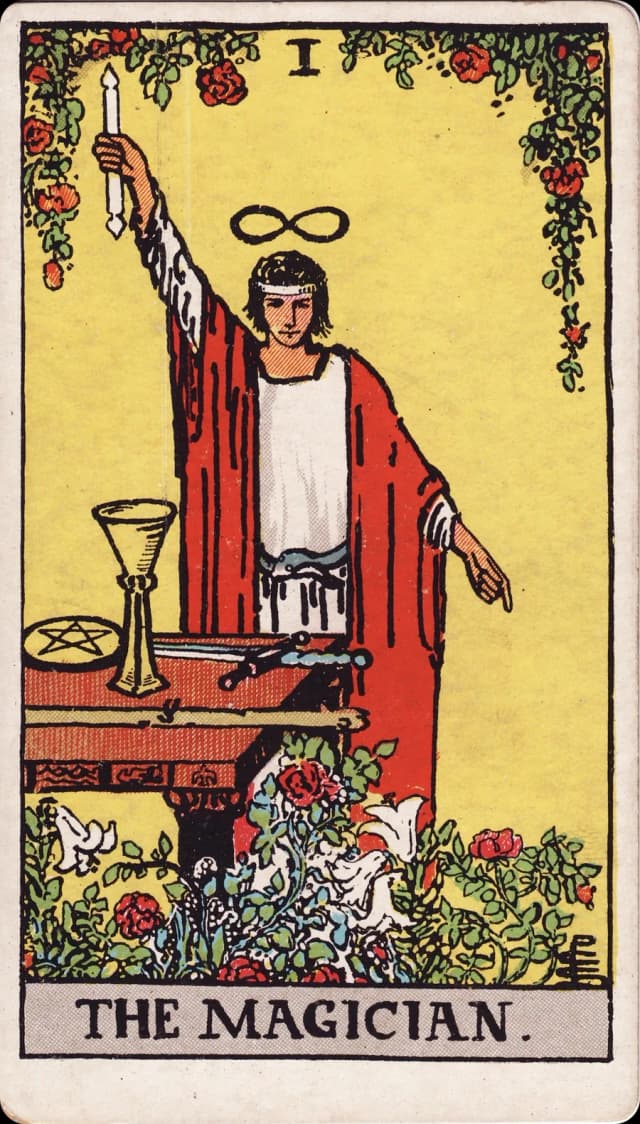
A youthful figure in the robe of a magician, having the countenance of divine Apollo, with smile of confidence and shining eyes. Above his head is the mysterious sign of the Holy Spirit, the sign of life, like an endless cord, forming the figure 8 in a horizontal position ∞. About his waist is a serpent-cincture, the serpent appearing to devour its own tail. This is familiar to most as a conventional symbol of eternity, but here it indicates more especially the eternity of attainment in the spirit. In the Magician's right hand is a wand raised towards heaven, while the left hand is pointing to the earth. This dual sign is known in very high grades of the Instituted Mysteries; it shews the descent of grace, virtue and light, drawn from things above and derived to things below. The suggestion throughout is therefore the possession and communication of the Powers and Gifts of the Spirit. On the table in front of the Magician are the symbols of the four Tarot suits, signifying the elements of natural life, which lie like counters before the adept, and he adapts them as he wills. Beneath are roses and lilies, the flos campi and lilium convallium, changed into garden flowers, to shew the culture of aspiration. This card signifies the divine motive in man, reflecting God, the will in the liberation of its union with that which is above. It is also the unity of individual being on all planes, and in a very high sense it is thought, in the fixation thereof. With further reference to what I have called the sign of life and its connexion with the number 8, it may be remembered that Christian Gnosticism speaks of rebirth in Christ as a change "unto the Ogdoad." The mystic number is termed Jerusalem above, the Land flowing with Milk and Honey, the Holy Spirit and the Land of the Lord. According to Martinism, 8 is the number of Christ.
마법사의 로브를 걸친 젊은 인물로, 신적인 아폴론의 용모에, 확신에 찬 미소와 빛나는 눈을 하고 있다. 그의 머리 위에는 성령의 신비로운 표징이 있으니, 끝없는 끈과도 같은 생명의 표징으로, 숫자 8을 가로로 누인 모양 ∞ 을 이룬다. 허리에는 뱀 띠가 둘러져 있으며, 뱀은 제 꼬리를 삼키는 모습이다. 이것은 영원의 통상적 상징으로 대부분에게 익숙하지만, 여기서는 보다 특별히 영에서의 도달이 지닌 영원성을 가리킨다. 마법사의 오른손에는 하늘을 향해 치켜든 지팡이가, 왼손은 땅을 가리키고 있다. 이 이중 표징은 제정된 신비의 아주 높은 위계들에서 알려져 있다. 그것은 위의 것들로부터 끌어와 아래의 것들에 전하는 은총과 덕과 빛의 하강을 보여준다. 따라서 전체적으로 영의 권능과 은사의 소유와 전달을 시사한다. 마법사 앞 탁자 위에는 네 타로 수트의 상징이 놓여 있어 자연적 삶의 원소들을 뜻하며, 그것들은 입문자 앞에 놓인 계산돌처럼 그가 뜻대로 다룬다. 아래에는 장미와 백합이 있는데, 들의 꽃(flos campi) 과 골짜기의 백합(lilium convallium) 이 정원의 꽃으로 바뀐 것이니, 열망의 도야를 보여주기 위해서다. 이 카드는 사람 안의 신적 동인을 뜻하되, 하느님을 반영하는 것이요, 위에 있는 것과의 합일에서 해방된 의지다. 또한 모든 층위에서의 개별적 존재의 통일이며, 매우 높은 뜻에서는 사유요, 그것의 고정이다. 내가 생명의 표징이라 부른 것과 숫자 8의 연관에 대해 더 언급하자면, 그리스도교 영지주의가 그리스도 안에서의 재탄생을 "옥도아드(여덟 번째)로의 변화"라 말함을 기억할 만하다. 이 신비의 수는 위의 예루살렘, 젖과 꿀이 흐르는 땅, 성령, 그리고 주님의 땅이라 불린다. 마르티니즘에 따르면 8은 그리스도의 수다.
II / The High Priestess
II / 여사제
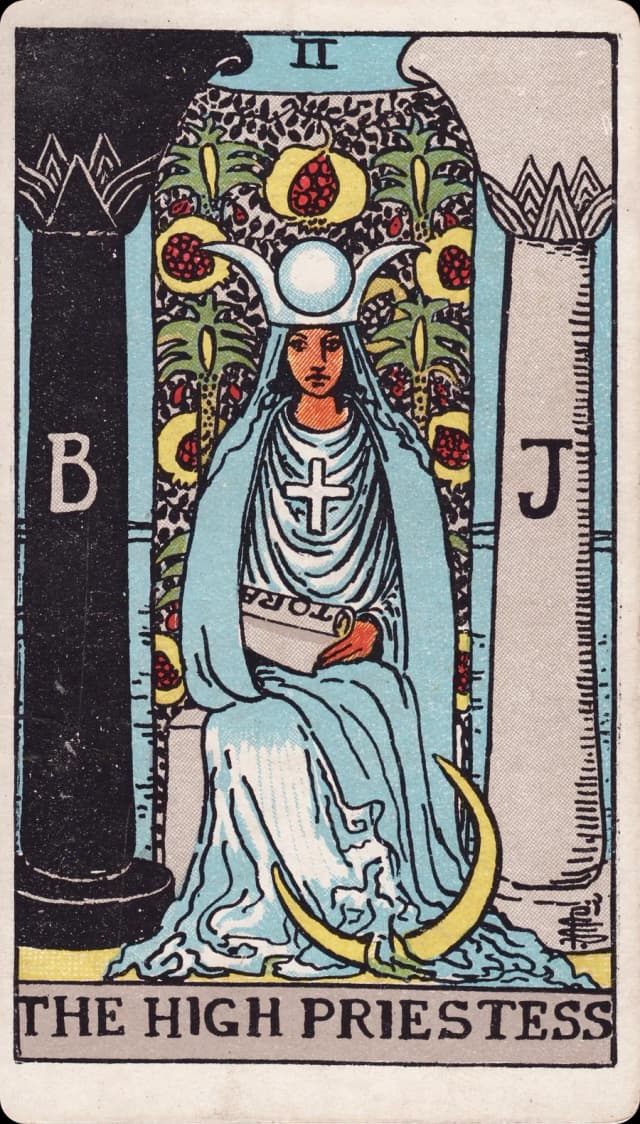
She has the lunar crescent at her feet, a horned diadem on her head, with a globe in the middle place, and a large solar cross on her breast. The scroll in her hands is inscribed with the word Tora, signifying the Greater Law, the Secret Law and the second sense of the Word. It is partly covered by her mantle, to shew that some things are implied and some spoken. She is seated between the white and black pillars—J. and B.—of the mystic Temple and the veil of the Temple is behind her: it is embroidered with palms and pomegranates. The vestments are flowing and gauzy, and the mantle suggests light—a shimmering radiance. She has been called Occult Science on the threshold of the Sanctuary of Isis, but she is really the Secret Church, the House which is of God and man. She represents also the Second Marriage of the Prince who is no longer of this world; she is the spiritual Bride and Mother, the daughter of the stars and the Higher Garden of Eden. She is, in fine, the Queen of the borrowed light, but this is the light of all. She is the Moon nourished by the milk of the Supernal Mother.
그녀의 발밑에는 달의 초승이, 머리에는 뿔 달린 왕관이, 그 가운데에는 구(球)가, 가슴에는 큰 태양 십자가 있다. 그녀가 든 두루마리에는 토라(Tora) 라는 글자가 적혀 있으니, 더 큰 율법, 비밀의 율법, 그리고 말씀의 두 번째 뜻을 의미한다. 그것은 그녀의 망토에 부분적으로 가려져 있어, 어떤 것은 함축되고 어떤 것은 말해짐을 보여준다. 그녀는 신비의 성전의 흰 기둥과 검은 기둥 — J.와 B. — 사이에 앉아 있으며, 성전의 휘장이 그 뒤에 드리워져 있다. 휘장에는 종려와 석류가 수놓여 있다. 의복은 흐르는 듯 비치며, 망토는 빛 — 어른거리는 광휘 — 을 시사한다. 그녀는 이시스 성소의 문턱에 선 비의학(祕儀學)이라 불려 왔으나, 실제로는 비밀 교회, 곧 하느님과 사람의 것인 집이다. 그녀는 또한 더 이상 이 세상의 것이 아닌 왕자의 두 번째 혼례를 나타내기도 한다. 그녀는 영적 신부이자 어머니이며, 별들의 딸이자 더 높은 에덴동산이다. 요컨대 그녀는 빌려온 빛의 여왕이되, 이 빛은 만인의 빛이다. 그녀는 지고의 어머니의 젖으로 길러진 달이다.
In a manner, she is also the Supernal Mother herself—that is to say, she is the bright reflection. It is in this sense of reflection that her truest and highest name in bolism is Shekinah—the co-habiting glory. According to Kabalism, there is a Shekinah both above and below. In the superior world it is called Binah, the Supernal Understanding which reflects to the emanations that are beneath. In the lower world it is Malkuth—that world being, for this purpose, understood as a blessed Kingdom—that with which it is made blessed being the Indwelling Glory. Mystically speaking, the Shekinah is the Spiritual Bride of the just man, and when he reads the Law she gives the Divine meaning. There are some respects in which this card is the highest and holiest of the Greater Arcana.
어떤 의미에서 그녀는 지고의 어머니 그 자체이기도 하다 — 다시 말해 그 밝은 반영이다. 상징에서 그녀의 가장 참되고 가장 높은 이름이 셰키나(Shekinah), 곧 함께 머무는 영광인 것은 바로 이 반영이라는 뜻에서다. 카발라에 따르면 셰키나 는 위에도 있고 아래에도 있다. 높은 세계에서 그것은 비나(Binah), 곧 그 아래 놓인 유출들에게 되비추는 지고의 이해라 불린다. 낮은 세계에서 그것은 말쿠트(Malkuth) 다 — 여기서 그 세계는 복된 왕국으로 이해되며, 그 왕국을 복되게 하는 것이 바로 내주하는 영광이다. 신비적으로 말하면 셰키나 는 의인의 영적 신부이고, 그가 율법을 읽을 때 그녀가 신적인 뜻을 준다. 이 카드는 몇 가지 점에서 대아르카나 가운데 가장 높고 가장 거룩한 카드다.
III / The Empress
III / 여황제
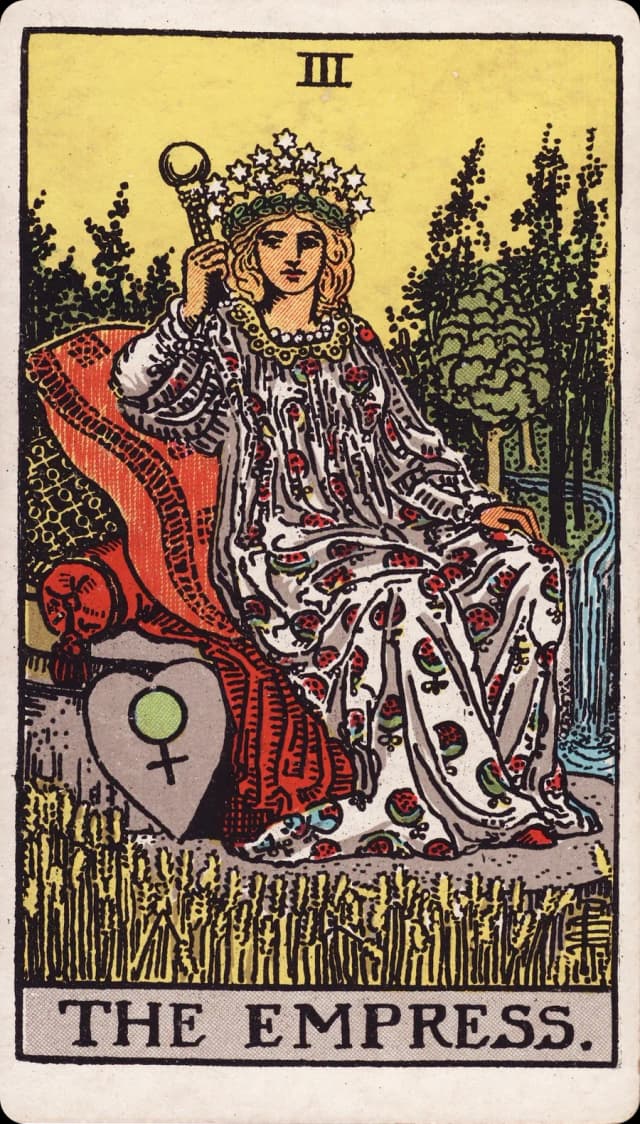
A stately figure, seated, having rich vestments and royal aspect, as of a daughter of heaven and earth. Her diadem is of twelve stars, gathered in a cluster. The symbol of Venus is on the shield which rests near her. A field of corn is ripening in front of her, and beyond there is a fall of water. The sceptre which she bears is surmounted by the globe of this world. She is the inferior Garden of Eden, the Earthly Paradise, all that is symbolized by the visible house of man. She is not Regina coeli, but she is still refugium peccatorum, the fruitful mother of thousands. There are also certain aspects in which she has been correctly described as desire and the wings thereof, as the woman clothed with the sun, as Gloria Mundi and the veil of the Sanctum Sanctorum; but she is not, I may add, the soul that has attained wings, unless all the symbolism is counted up another and unusual way. She is above all things universal fecundity and the outer sense of the Word. This is obvious, because there is no direct message which has been given to man like that which is borne by woman; but she does not herself carry its interpretation.
위엄 있는 인물이 앉아 있으며, 화려한 의복과 왕다운 면모를 갖추었으니, 마치 하늘과 땅의 딸 같다. 그녀의 왕관은 열두 별을 모아 놓은 것이다. 비너스의 상징이 곁에 놓인 방패에 있다. 앞쪽에는 곡식 밭이 익어 가고, 그 너머에는 폭포가 있다. 그녀가 든 홀(笏)은 이 세상의 구(球)로 마감되어 있다. 그녀는 이 아래쪽의 에덴동산, 지상 낙원이며, 사람의 눈에 보이는 집이 상징하는 모든 것이다. 그녀는 하늘의 여왕(Regina coeli) 은 아니되, 여전히 죄인의 피난처(refugium peccatorum) 요, 수천의 다산한 어머니다. 그녀가 욕망과 그 날개, 해를 입은 여인, 세상의 영광(Gloria Mundi), 그리고 지성소의 휘장(Sanctum Sanctorum) 이라 옳게 묘사된 측면들도 있다. 다만 모든 상징을 다른 비범한 방식으로 헤아리지 않는 한, 그녀는 날개를 얻은 영혼은 아니라고 덧붙여야겠다. 그녀는 무엇보다 보편적 다산이며 말씀의 바깥쪽 뜻이다. 이는 분명하다, 왜냐하면 여자가 전하는 것만큼 사람에게 직접적으로 주어진 전언은 없기 때문이다. 그러나 그녀 자신이 그 해석을 지니고 있지는 않다.
In another order of ideas, the card of the Empress signifies the door or gate by which an entrance is obtained into this life, as into the Garden of Venus; and then the way which leads out therefrom, into that which is beyond, is the secret known to the High Priestess: it is communicated by her to the elect. Most old attributions of this card are completely wrong on the symbolism—as, for example, its identification with the Word, Divine Nature, the Triad, and so forth.
다른 갈래의 관념에서 보면, 여황제 카드는 이 삶으로 들어서는 문 또는 관문을 뜻한다 — 비너스의 정원으로 들어가듯이 말이다. 그리고 거기서 빠져나와 그 너머로 이끄는 길은 여사제가 아는 비밀이며, 그녀가 택함받은 이들에게 전한다. 이 카드에 붙은 옛 배정은 상징에 관한 한 대부분 완전히 틀렸다 — 예컨대 말씀, 신적 본성, 삼일성 따위와 동일시한 것이 그렇다.
IV / The Emperor
IV / 황제
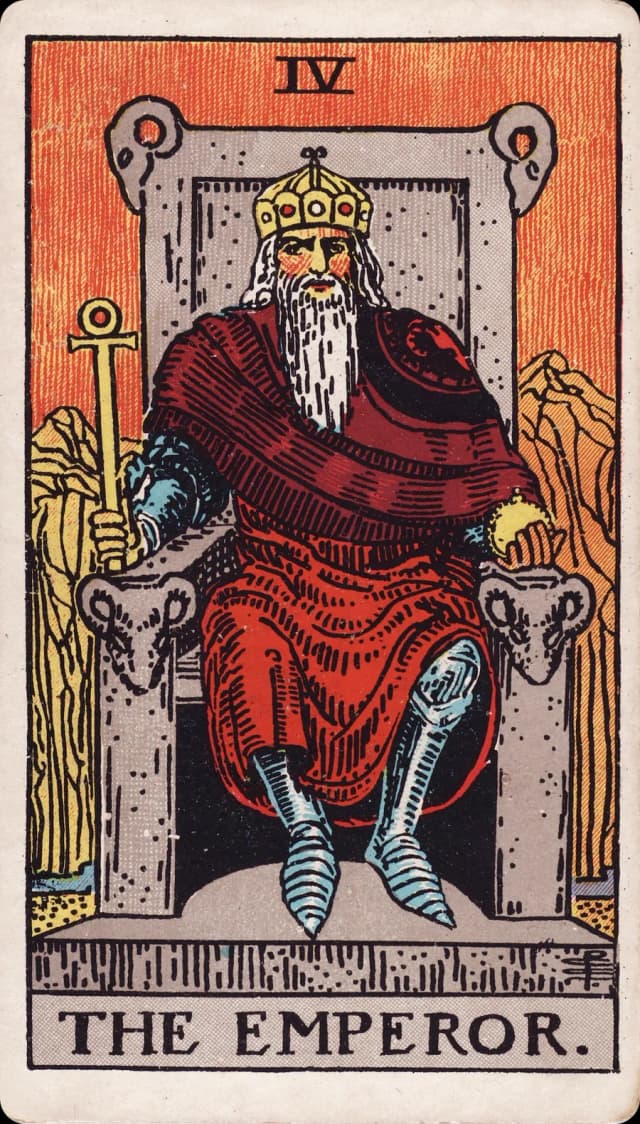
He has a form of the Crux ansata for his sceptre and a globe in his left hand. He is a crowned monarch—commanding, stately, seated on a throne, the arms of which are fronted by rams' heads. He is executive and realization, the power of this world, here clothed with the highest of its natural attributes. He is occasionally represented as seated on a cubic stone, which, however, confuses some of the issues. He is the virile power, to which the Empress responds, and in this sense is he who seeks to remove the Veil of Isis; yet she remains virgo intacta.
그는 홀로 앙크 십자(Crux ansata) 의 한 형태를 들고, 왼손에는 구(球)를 쥐고 있다. 그는 왕관을 쓴 군주로 — 명령하는 자세로, 위엄 있게, 팔걸이 앞쪽에 숫양 머리가 달린 왕좌에 앉아 있다. 그는 집행이자 실현이며, 이 세상의 권능이 여기서 그 자연적 속성 가운데 가장 높은 것으로 옷 입은 모습이다. 그는 이따금 정육면체 돌 위에 앉은 것으로 그려지기도 하는데, 그러면 몇 가지 논점이 흐려진다. 그는 여황제가 응답하는 남성적 권능이며, 그런 뜻에서 이시스의 베일을 벗기려 하는 자다. 그럼에도 그녀는 손대지 않은 처녀(virgo intacta) 로 남는다.
It should be understood that this card and that of the Empress do not precisely represent the condition of married life, though this state is implied. On the surface, as I have indicated, they stand for mundane royalty, uplifted on the seats of the mighty; but above this there is the suggestion of another presence. They signify also—and the male figure especially—the higher kingship, occupying the intellectual throne. Hereof is the lordship of thought rather than of the animal world. Both personalities, after their own manner, are "full of strange experience," but theirs is not consciously the wisdom which draws from a higher world. The Emperor has been described as (a) will in its embodied form, but this is only one of its applications, and (b) as an expression of virtualities contained in the Absolute Being—but this is fantasy.
이 카드와 여황제 카드는 혼인 생활의 상태를 정확히 나타내는 것이 아님을 알아야 한다. 비록 그 상태가 함축되어 있기는 하지만 말이다. 표면적으로는 내가 가리킨 대로 세속의 왕족이 권좌에 오른 모습이지만, 그 위에 또 다른 임재의 시사가 있다. 그들은 또한 — 남성 인물이 특히 — 더 높은 왕권을 뜻하니, 지성의 왕좌를 차지하는 왕권이다. 여기에는 동물적 세계가 아니라 사유의 군림이 있다. 두 인물 모두 제 나름대로 "기이한 경험으로 가득"하지만, 그들이 지닌 것은 더 높은 세계에서 끌어오는 지혜를 의식적으로 아는 것은 아니다. 황제는 (a) 구현된 형태의 의지로 서술된 바 있으나, 이는 그 응용 가운데 하나일 뿐이다. 또한 (b) 절대적 존재에 담긴 잠재력의 표현이라는 설명도 있으나, 이는 환상이다.
V / The Hierophant
V / 교황
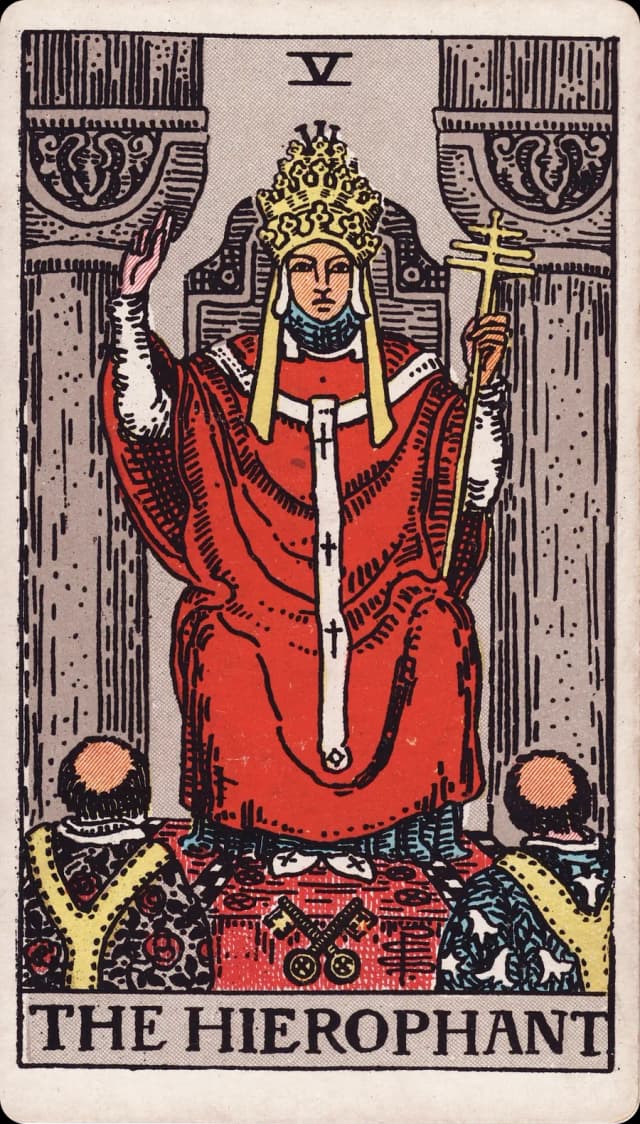
He wears the triple crown and is seated between two pillars, but they are not those of the Temple which is guarded by the High Priestess. In his left hand he holds a sceptre terminating in the triple cross, and with his right hand he gives the well-known ecclesiastical sign which is called that of esotericism, distinguishing between the manifest and concealed part of doctrine. It is noticeable in this connexion that the High Priestess makes no sign. At his feet are the crossed keys, and two priestly ministers in albs kneel before him. He has been usually called the Pope, which is a particular application of the more general office that he symbolizes. He is the ruling power of external religion, as the High Priestess is the prevailing genius of the esoteric, withdrawn power. The proper meanings of this card have suffered woeful admixture from nearly all hands. Grand Orient says truly that the Hierophant is the power of the keys, exoteric orthodox doctrine, and the outer side of the life which leads to the doctrine; but he is certainly not the prince of occult doctrine, as another commentator has suggested.
그는 삼중관을 쓰고 두 기둥 사이에 앉아 있되, 그것은 여사제가 지키는 성전의 기둥이 아니다. 왼손에는 삼중 십자로 마감된 홀을 들고, 오른손으로는 비의주의(祕儀主義)의 표징이라 불리는 잘 알려진 교회의 수인(手印)을 짓고 있으니, 교의의 드러난 부분과 감추어진 부분을 가르는 것이다. 여기서 주목할 것은 여사제는 아무 수인도 짓지 않는다는 점이다. 그의 발밑에는 교차된 열쇠가 있고, 두 명의 사제직 보좌가 백의를 입고 그 앞에 무릎을 꿇고 있다. 그는 으레 교황이라 불려 왔는데, 이는 그가 상징하는 더 일반적 직무의 한 특수한 적용이다. 그는 외적 종교의 지배 권능이며, 여사제가 비의적이고 물러선 권능의 주재하는 수호신인 것과 대응한다. 이 카드의 본래 의미는 거의 모든 손을 거치며 참담한 혼합을 겪었다. 그랑 오리앙은 교황이 열쇠의 권능이자, 외현적이고 정통적인 교의이자, 교의에 이르는 삶의 바깥면이라고 옳게 말한다. 그러나 다른 논평가가 제안한 것처럼 비의 교의의 왕자는 분명 아니다.
He is rather the summa totius theologiæ, when it has passed into the utmost rigidity of expression; but he symbolizes also all things that are righteous and sacred on the manifest side. As such, he is the channel of grace belonging to the world of institution as distinct from that of Nature, and he is the leader of salvation for the human race at large. He is the order and the head of the recognized hierarchy, which is the reflection of another and greater hierarchic order; but it may so happen that the pontiff forgets the significance of this his symbolic state and acts as if he contained within his proper measures all that his sign signifies or his symbol seeks to shew forth. He is not, as it has been thought, philosophy—except on the theological side; he is not inspiration; and he is not religion, although he is a mode of its expression.
그는 차라리 신학 전체의 총합(summa totius theologiæ) 이다 — 그것이 표현의 극단적 경직에 이르렀을 때의 모습으로서 말이다. 그러나 그는 드러난 쪽에서 의롭고 거룩한 모든 것을 상징하기도 한다. 그런 자로서 그는 자연의 세계와 구별되는 제도의 세계에 속한 은총의 통로이며, 인류 전체를 향한 구원의 인도자다. 그는 인정된 위계의 질서이자 그 우두머리이고, 그 위계는 또 다른 더 큰 위계 질서의 반영이다. 다만 교황이 자신의 이 상징적 지위가 지닌 뜻을 잊고, 자기 표징이 가리키는 것 또는 자기 상징이 드러내려는 것 전부를 제 그릇 안에 담고 있는 양 행동하는 일이 생길 수는 있다. 그는 사람들이 생각해 온 것과 달리 철학이 아니다 — 신학적인 면을 빼면 그렇다. 그는 영감도 아니다. 그리고 그는 종교의 한 표현 방식이기는 하지만 종교 자체도 아니다.
VI / The Lovers
VI / 연인
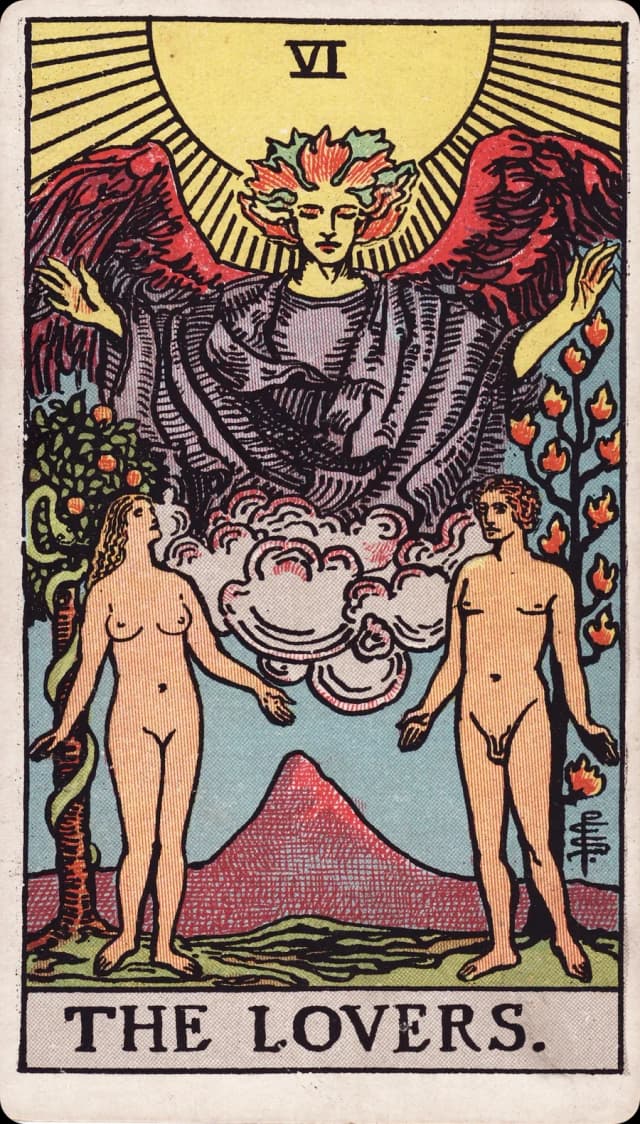
The sun shines in the zenith, and beneath is a great winged figure with arms extended, pouring down influences. In the foreground are two human figures, male and female, unveiled before each other, as if Adam and Eve when they first occupied the paradise of the earthly body. Behind the man is the Tree of Life, bearing twelve fruits, and the Tree of the Knowledge of Good and Evil is behind the woman; the serpent is twining round it. The figures suggest youth, virginity, innocence and love before it is contaminated by gross material desire. This is in all simplicity the card of human love, here exhibited as part of the way, the truth and the life. It replaces, by recourse to first principles, the old card of marriage, which I have described previously, and the later follies which depicted man between vice and virtue. In a very high sense, the card is a mystery of the Covenant and Sabbath.
해가 천정에서 빛나고, 그 아래에는 두 팔을 벌린 커다란 날개 달린 존재가 영향력을 쏟아붓고 있다. 앞쪽에는 남자와 여자 두 사람이 서로 앞에서 아무것도 가리지 않은 채 서 있다 — 아담과 하와가 흙으로 된 몸의 낙원에 처음 자리 잡았을 때처럼. 남자 뒤에는 열두 열매가 달린 생명나무가 있고, 여자 뒤에는 선악을 알게 하는 나무가 있으며 뱀이 그것을 감고 있다. 이 인물들은 젊음과 순결, 무구함, 그리고 거친 물질적 욕망에 물들기 전의 사랑을 떠올리게 한다. 이것은 아주 단순하게 인간의 사랑을 담은 카드이며, 여기서는 길이자 진리이자 생명의 한 부분으로 제시된다. 이 카드는 제1원리로 되돌아감으로써, 앞서 내가 서술한 옛 결혼 카드와, 사람을 악덕과 미덕 사이에 세워 두던 후대의 어리석음을 대신한다. 아주 높은 뜻에서 이 카드는 계약과 안식일의 신비다.
The suggestion in respect of the woman is that she signifies that attraction towards the sensitive life which carries within it the idea of the Fall of Man, but she is rather the working of a Secret Law of Providence than a willing and conscious temptress. It is through her imputed lapse that man shall arise ultimately, and only by her can he complete himself. The card is therefore in its way another intimation concerning the great mystery of womanhood. The old meanings fall to pieces of necessity with the old pictures, but even as interpretations of the latter, some of them were of the order of commonplace and others were false in symbolism.
여자에 관해 시사되는 것은, 그녀가 인간의 타락이라는 관념을 품고 있는 감각적 삶에의 끌림을 뜻한다는 것이다. 그러나 그녀는 의지적이고 의식적인 유혹자라기보다는 차라리 섭리의 비밀 법칙이 작동하는 것이다. 그녀에게 귀속된 타락을 통해서 사람은 궁극에 일어설 것이며, 오직 그녀에 의해서만 그는 자기를 완성할 수 있다. 따라서 이 카드는 그 나름으로 여성이라는 큰 신비에 관한 또 하나의 암시다. 옛 의미들은 옛 그림들과 함께 필연적으로 부서지지만, 후자의 해석으로서조차 그 가운데 일부는 상투적인 수준이었고 다른 일부는 상징에서 틀렸다.
VII / The Chariot
VII / 전차
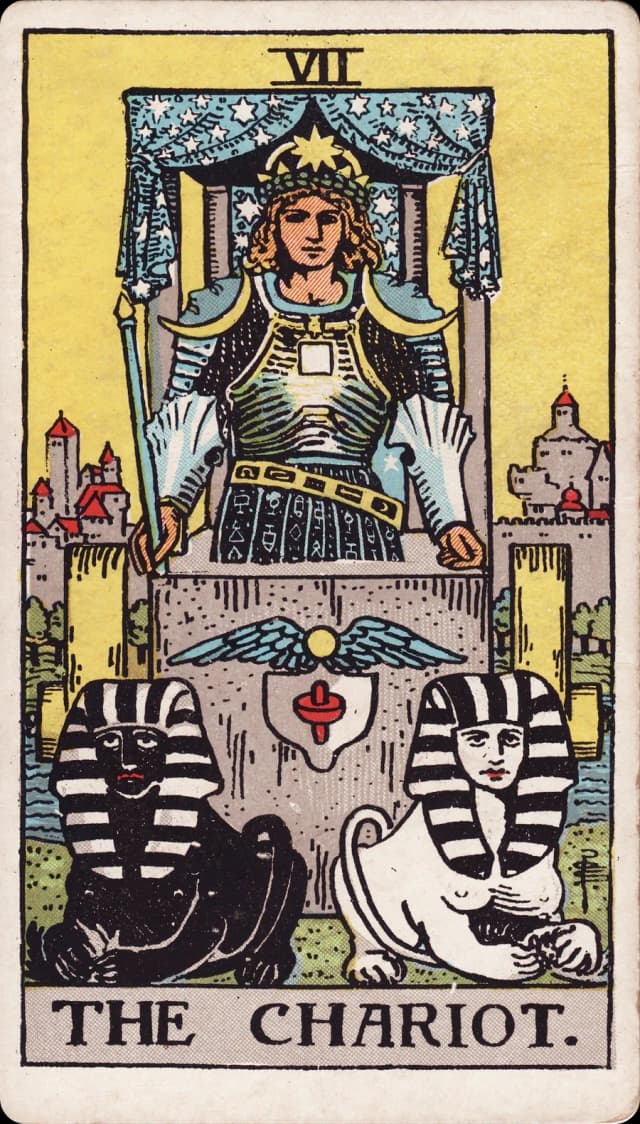
An erect and princely figure carrying a drawn sword and corresponding, broadly speaking, to the traditional description which I have given in the first part. On the shoulders of the victorious hero are supposed to be the Urim and Thummim. He has led captivity captive; he is conquest on all planes—in the mind, in science, in progress, in certain trials of initiation. He has thus replied to the sphinx, and it is on this account that I have accepted the variation of Éliphas Lévi; two sphinxes thus draw his chariot. He is above all things triumph in the mind.
뽑아 든 검을 쥔 꼿꼿하고 당당한 인물로, 대체로 1부에서 내가 제시한 전통적 서술과 들어맞는다. 승리한 영웅의 두 어깨에는 우림 과 둠밈 이 있다고 본다. 그는 사로잡힌 것을 사로잡아 끌고 왔다. 그는 모든 층위에서의 정복이다 — 정신에서, 학문에서, 진보에서, 입문의 어떤 시련들에서. 그리하여 그는 스핑크스에게 답한 셈이고, 그 때문에 나는 엘리파스 레비의 변형을 받아들였다. 그렇게 두 마리 스핑크스가 그의 전차를 끈다. 그는 무엇보다 정신에서의 승리다.
It is to be understood for this reason (a) that the question of the sphinx is concerned with a Mystery of Nature and not of the world of Grace, to which the charioteer could offer no answer; (b) that the planes of his conquest are manifest or external and not within himself; (c) that the liberation which he effects may leave himself in the bondage of the logical understanding; (d) that the tests of initiation through which he has passed in triumph are to be understood physically or rationally; and (e) that if he came to the pillars of that Temple between which the High Priestess is seated, he could not open the scroll called Tora, nor if she questioned him could he answer. He is not hereditary royalty and he is not priesthood.
이런 이유에서 다음을 이해해야 한다. (a) 스핑크스의 질문은 자연의 신비에 관한 것이지 은총의 세계에 관한 것이 아니며, 전차를 모는 이는 그 세계에 답을 내놓을 수 없다. (b) 그의 정복의 층위들은 드러나거나 외적인 것이지 그 안에 있는 것이 아니다. (c) 그가 이루어 낸 해방이 그 자신을 논리적 지성의 속박 안에 남겨 둘 수 있다. (d) 그가 승리로 통과한 입문의 시련들은 물리적으로 또는 이성적으로 이해되어야 한다. (e) 그가 여사제가 앉아 있는 성전의 두 기둥 앞에 이르렀다 해도, 토라 라 불리는 두루마리를 펼칠 수 없을 것이며, 그녀가 질문해도 그는 답할 수 없을 것이다. 그는 세습 왕족도 아니고 사제직도 아니다.
VIII / Strength, or Fortitude
VIII / 힘, 또는 불굴
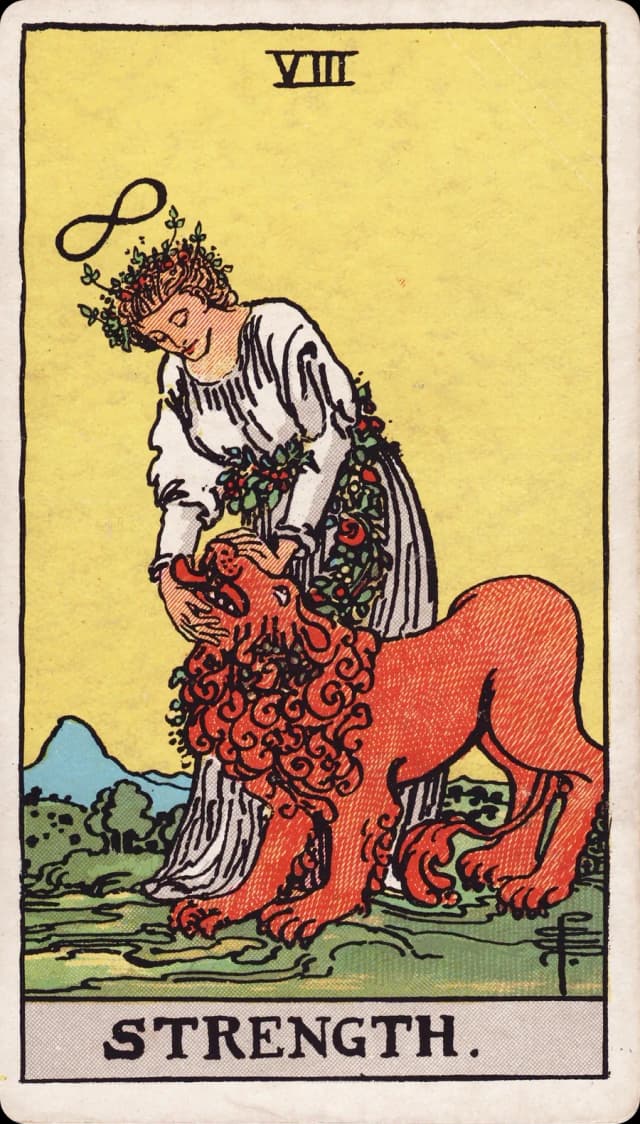
A woman, over whose head there broods the same symbol of life which we have seen in the card of the Magician, is closing the jaws of a lion. The only point in which this design differs from the conventional presentations is that her beneficent fortitude has already subdued the lion, which is being led by a chain of flowers. For reasons which satisfy myself, this card has been interchanged with that of Justice, which is usually numbered eight. As the variation carries nothing with it which will signify to the reader, there is no cause for explanation. Fortitude, in one of its most exalted aspects, is connected with the Divine Mystery of Union; the virtue, of course, operates in all planes, and hence draws on all in its symbolism. It connects also with innocentia inviolata, and with the strength which resides in contemplation.
한 여인이 있고, 그 머리 위에는 마법사 카드에서 본 것과 같은 생명의 표징이 드리워져 있으며, 그녀는 사자의 턱을 다물리고 있다. 이 도안이 통상적인 그림들과 다른 점은 단 하나, 그녀의 자애로운 불굴이 이미 사자를 굴복시켜 꽃사슬로 이끌고 있다는 것이다. 나 자신이 납득하는 이유들 때문에 이 카드는 보통 여덟 번으로 매겨지는 정의 카드와 자리를 맞바꾸었다. 그 변경이 독자에게 어떤 뜻을 전하는 것은 아니므로 따로 설명할 까닭은 없다. 불굴은 가장 고양된 측면 가운데 하나에서 합일이라는 신적 신비와 이어진다. 물론 이 덕은 모든 층위에서 작동하며, 그래서 상징에서도 모든 층위를 끌어온다. 그것은 또한 침해되지 않은 무구함(innocentia inviolata) 과, 그리고 관상(觀想) 안에 깃든 힘과도 이어진다.
These higher meanings are, however, matters of inference, and I do not suggest that they are transparent on the surface of the card. They are intimated in a concealed manner by the chain of flowers, which signifies, among many other things, the sweet yoke and the light burden of Divine Law, when it has been taken into the heart of hearts. The card has nothing to do with self-confidence in the ordinary sense, though this has been suggested—but it concerns the confidence of those whose strength is God, who have found their refuge in Him. There is one aspect in which the lion signifies the passions, and she who is called Strength is the higher nature in its liberation. It has walked upon the asp and the basilisk and has trodden down the lion and the dragon.
그러나 이 더 높은 뜻들은 추론의 문제이며, 카드 표면에 그것들이 투명하게 드러난다고 주장하는 것은 아니다. 그것들은 다른 많은 것들 사이에서 특히 신적 율법의 부드러운 멍에와 가벼운 짐을 뜻하는 꽃사슬에 의해, 숨겨진 방식으로 암시된다 — 그 율법이 마음속 깊이 받아들여졌을 때 말이다. 이 카드는 보통 뜻에서의 자기 확신과는 관계가 없다. 그런 제안이 있기는 했지만 말이다. 이것은 하느님이 그 힘인 이들, 그분 안에 피난처를 찾은 이들의 확신에 관계한다. 사자가 열정을 뜻하고 불굴이라 불리는 그녀가 해방된 더 높은 본성인 측면이 하나 있다. 그것은 독사와 뱀 위를 걸었고, 사자와 용을 밟았다.
IX / The Hermit
IX / 은둔자
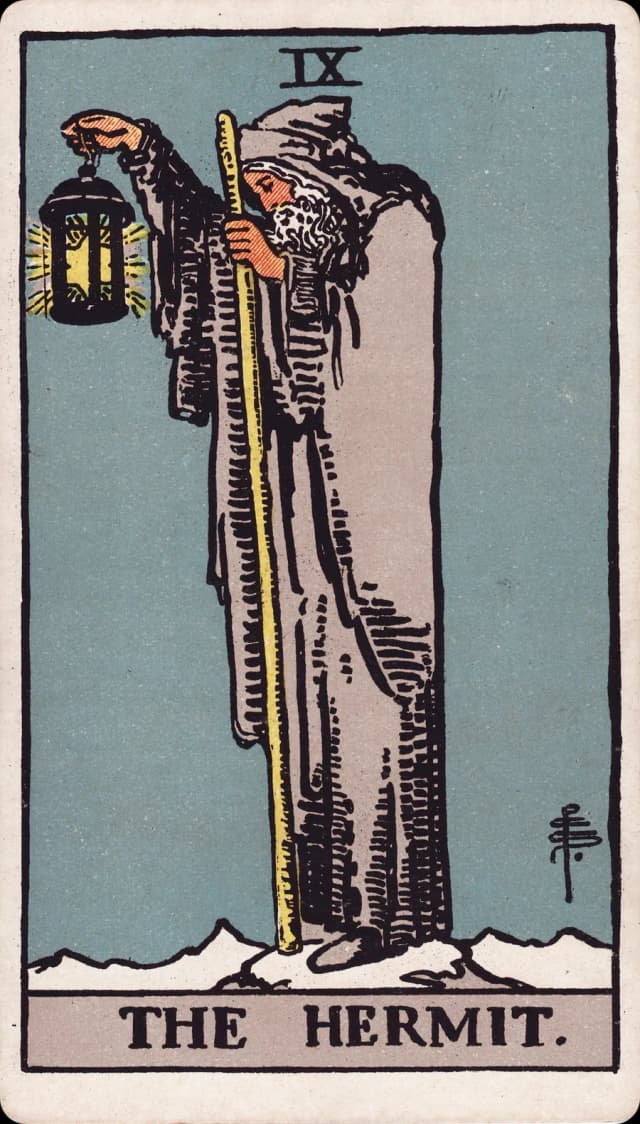
The variation from the conventional models in this card is only that the lamp is not enveloped partially in the mantle of its bearer, who blends the idea of the Ancient of Days with the Light of the World. It is a star which shines in the lantern. I have said that this is a card of attainment, and to extend this conception the figure is seen holding up his beacon on an eminence. Therefore the Hermit is not, as Court de Gebelin explained, a wise man in search of truth and justice; nor is he, as a later explanation proposes, an especial example of experience. His beacon intimates that "where I am, you also may be."
이 카드가 통상적인 모형과 달라진 점은, 등불이 그것을 든 이의 망토에 부분적으로 가려져 있지 않다는 것뿐이다. 그는 옛적부터 계신 이라는 관념과 세상의 빛이라는 관념을 겹쳐 놓은 인물이다. 초롱 안에서 빛나는 것은 별이다. 나는 이것이 도달의 카드라고 말했는데, 그 생각을 넓히기 위해 인물은 높은 곳에서 자기 봉화를 들어 올린 모습으로 그려진다. 그러므로 은둔자는 쿠르 드 제블랭이 설명한 것처럼 진리와 정의를 찾아 나선 현자가 아니다. 후대의 어떤 설명이 내놓듯 경험의 특별한 본보기도 아니다. 그의 봉화가 알리는 것은 "내가 있는 이곳에 너 또한 있을 수 있다"는 것이다.
It is further a card which is understood quite incorrectly when it is connected with the idea of occult isolation, as the protection of personal magnetism against admixture. This is one of the frivolous renderings which we owe to Éliphas Lévi. It has been adopted by the French Order of Martinism and some of us have heard a great deal of the Silent and Unknown Philosophy enveloped by his mantle from the knowledge of the profane. In true Martinism, the significance of the term Philosophe inconnu was of another order. It did not refer to the intended concealment of the Instituted Mysteries, much less of their substitutes, but—like the card itself—to the truth that the Divine Mysteries secure their own protection from those who are unprepared.
나아가 이 카드는, 오컬트적 은둔이라는 관념과 연결될 때 — 외부의 혼입으로부터 개인의 자기장을 보호하는 것으로서 — 완전히 잘못 이해되는 카드다. 이는 엘리파스 레비에게서 비롯된 경박한 해석 가운데 하나다. 이것은 프랑스 마르티니즘 교단에 의해 채택되었고, 우리 가운데 일부는 그의 망토로 속인들의 지식으로부터 감싸인 침묵하는 알려지지 않은 철학에 대해 많은 이야기를 들어 왔다. 진정한 마르티니즘에서 알려지지 않은 철학자(Philosophe inconnu) 라는 용어의 의미는 다른 차원의 것이었다. 그것은 제정된 신비의 의도적 은폐를 가리키는 것이 아니었고, 하물며 그 대용물의 은폐는 더더욱 아니었다. 오히려 — 이 카드 자체처럼 — 신적 신비가 준비되지 않은 자들로부터 스스로를 지킨다는 진리를 가리켰다.
X / Wheel of Fortune
X / 운명의 수레바퀴
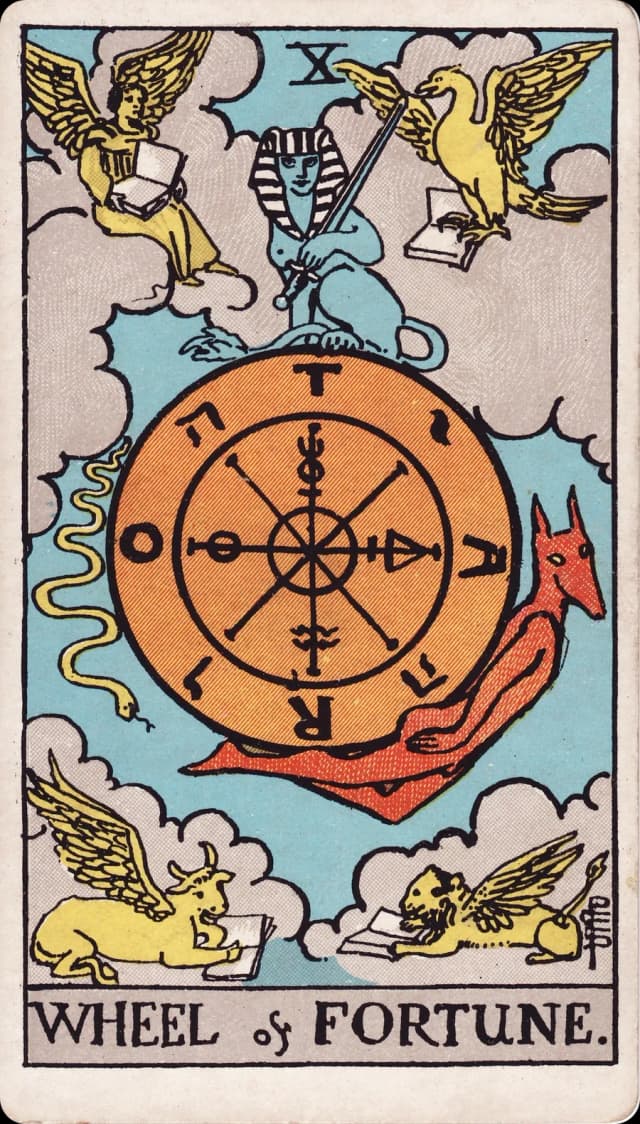
In this symbol I have again followed the reconstruction of Éliphas Lévi, who has furnished several variants. It is legitimate—as I have intimated—to use Egyptian symbolism when this serves our purpose, provided that no theory of origin is implied therein. I have, however, presented Typhon in his serpent form. The symbolism is, of course, not exclusively Egyptian, as the four Living Creatures of Ezekiel occupy the angles of the card, and the wheel itself follows other indications of Lévi in respect of Ezekiel's vision, as illustrative of the particular Tarot Key. With the French occultist, and in the design itself, the symbolic picture stands for the perpetual motion of a fluidic universe and for the flux of human life. The Sphinx is the equilibrium therein. The transliteration of Taro as Rota is inscribed on the wheel, counterchanged with the letters of the Divine Name—to shew that Providence is implied through all. But this is the Divine intention within, and the similar intention without is exemplified by the four Living Creatures. Sometimes the sphinx is represented couchant on a pedestal above, which defrauds the symbolism by stultifying the essential idea of stability amidst movement.
이 상징에서 나는 다시 엘리파스 레비의 복원을 따랐으며, 그는 여러 변형을 내놓은 바 있다. 우리의 목적에 부합할 때 이집트 상징을 사용하는 것은 — 내가 시사한 대로 — 정당하다. 다만 거기에 기원에 관한 이론이 함축되어서는 안 된다. 그러나 나는 티폰을 뱀의 형태로 제시했다. 상징은 물론 배타적으로 이집트적인 것은 아니니, 에제키엘의 네 생물이 카드의 네 모서리를 차지하고, 바퀴 자체는 에제키엘의 환시에 관한 레비의 다른 지시를 따르되 이 특정한 타로 열쇠의 예시로서 그렇다. 프랑스의 오컬티스트에게서도, 그리고 도안 자체에서도, 이 상징적 그림은 유동하는 우주의 영구적 운동과 인간 삶의 흐름을 나타낸다. 스핑크스는 그 안의 균형이다. 타로(Taro) 를 로타(Rota) 로 바꿔 쓴 것이 바퀴에 새겨져 있으며, 신적 이름의 글자들과 교차 배치되어 있다 — 섭리가 만물에 함축되어 있음을 보여주기 위해서다. 그러나 이것은 안에 있는 신적 의도이고, 바깥에 있는 같은 의도는 네 생물로 예시된다. 때로 스핑크스는 위의 받침대 위에 엎드려 있는 것으로 그려지기도 하는데, 이는 운동 속의 안정이라는 본질적 관념을 무력화하여 상징을 갉아먹는다.
Behind the general notion expressed in the symbol there lies the denial of chance and the fatality which is implied therein. It may be added that, from the days of Lévi onward, the occult explanations of this card are—even for occultism itself—of a singularly fatuous kind. It has been said to mean principle, fecundity, virile honour, ruling authority, etc. The findings of common fortune-telling are better than this on their own plane.
이 상징이 표현하는 일반적 관념 뒤에는 우연의 부정과, 거기 함축된 숙명이 놓여 있다. 덧붙이자면 레비 이후로 이 카드에 대한 오컬트식 설명은 — 오컬티즘 자체의 기준으로 보아도 — 유난히 실없는 종류였다. 원리, 다산, 남성적 명예, 지배하는 권위 따위를 뜻한다고들 했다. 흔한 카드점의 결론이 제 층위에서는 이보다 낫다.
XI / Justice
XI / 정의
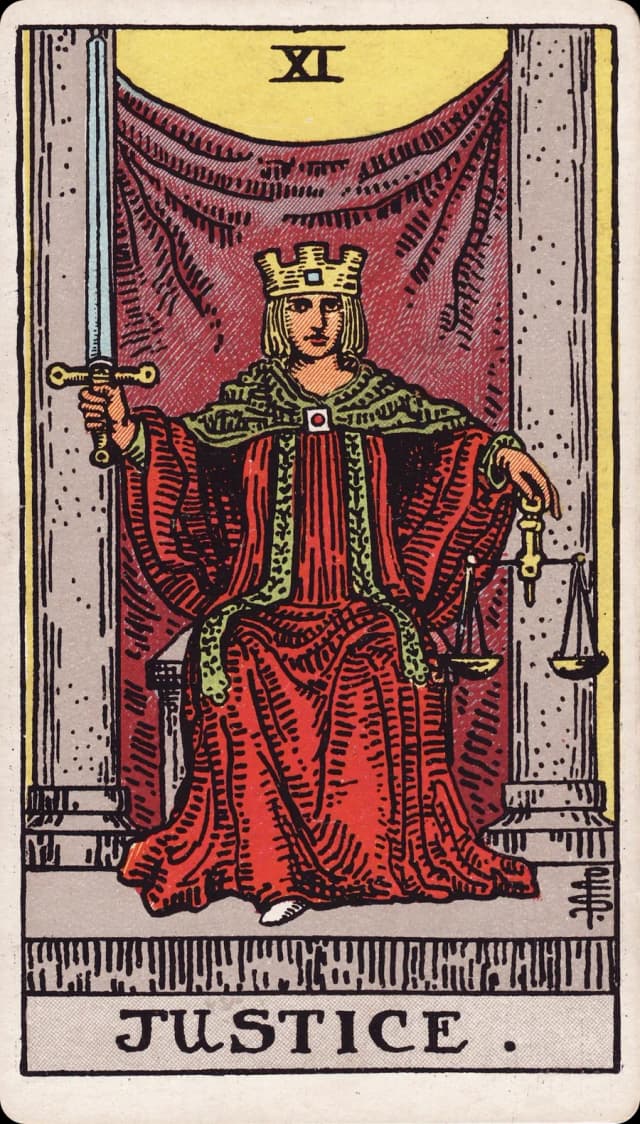
As this card follows the traditional symbolism and carries above all its obvious meanings, there is little to say regarding it outside the few considerations collected in the first part, to which the reader is referred.
이 카드는 전통적 상징을 그대로 따르고 무엇보다 그 명백한 뜻들을 지니고 있으므로, 1부에 모아 둔 몇 가지 고찰 말고는 여기서 덧붙일 말이 별로 없다. 독자는 그쪽을 참고하기 바란다.
It will be seen, however, that the figure is seated between pillars, like the High Priestess, and on this account it seems desirable to indicate that the moral principle which deals unto every man according to his works—while, of course, it is in strict analogy with higher things—differs in its essence from the spiritual justice which is involved in the idea of election. The latter belongs to a mysterious order of Providence, in virtue of which it is possible for certain men to conceive the idea of dedication to the highest things. The operation of this is like the breathing of the Spirit where it wills, and we have no canon of criticism or ground of explanation concerning it. It is analogous to the possession of the fairy gifts and the high gifts and the gracious gifts of the poet we have them or have not, and their presence is as much a mystery as their absence. The law of Justice is not however involved by either alternative. In conclusion, the pillars of Justice open into one world and the pillars of the High Priestess into another.
그러나 이 인물이 여사제처럼 기둥들 사이에 앉아 있음을 보게 될 것이며, 그런 까닭에 각자에게 그 행위에 따라 갚는 도덕 원리가 — 물론 더 높은 것들과 엄밀한 유비에 있지만 — 선택이라는 관념에 수반되는 영적 정의와는 본질에서 다름을 가리켜야 할 것 같다. 후자는 섭리의 신비로운 질서에 속하며, 그 힘으로 어떤 사람들이 가장 높은 것에 헌신한다는 관념을 품을 수 있게 된다. 이것의 작동은 영이 원하는 곳에서 부는 것과 같으며, 우리에게는 그것에 관한 비평의 기준도 설명의 근거도 없다. 그것은 요정의 재능과 높은 재능과 시인의 은혜로운 재능의 소유와 유비적이다. 그것을 지니거나 지니지 않거나이며, 그것의 있음은 없음만큼이나 신비다. 그러나 정의의 법칙은 어느 쪽에 의해서도 침해되지 않는다. 결론적으로, 정의의 기둥들은 한 세계로 열리고 여사제의 기둥들은 다른 세계로 열린다.
XII / The Hanged Man
XII / 매달린 남자
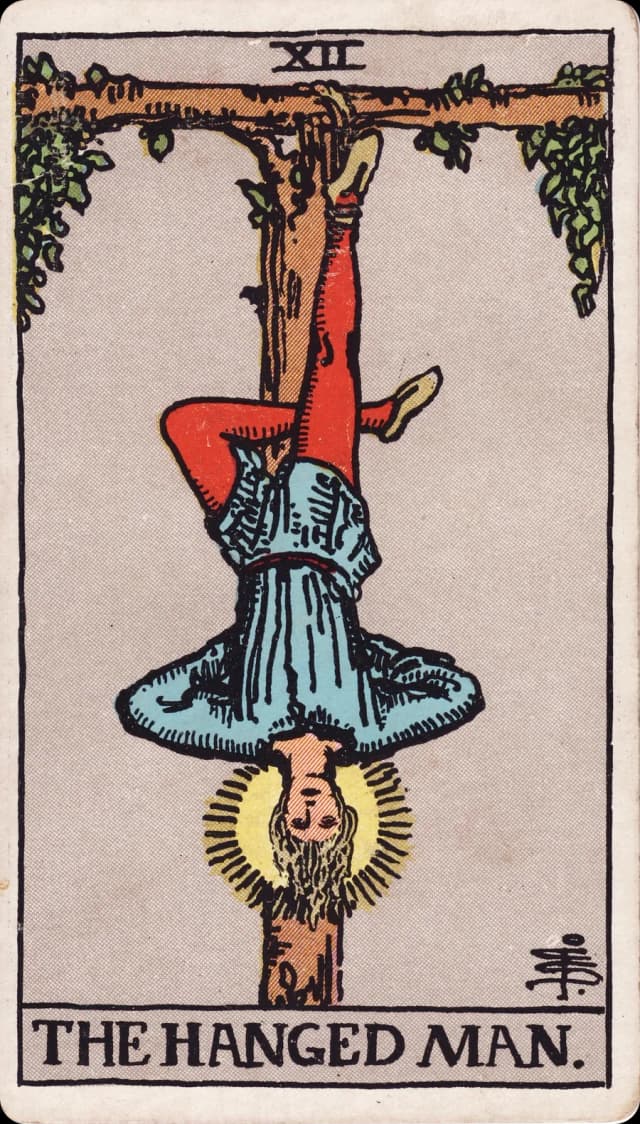
The gallows from which he is suspended forms a Tau cross, while the figure—from the position of the legs—forms a fylfot cross. There is a nimbus about the head of the seeming martyr. It should be noted (1) that the tree of sacrifice is living wood, with leaves thereon; (2) that the face expresses deep entrancement, not suffering; (3) that the figure, as a whole, suggests life in suspension, but life and not death. It is a card of profound significance, but all the significance is veiled. One of his editors suggests that Éliphas Lévi did not know the meaning, which is unquestionable—nor did the editor himself. It has been called falsely a card of martyrdom, a card of prudence, a card of the Great Work, a card of duty; but we may exhaust all published interpretations and find only vanity. I will say very simply on my own part that it expresses the relation, in one of its aspects, between the Divine and the Universe.
그가 매달린 교수대는 타우 십자를 이루고, 그 인물은 — 다리의 자세 때문에 — 갈고리 십자를 이룬다. 순교자로 보이는 이의 머리 둘레에는 후광이 있다. 눈여겨볼 것은 (1) 희생의 나무가 잎이 달린 살아 있는 나무라는 점, (2) 얼굴이 고통이 아니라 깊은 황홀을 나타낸다는 점, (3) 인물 전체가 매달린 상태의 생명을 떠올리게 하되 그것이 죽음이 아니라 생명이라는 점이다. 이것은 깊은 뜻을 지닌 카드지만 그 뜻은 전부 베일에 가려 있다. 엘리파스 레비의 한 편집자는 레비가 그 뜻을 몰랐다고 시사하는데, 그 점은 의심할 여지가 없다 — 그리고 그 편집자 자신도 몰랐다. 이 카드는 순교의 카드라느니, 신중의 카드라느니, 대업의 카드라느니, 의무의 카드라느니 잘못 불려 왔다. 그러나 출간된 해석을 모조리 훑어봐도 헛된 것밖에 찾지 못한다. 나는 내 몫으로 아주 간단히 말하겠다. 그것은 신적인 것과 우주 사이의 관계를, 그 한 측면에서 표현한다.
He who can understand that the story of his higher nature is imbedded in this symbolism will receive intimations concerning a great awakening that is possible, and will know that after the sacred Mystery of Death there is a glorious Mystery of Resurrection.
자기 더 높은 본성의 이야기가 이 상징에 심겨 있음을 이해할 수 있는 자는, 가능한 위대한 각성에 관한 암시를 받을 것이며, 죽음의 거룩한 신비 뒤에 부활의 영광스러운 신비가 있음을 알게 될 것이다.
XIII / Death
XIII / 죽음
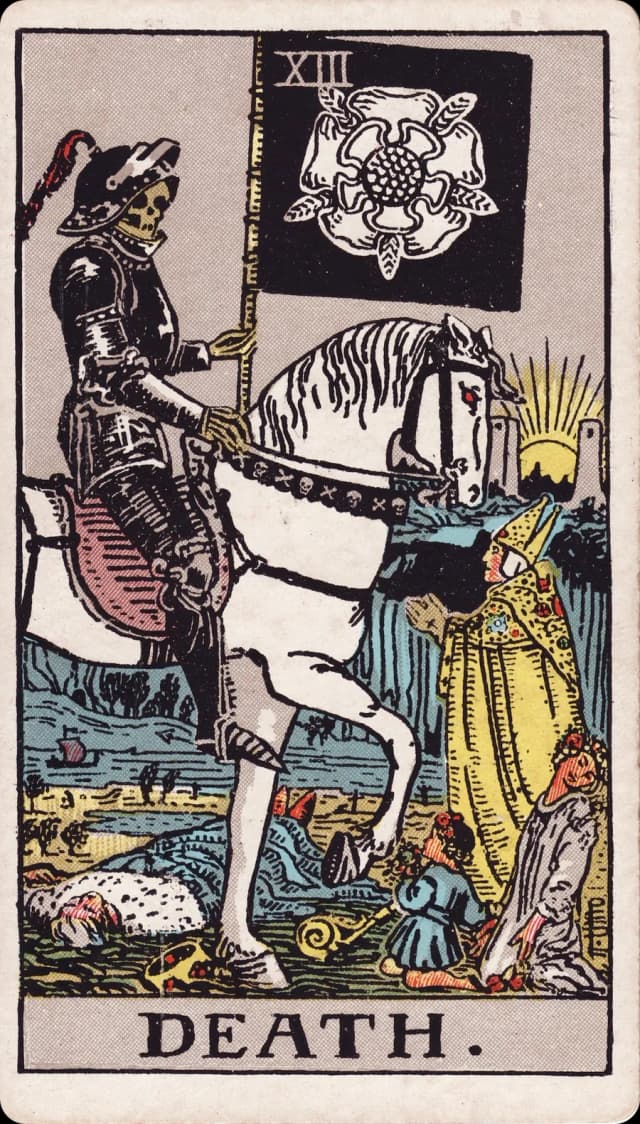
The veil or mask of life is perpetuated in change, transformation and passage from lower to higher, and this is more fitly represented in the rectified Tarot by one of the apocalyptic visions than by the crude notion of the reaping skeleton. Behind it lies the whole world of ascent in the spirit. The mysterious horseman moves slowly, bearing a black banner emblazoned with the Mystic Rose, which signifies life. Between two pillars on the verge of the horizon there shines the sun of immortality. The horseman carries no visible weapon, but king and child and maiden fall before him, while a prelate with clasped hands awaits his end.
생명의 베일 또는 가면은 변화와 변형, 낮은 데서 높은 데로의 이행 속에서 이어진다. 그리고 이것은 낫을 든 해골이라는 조야한 발상보다, 교정된 타로에서 묵시의 환시 가운데 하나로 그리는 편이 더 적절하다. 그 뒤에는 영 안에서의 상승이라는 세계 전체가 놓여 있다. 신비로운 기수가 천천히 나아가며, 생명을 뜻하는 신비의 장미가 새겨진 검은 깃발을 들고 있다. 지평선 가장자리의 두 기둥 사이에서 불멸의 태양이 빛난다. 기수는 눈에 보이는 무기를 지니지 않았으나 왕도 아이도 처녀도 그 앞에 쓰러지고, 두 손을 맞잡은 고위 성직자는 자기 최후를 기다린다.
There should be no need to point out that the suggestion of death which I have made in connection with the previous card is, of course, to be understood mystically, but this is not the case in the present instance. The natural transit of man to the next stage of his being either is or may be one form of his progress, but the exotic and almost unknown entrance, while still in this life, into the state of mystical death is a change in the form of consciousness and the passage into a state to which ordinary death is neither the path nor gate. The existing occult explanations of the 13th card are, on the whole, better than usual, rebirth, creation, destination, renewal, and the rest.
앞 카드와 관련하여 내가 제시한 죽음의 시사가 물론 신비적으로 이해되어야 함을 굳이 지적할 필요는 없을 것이나, 지금 이 카드에서는 사정이 다르다. 사람이 다음 단계의 존재로 자연적으로 이행하는 것은 그의 진보의 한 형태이거나 그럴 수 있지만, 이 삶에 아직 있는 동안 신비적 죽음의 상태로 들어가는 이국적이고 거의 알려지지 않은 입문은 의식의 형태가 바뀌는 것이고, 보통의 죽음이 그 길도 관문도 아닌 상태로의 이행이다. 13번 카드에 대한 기존의 오컬트적 설명들은 대체로 평소보다 나은 편이다 — 재탄생, 창조, 목적지, 갱신, 그 밖의 것들.
XIV / Temperance
XIV / 절제
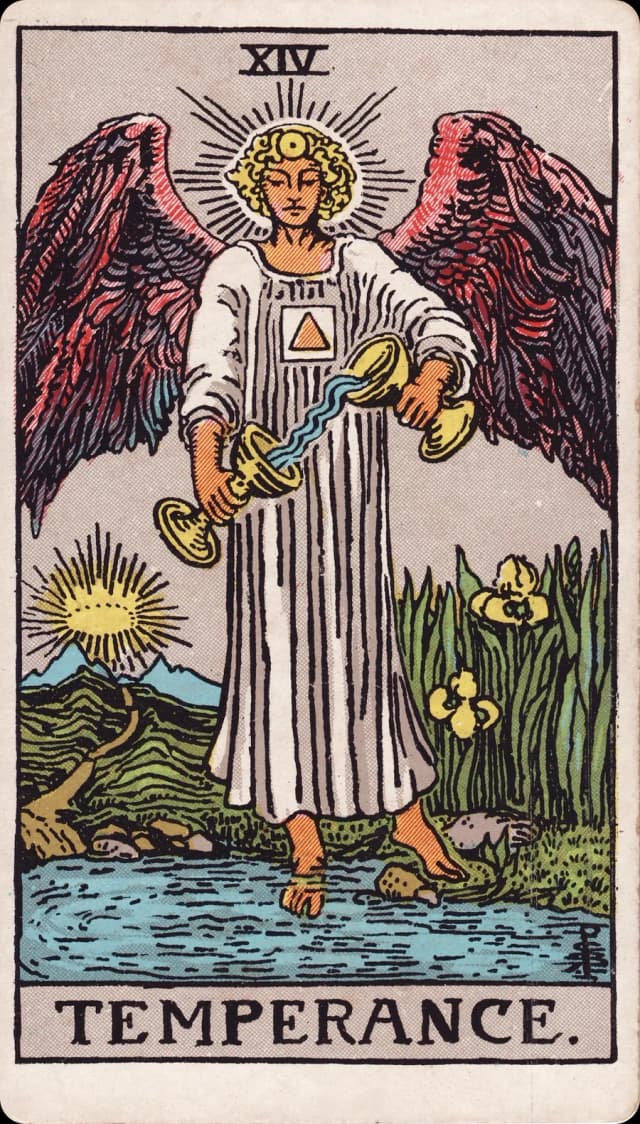
A winged angel, with the sign of the sun upon his forehead and on his breast the square and triangle of the septenary. I speak of him in the masculine sense, but the figure is neither male nor female. It is held to be pouring the essences of life from chalice to chalice. It has one foot upon the earth and one upon waters, thus illustrating the nature of the essences. A direct path goes up to certain heights on the verge of the horizon, and above there is a great light, through which a crown is seen vaguely. Hereof is some part of the Secret of Eternal Life, as it is possible to man in his incarnation. All the conventional emblems are renounced herein.
날개 달린 천사가 있고, 이마에는 해의 표징이, 가슴에는 칠(七)을 나타내는 사각형과 삼각형이 있다. 나는 그를 남성으로 말하지만 이 인물은 남성도 여성도 아니다. 그는 생명의 정수를 이 잔에서 저 잔으로 옮겨 붓고 있다고 여겨진다. 한 발은 땅에, 다른 한 발은 물에 두어 그 정수의 본성을 드러낸다. 곧은 길 하나가 지평선 가장자리의 어떤 높은 곳까지 올라가고, 그 위에는 큰 빛이 있어 그 사이로 왕관이 어렴풋이 보인다. 여기에 영원한 생명의 비밀 가운데 일부가 있다 — 육신을 입은 사람에게 가능한 만큼으로 말이다. 통상적인 표장들은 여기서 모두 버려졌다.
So also are the conventional meanings, which refer to changes in the seasons, perpetual movement of life and even the combination of ideas. It is, moreover, untrue to say that the figure symbolizes the genius of the sun, though it is the analogy of solar light, realized in the third part of our human triplicity. It is called Temperance fantastically, because, when the rule of it obtains in our consciousness, it tempers, combines and harmonises the psychic and material natures. Under that rule we know in our rational part something of whence we came and whither we are going.
통상적 의미들도 마찬가지인데, 계절의 변화, 삶의 영속적 운동, 심지어 관념들의 결합에까지 언급한다. 더욱이 이 인물이 태양의 수호신을 상징한다고 말하는 것은 사실이 아니다. 비록 그것이 태양 빛의 유비이기는 하되, 우리 인간 삼중성의 셋째 부분에서 실현된 것으로서 그렇다. 이것이 절제라 불리는 것은 기이하거니와, 그 다스림이 우리 의식 안에서 작동할 때 그것이 혼적 본성과 물질적 본성을 절제하고, 결합하고, 조화시키기 때문이다. 그 다스림 아래에서 우리는 이성적 부분으로 우리가 어디서 왔고 어디로 가는지에 관해 얼마간을 안다.
XV / The Devil
XV / 악마
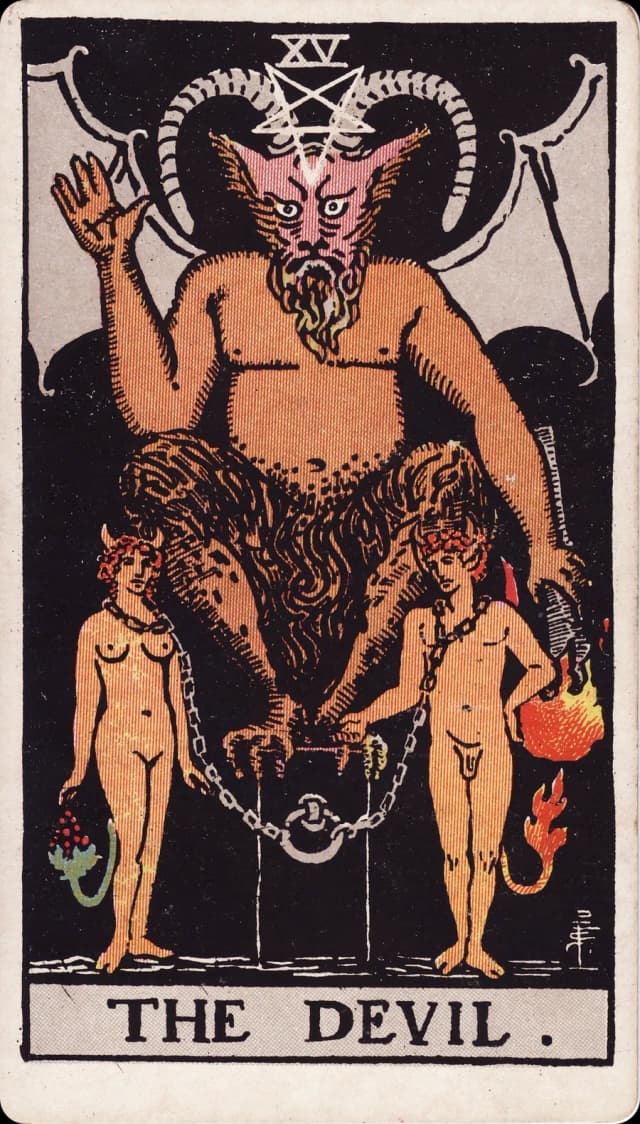
The design is an accommodation, mean or harmony, between several motives mentioned in the first part. The Horned Goat of Mendes, with wings like those of a bat, is standing on an altar. At the pit of the stomach there is the sign of Mercury. The right hand is upraised and extended, being the reverse of that benediction which is given by the Hierophant in the fifth card. In the left hand there is a great flaming torch, inverted towards the earth. A reversed pentagram is on the forehead. There is a ring in front of the altar, from which two chains are carried to the necks of two figures, male and female. These are analogous with those of the fifth card, as if Adam and Eve after the Fall. Hereof is the chain and fatality of the material life.
이 도안은 1부에서 언급한 여러 동기 사이의 절충이자 중간이며 조화다. 박쥐 같은 날개를 단 멘데스의 뿔 달린 염소가 제단 위에 서 있다. 명치께에는 수성의 표징이 있다. 오른손은 들어 올려 펼쳐져 있는데, 다섯 번째 카드에서 교황이 베푸는 축복을 뒤집은 모습이다. 왼손에는 크게 타오르는 횃불이 땅을 향해 거꾸로 들려 있다. 이마에는 뒤집힌 오각별이 있다. 제단 앞에는 고리가 하나 있고, 거기서 두 개의 사슬이 남자와 여자 두 인물의 목으로 이어진다. 이들은 다섯 번째 카드의 인물들과 대응하는데, 타락 이후의 아담과 하와인 셈이다. 여기에 물질적 삶의 사슬과 숙명이 있다.
The figures are tailed, to signify the animal nature, but there is human intelligence in the faces, and he who is exalted above them is not to be their master for ever. Even now, he is also a bondsman, sustained by the evil that is in him and blind to the liberty of service. With more than his usual derision for the arts which he pretended to respect and interpret as a master therein, Éliphas Lévi affirms that the Baphometic figure is occult science and magic. Another commentator says that in the Divine world it signifies predestination, but there is no correspondence in that world with the things which below are of the brute. What it does signify is the Dweller on the Threshold without the Mystical Garden when those are driven forth therefrom who have eaten the forbidden fruit.
인물들에게는 꼬리가 달려 있어 동물적 본성을 뜻하지만, 얼굴에는 인간의 지성이 있으며, 그들 위에 높여진 자가 영원히 그들의 주인일 수는 없다. 지금도 이미 그 역시 속박된 자이니, 자기 안의 악에 의해 지탱되며 봉사의 자유에 눈먼 존재다. 자기가 존경하고 해석하는 체한 기예에 대해 유례없이 조롱하면서, 엘리파스 레비는 바포메트 형상이 비의학과 마법이라고 단언한다. 또 다른 논평가는 신적 세계에서 그것이 예정(豫定)을 뜻한다고 말하나, 그 세계에는 아래쪽에서 짐승의 것인 것들과 대응하는 것이 없다. 이것이 실제로 뜻하는 것은, 신비의 정원에서 금단의 열매를 먹은 자들이 쫓겨날 때 그 정원 밖의 문턱에 서 있는 거주자다.
XVI / The Tower
XVI / 탑
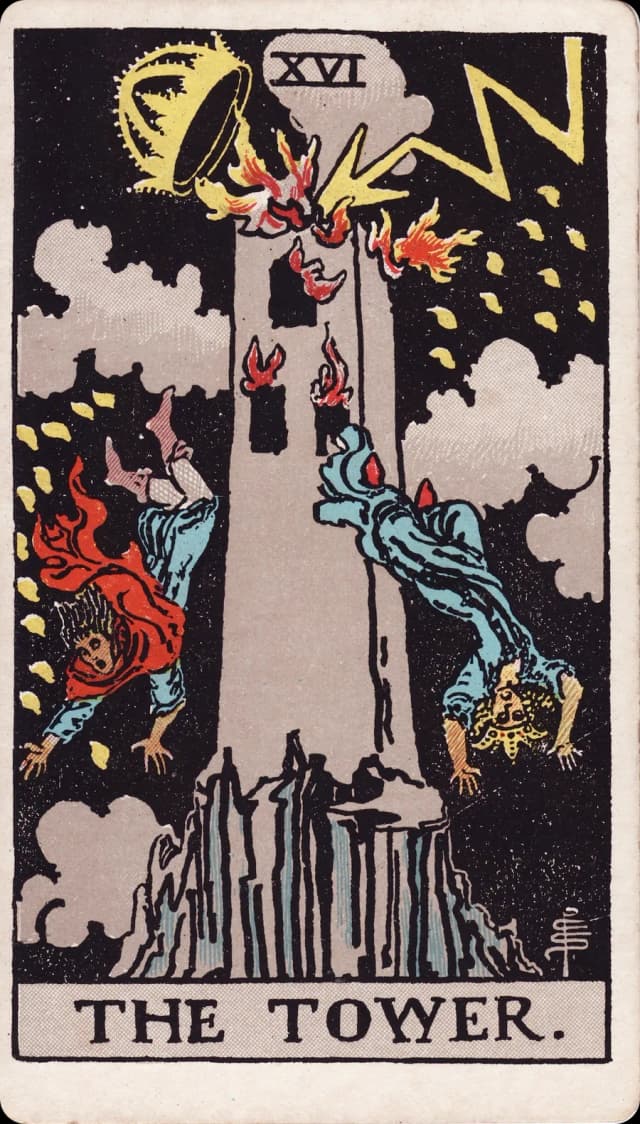
Occult explanations attached to this card are meagre and mostly disconcerting. It is idle to indicate that it depicts ruin in all its aspects, because it bears this evidence on the surface. It is said further that it contains the first allusion to a material building, but I do not conceive that the Tower is more or less material than the pillars which we have met with in three previous cases. I see nothing to warrant Papus in supposing that it is literally the fall of Adam, but there is more in favour of his alternative—that it signifies the materialization of the spiritual word. The bibliographer Christian imagines that it is the downfall of the mind, seeking to penetrate the mystery of God. I agree rather with Grand Orient that it is the ruin of the House of Life, when evil has prevailed therein, and above all that it is the rending of a House of Doctrine. I understand that the reference is, however, to a House of Falsehood. It illustrates also in the most comprehensive way the old truth that "except the Lord build the house, they labour in vain that build it."
이 카드에 붙은 오컬트적 설명들은 빈약하고 대부분 당혹스럽다. 그것이 온갖 면에서의 파멸을 그린다고 지적하는 것은 부질없다. 표면에 그 증거가 있기 때문이다. 나아가 이것이 물질적 건축물에 대한 최초의 언급을 담고 있다고들 하나, 나로서는 탑이 앞서 세 경우에서 만난 기둥들보다 더 또는 덜 물질적이라고 보지 않는다. 파퓌스가 이것을 문자 그대로 아담의 타락이라 여기는 것을 뒷받침할 만한 것은 보이지 않으나, 그의 대안 — 곧 영적 말씀의 물질화를 뜻한다는 것 — 에는 더 나은 근거가 있다. 서지학자 크리스티앙은 그것이 하느님의 신비를 꿰뚫으려 하는 정신의 전복이라 상상한다. 나는 차라리 그랑 오리앙의 견해에 동의한다. 곧 악이 그 안에서 득세했을 때의 삶의 집의 파멸이며, 무엇보다 교의의 집의 찢김이라는 것이다. 다만 내가 이해하기로 그 참조는 거짓의 집에 관한 것이다. 이 카드는 또한 가장 포괄적인 방식으로 옛 진리를 예시한다 — "여호와께서 집을 세우지 아니하시면 세우는 자의 수고가 헛되다."
There is a sense in which the catastrophe is a reflection from the previous card, but not on the side of the symbolism which I have tried to indicate therein. It is more correctly a question of analogy; one is concerned with the fall into the material and animal state, while the other signifies destruction on the intellectual side. The Tower has been spoken of as the chastisement of pride and the intellect overwhelmed in the attempt to penetrate the Mystery of God; but in neither case do these explanations account for the two persons who are the living sufferers. The one is the literal word made void and the other its false interpretation. In yet a deeper sense, it may signify also the end of a dispensation, but there is no possibility here for the consideration of this involved question.
이 파국이 앞 카드의 반영이라 할 만한 측면이 있기는 하다. 다만 내가 그 카드에서 가리키려 한 상징의 쪽에서는 아니다. 더 정확히는 유비의 문제다. 하나는 물질적이고 동물적인 상태로의 추락에 관계하고, 다른 하나는 지성의 쪽에서의 파괴를 뜻한다. 탑은 교만에 대한 징벌, 그리고 하느님의 신비를 꿰뚫으려 하다 압도당한 지성이라고 이야기되어 왔다. 그러나 두 설명 어느 쪽도 실제로 고통받고 있는 두 사람을 설명해 주지는 못한다. 하나는 무효가 된 문자 그대로의 말이고, 다른 하나는 그 말의 그릇된 해석이다. 더 깊은 뜻에서 그것은 한 경륜(經綸)의 끝을 뜻할 수도 있으나, 여기서 이 얽힌 문제를 다룰 여지는 없다.
XVII / The Star
XVII / 별
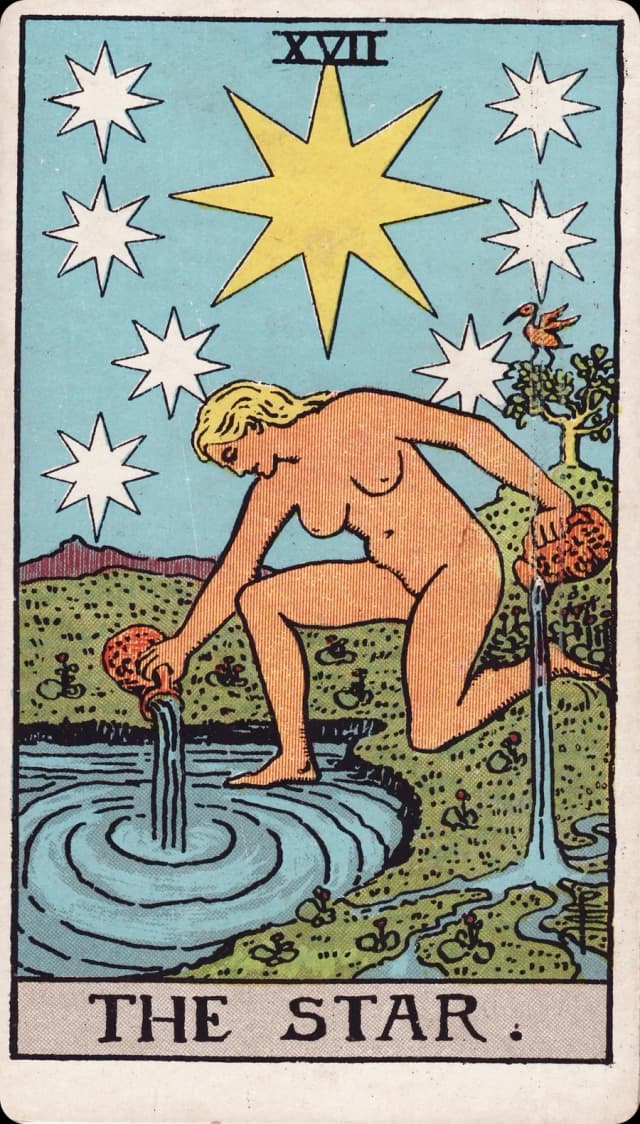
A great, radiant, star of eight rays, surrounded by seven lesser stars—also of eight rays. The female figure in the foreground is entirely naked. Her left knee is on the land and her right foot upon the water. She pours Water of Life from two great ewers, irrigating sea and land. Behind her is rising ground and on the right a shrub or tree, whereon a bird alights. The figure expresses eternal youth and beauty. The star is l'étoile flamboyante, which appears in Masonic symbolism, but has been confused therein. That which the figure communicates to the living scene is the substance of the heavens and the elements. It has been said truly that the mottoes of this card are "Waters of Life freely" and "Gifts of the Spirit."
여덟 갈래로 빛나는 큰 별 하나가 있고, 그 둘레를 역시 여덟 갈래인 작은 별 일곱이 에워싸고 있다. 앞쪽의 여성 인물은 완전히 벌거벗었다. 왼 무릎은 땅에, 오른발은 물에 놓여 있다. 그녀는 커다란 물병 둘에서 생명의 물을 부어 바다와 땅을 적신다. 뒤로는 땅이 솟아 있고 오른쪽에는 관목인지 나무인지가 있어 그 위에 새 한 마리가 내려앉는다. 이 인물은 영원한 젊음과 아름다움을 나타낸다. 이 별은 프리메이슨 상징에 나오는 타오르는 별(l'étoile flamboyante) 인데, 거기서는 혼동되어 왔다. 이 인물이 살아 있는 장면에 전하는 것은 하늘과 원소들의 실질이다. 이 카드의 표어가 "생명의 물을 값없이"와 "영의 선물들"이라고 한 말은 옳다.
The summary of several tawdry explanations says that it is a card of hope. On other planes it has been certified as immortality and interior light. For the majority of prepared minds, the figure will appear as the type of Truth unveiled, glorious in undying beauty, pouring on the waters of the soul some part and measure of her priceless possession. But she is in reality the Great Mother in the Kabalistic Sephira Binah, which is supernal Understanding, who communicates to the Sephiroth that are below in the measure that they can receive her influx.
여러 조잡한 설명의 요약은 이것이 희망의 카드라고 말한다. 다른 층위에서는 불멸과 내면의 빛으로 인증되었다. 준비된 정신의 대다수에게 이 인물은 베일 벗은 진리의 전형으로 보일 것이니, 불멸의 아름다움 안에서 영광스럽게, 영혼의 물 위에 그녀의 값을 매길 수 없는 소유물의 일부와 분량을 부어 주는 모습이다. 그러나 그녀는 실제로는 카발라의 세피라 비나(Sephira Binah) 에 있는 위대한 어머니이니, 이는 지고의 이해로서 그 아래에 있는 세피롯 에게 그들이 받을 수 있는 만큼의 유입을 전한다.
XVIII / The Moon
XVIII / 달
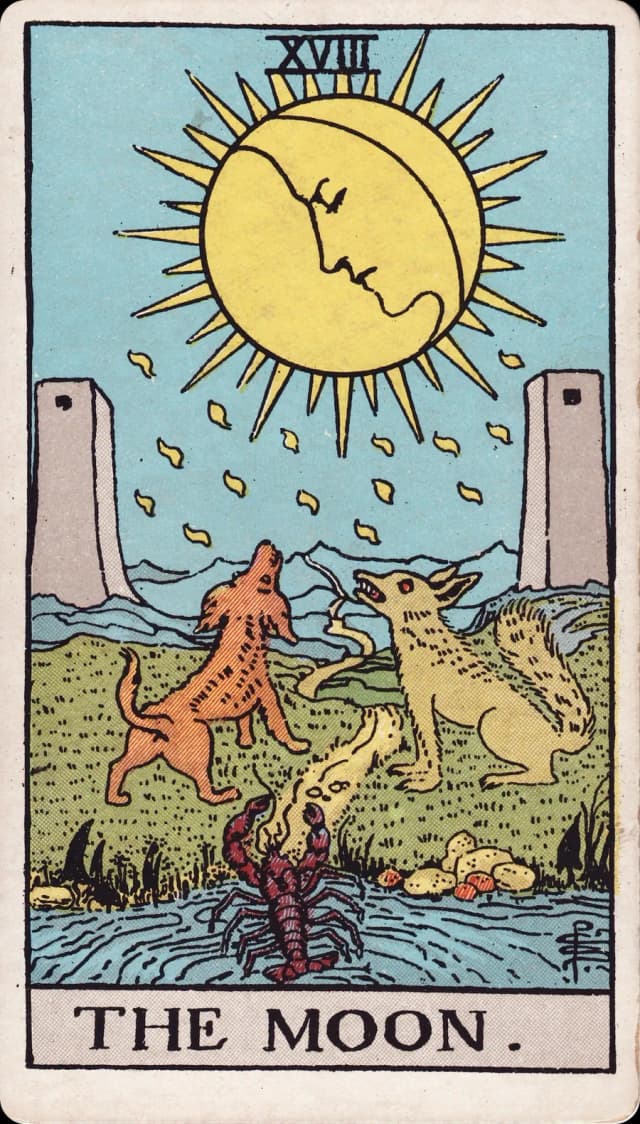
The distinction between this card and some of the conventional types is that the moon is increasing on what is called the side of mercy, to the right of the observer. It has sixteen chief and sixteen secondary rays. The card represents life of the imagination apart from life of the spirit. The path between the towers is the issue into the unknown. The dog and wolf are the fears of the natural mind in the presence of that place of exit, when there is only reflected light to guide it.
이 카드가 통상적인 유형 몇몇과 다른 점은, 달이 이른바 자비의 쪽 — 보는 이의 오른쪽 — 에서 차오르고 있다는 것이다. 달에는 주된 빛살 열여섯과 부차적인 빛살 열여섯이 있다. 이 카드는 영의 삶과 구별되는 상상의 삶을 나타낸다. 두 탑 사이의 길은 미지로 나아가는 출구다. 개와 늑대는 그 출구 앞에서 자연적 정신이 느끼는 두려움이다 — 길을 밝혀 줄 것이라고는 반사된 빛뿐일 때 말이다.
The last reference is a key to another form of symbolism. The intellectual light is a reflection and beyond it is the unknown mystery which it cannot shew forth. It illuminates our animal nature, types of which are represented below—the dog, the wolf and that which comes up out of the deeps, the nameless and hideous tendency which is lower than the savage beast. It strives to attain manifestation, symbolized by crawling from the abyss of water to the land, but as a rule it sinks back whence it came. The face of the mind directs a calm gaze upon the unrest below; the dew of thought falls; the message is: Peace, be still; and it may be that there shall come a calm upon the animal nature, while the abyss beneath shall cease from giving up a form.
마지막 언급은 상징의 또 다른 형태로 가는 열쇠다. 지성의 빛은 반사된 것이며, 그 너머에는 그것이 드러내 보일 수 없는 알려지지 않은 신비가 있다. 그 빛은 우리의 동물적 본성을 비추며, 그 유형들이 아래에 표현되어 있다 — 개, 늑대, 그리고 깊은 곳에서 올라오는 것, 야만적인 짐승보다도 낮은 이름 없고 흉측한 경향이다. 그것은 현현에 도달하려 애쓰며, 물의 심연에서 기어 나와 땅에 이르는 것으로 상징되나, 대개는 나온 곳으로 다시 가라앉는다. 정신의 얼굴은 아래의 불안에 차분한 시선을 보낸다. 사유의 이슬이 내린다. 전언은 이렇다: 평안하라, 고요하라. 그리하여 동물적 본성에 고요함이 올 수도 있고, 그 아래의 심연은 형상을 내보내기를 그칠 수도 있다.
XIX / The Sun
XIX / 태양
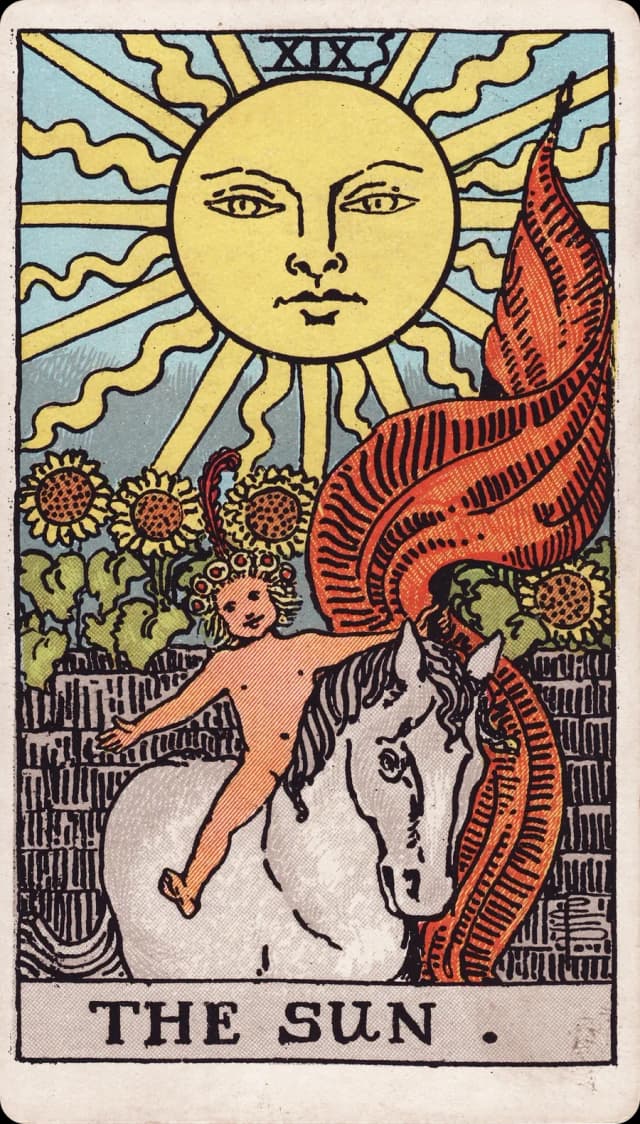
The naked child mounted on a white horse and displaying a red standard has been mentioned already as the better symbolism connected with this card. It is the destiny of the Supernatural East and the great and holy light which goes before the endless procession of humanity, coming out from the walled garden of the sensitive life and passing on the journey home. The card signifies, therefore, the transit from the manifest light of this world, represented by the glorious sun of earth, to the light of the world to come, which goes before aspiration and is typified by the heart of a child.
흰 말에 올라 붉은 깃발을 펼쳐 든 벌거벗은 아이는 이 카드와 이어지는 더 나은 상징으로 앞서 언급한 바 있다. 그것은 초자연적 동방의 운명이며, 감각적 삶의 담장 두른 정원에서 나와 귀향길에 오른 인류의 끝없는 행렬 앞에 서서 나아가는 크고 거룩한 빛이다. 그러므로 이 카드는 이 세상의 드러난 빛 — 땅의 영광스러운 태양으로 나타나는 빛 — 에서, 장차 올 세상의 빛으로 건너감을 뜻한다. 그 빛은 열망에 앞서 나아가며 아이의 마음으로 표상된다.
But the last allusion is again the key to a different form or aspect of the symbolism. The sun is that of consciousness in the spirit—the direct as the antithesis of the reflected light. The characteristic type of humanity has become a little child therein—a child in the sense of simplicity and innocence in the sense of wisdom. In that simplicity, he bears the seal of Nature and of Art; in that innocence, he signifies the restored world. When the self-knowing spirit has dawned in the consciousness above the natural mind, that mind in its renewal leads forth the animal nature in a state of perfect conformity.
그러나 마지막 언급은 또다시 상징의 다른 형태 또는 측면으로 가는 열쇠다. 태양은 영 안의 의식의 태양이다 — 반사된 빛의 정반대인 직접적 빛으로서. 인류의 특성적 유형은 그 안에서 어린아이가 되었다 — 단순함이라는 의미에서의 아이이자 지혜라는 의미에서의 무구함이다. 그 단순함 안에서 그는 자연과 기예의 도장을 지니고, 그 무구함 안에서 그는 회복된 세계를 뜻한다. 스스로를 아는 영이 자연적 정신 위의 의식에서 밝아 왔을 때, 그 정신은 갱신 속에서 동물적 본성을 완전한 순응의 상태로 이끌어 낸다.
XX / The Last Judgment
XX / 심판
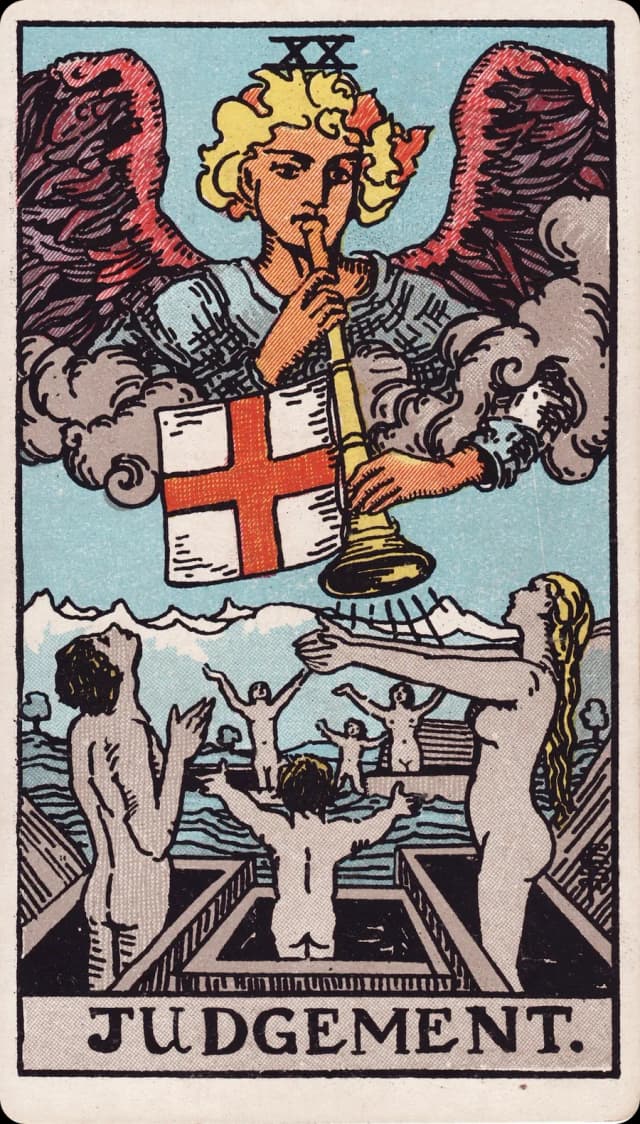
I have said that this symbol is essentially invariable in all Tarot sets, or at least the variations do not alter its character. The great angel is here encompassed by clouds, but he blows his bannered trumpet, and the cross as usual is displayed on the banner. The dead are rising from their tombs—a woman on the right, a man on the left hand, and between them their child, whose back is turned. But in this card there are more than three who are restored, and it has been thought worth while to make this variation as illustrating the insufficiency of current explanations. It should be noted that all the figures are as one in the wonder, adoration and ecstacy expressed by their attitudes. It is the card which registers the accomplishment of the great work of transformation in answer to the summons of the Supernal—which summons is heard and answered from within.
나는 이 상징이 모든 타로 세트에서 본질적으로 변하지 않는다고, 적어도 그 변형들이 성격을 바꾸지는 않는다고 말했다. 여기서 큰 천사는 구름에 둘러싸여 있으나 깃발 달린 나팔을 불고 있고, 여느 때처럼 깃발에는 십자가 그려져 있다. 죽은 이들이 무덤에서 일어난다 — 오른쪽에 여자, 왼쪽에 남자, 그 사이에 등을 돌린 그들의 아이. 다만 이 카드에서는 되살아나는 이가 셋보다 많다. 지금까지의 설명이 충분하지 못함을 보이기 위해 이 변형을 둘 만하다고 여겼다. 눈여겨볼 것은 모든 인물이 그 자세로 나타내는 경이와 경배와 황홀에서 하나라는 점이다. 이 카드는 지고의 부르심에 응답하여 변형의 대업이 이루어졌음을 기록하는 카드다 — 그 부르심은 안에서 들리고 안에서 응답된다.
Herein is the intimation of a significance which cannot well be carried further in the present place. What is that within us which does sound a trumpet and all that is lower in our nature rises in response—almost in a moment, almost in the twinkling of an eye? Let the card continue to depict, for those who can see no further, the Last Judgment and the resurrection in the natural body; but let those who have inward eyes look and discover therewith. They will understand that it has been called truly in the past a card of eternal life, and for this reason it may be compared with that which passes under the name of Temperance.
여기에 이 자리에서 더 밀고 나가기 어려운 의미의 암시가 있다. 우리 안에서 나팔을 불어 우리 본성의 낮은 모든 것이 그에 응하여 일어나는 것은 무엇인가 — 거의 순식간에, 거의 눈 깜짝할 사이에? 이 카드로 하여금, 더 멀리 볼 수 없는 이들을 위해, 최후의 심판과 자연적 몸의 부활을 계속 그리게 하라. 그러나 안의 눈을 가진 이들은 보아 그로써 깨달으라. 그들은 이 카드가 과거에 영원한 생명의 카드라 참되게 불려 왔음을 이해할 것이며, 이런 까닭에 절제라는 이름으로 통하는 카드와 비교될 수 있을 것이다.
0 / ZERO / The Fool
0 / 영(零) / 바보
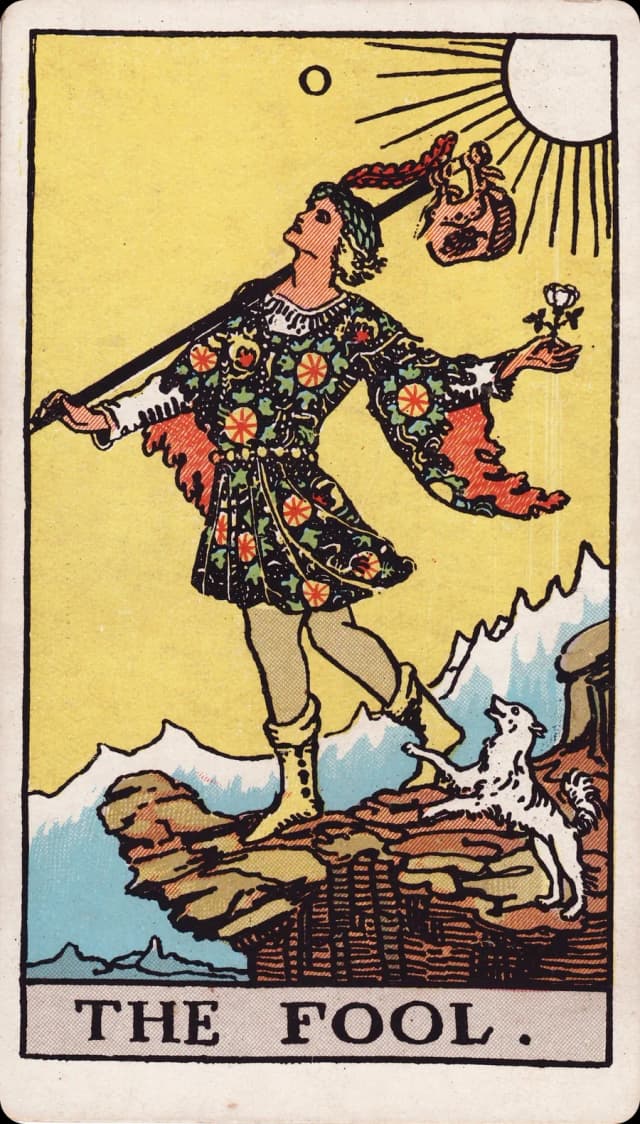
With light step, as if earth and its trammels had little power to restrain him, a young man in gorgeous vestments pauses at the brink of a precipice among the great heights of the world; he surveys the blue distance before him—its expanse of sky rather than the prospect below. His act of eager walking is still indicated, though he is stationary at the given moment; his dog is still bounding. The edge which opens on the depth has no terror; it is as if angels were waiting to uphold him, if it came about that he leaped from the height. His countenance is full of intelligence and expectant dream. He has a rose in one hand and in the other a costly wand, from which depends over his right shoulder a wallet curiously embroidered. He is a prince of the other world on his travels through this one—all amidst the morning glory, in the keen air. The sun, which shines behind him, knows whence he came, whither he is going, and how he will return by another path after many days. He is the spirit in search of experience. Many symbols of the Instituted Mysteries are summarized in this card, which reverses, under high warrants, all the confusions that have preceded it.
가벼운 발걸음으로, 마치 땅과 그 속박이 그를 붙들 힘이 거의 없는 듯, 화려한 의복을 걸친 젊은이가 세상의 위대한 높이들 사이 벼랑 끝에 멈춰 서 있다. 그는 눈앞의 푸른 먼 곳을 — 아래의 조망보다는 하늘의 광활함을 — 바라본다. 그 순간 그는 정지해 있으나 열심히 걷던 동작이 아직 나타나 있고, 그의 개도 아직 뛰고 있다. 깊이로 열리는 벼랑 끝에 두려움은 없다. 마치 그가 그 높이에서 뛰어내린다 해도 천사들이 그를 떠받칠 것만 같다. 그의 용모는 지성과 기대에 찬 꿈으로 가득하다. 한 손에는 장미를, 다른 손에는 값비싼 지팡이를 들고 있는데, 그 지팡이에서 오른 어깨 너머로 정교하게 수놓은 자루가 드리워져 있다. 그는 이 세상을 지나가는 여행 중인 다른 세계의 왕자다 — 아침의 영광 한가운데, 상쾌한 공기 속에서 말이다. 그 뒤에서 빛나는 해는 그가 어디서 왔고, 어디로 가며, 여러 날 뒤에 어떻게 다른 길로 돌아올지를 안다. 그는 경험을 찾아 나선 영이다. 제정된 신비의 많은 상징이 이 카드에 요약되어 있으니, 높은 위임 아래 앞서 있었던 모든 혼란을 뒤집는다.
In his Manual of Cartomancy, Grand Orient has a curious suggestion of the office of Mystic Fool, as a part of his process in higher divination; but it might call for more than ordinary gifts to put it into operation. We shall see how the card fares according to the common arts of fortune-telling, and it will be an example, to those who can discern, of the fact, otherwise so evident, that the Trumps Major had no place originally in the arts of psychic gambling, when cards are used as the counters and pretexts. Of the circumstances under which this art arose we know, however, very little. The conventional explanations say that the Fool signifies the flesh, the sensitive life, and by a peculiar satire its subsidiary name was at one time the alchemist, as depicting folly at the most insensate stage.
그랑 오리앙은 『카드점 편람』에서 더 높은 점술의 절차 가운데 하나로 신비의 바보라는 직무에 관해 흥미로운 제안을 내놓는다. 다만 그것을 실제로 운용하려면 예사롭지 않은 재능이 필요할 것이다. 우리는 이 카드가 흔한 점술의 기예 안에서 어떻게 다루어지는지 보게 될 텐데, 그것은 분별할 줄 아는 이들에게 하나의 사례가 될 것이다 — 달리 보아도 명백한 사실, 곧 카드가 점수패이자 구실로 쓰이는 심령적 노름의 기예에 대아르카나는 본래 자리가 없었다는 사실 말이다. 그러나 그 기예가 어떤 정황에서 생겨났는지에 대해 우리가 아는 것은 매우 적다. 통상적인 설명은 바보가 육신, 곧 감각적 삶을 뜻한다고 말하며, 묘한 풍자로 한때 그 부차적 이름이 연금술사였다 — 가장 무감각한 단계의 어리석음을 그린 것으로서.
XXI / The World
XXI / 세계
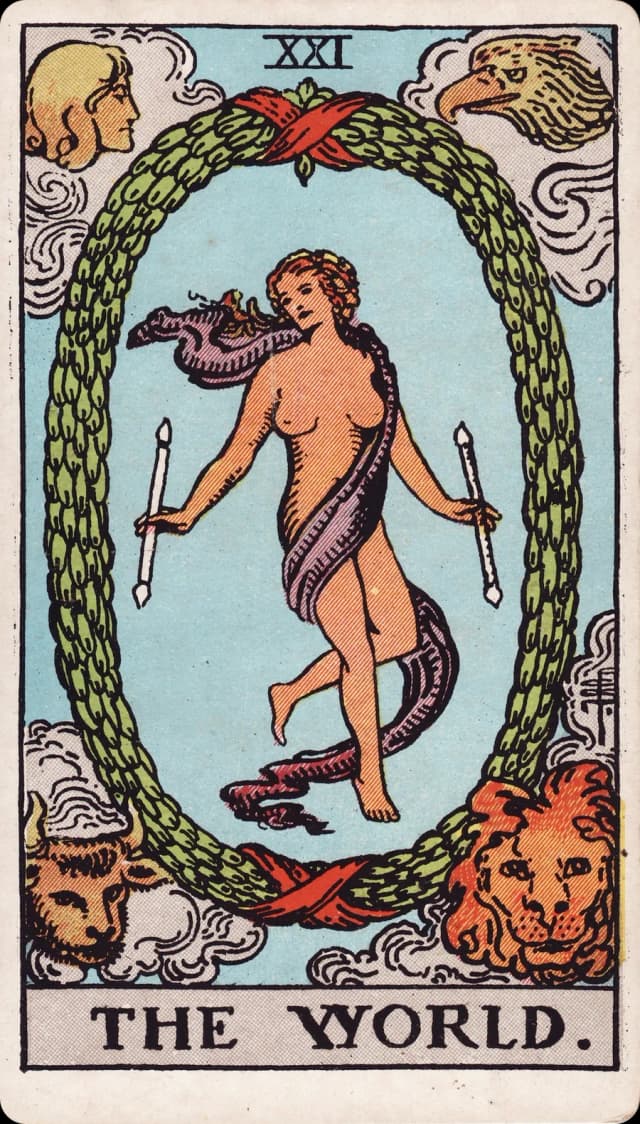
As this final message of the Major Trumps is unchanged—and indeed unchangeable—in respect of its design, it has been partly described already regarding its deeper sense. It represents also the perfection and end of the Cosmos, the secret which is within it, the rapture of the universe when it understands itself in God. It is further the state of the soul in the consciousness of Divine Vision, reflected from the self-knowing spirit. But these meanings are without prejudice to that which I have said concerning it on the material side.
대아르카나의 이 마지막 전언은 도안에 관한 한 변한 적이 없고 실은 변할 수도 없으므로, 그 깊은 뜻에 대해서는 이미 얼마간 서술했다. 그것은 또한 코스모스의 완성이자 끝, 그 안에 있는 비밀, 우주가 하느님 안에서 스스로를 이해할 때의 황홀을 나타낸다. 나아가 그것은 스스로를 아는 영에서 되비친, 신적 환시를 의식하는 영혼의 상태다. 다만 이 뜻들은 내가 물질적인 쪽에서 말한 바를 물리지 않는다.
It has more than one message on the macrocosmic side and is, for example, the state of the restored world when the law of manifestation shall have been carried to the highest degree of natural perfection. But it is perhaps more especially a story of the past, referring to that day when all was declared to be good, when the morning stars sang together and all the Sons of God shouted for joy. One of the worst explanations concerning it is that the figure symbolizes the Magus when he has reached the highest degree of initiation; another account says that it represents the absolute, which is ridiculous. The figure has been said to stand for Truth, which is, however, more properly allocated to the seventeenth card. Lastly, it has been called the Crown of the Magi.
대우주의 쪽에서 그것은 둘 이상의 전언을 지니며, 예컨대 현현의 법칙이 자연적 완전의 최고 단계까지 수행되었을 때의 회복된 세계의 상태다. 그러나 이것은 아마 더 특별히 과거의 이야기일 것이니, 모든 것이 선하다 선포되던 날, 새벽별들이 함께 노래하고 하느님의 모든 아들이 기쁨으로 소리 지르던 날을 가리킨다. 이 카드에 관한 최악의 설명 가운데 하나는 그 인물이 입문의 최고 단계에 이른 마구스를 상징한다는 것이다. 또 다른 설명은 그것이 절대자를 나타낸다고 하는데, 우스꽝스럽다. 그 인물이 진리를 나타낸다고도 말해 왔으나, 이는 열일곱 번째 카드에 더 적절히 배정되는 것이다. 끝으로, 그것은 마기의 관(冠)이라 불려 왔다.
§ 3
§ 3
Conclusion as to the Greater Keys
대열쇠에 관한 결론
There has been no attempt in the previous tabulation to present the symbolism in what is called the three worlds—that of Divinity, of the Macrocosm and the Microcosm. A large volume would be required for developments of this kind. I have taken the cards on the high plane of their more direct significance to man, who—in material life—is on the quest of eternal things. The compiler of the Manual of Cartomancy has treated them under three headings: the World of Human Prudence, which does not differ from divination on its more serious side; the World of Conformity, being the life of religious devotion; and the World of Attainment, which is that of "the soul's progress towards the term of its research." He gives also a triple process of consultation, according to these divisions, to which the reader is referred. I have no such process to offer, as I think that more may be gained by individual reflection on each of the Trumps Major. I have also not adopted the prevailing attribution of the cards to the Hebrew alphabet—firstly, because it would serve no purpose in an elementary handbook; secondly, because nearly every attribution is wrong. Finally, I have not attempted to rectify the position of the cards in their relation to one another; the Zero therefore appears after No. 20, but I have taken care not to number the World or Universe otherwise than as 21. Wherever it ought to be put, the Zero is an unnumbered card.
앞의 정리에서는 이른바 세 세계 — 신성의 세계, 대우주의 세계, 소우주의 세계 — 로 상징을 제시하려 하지 않았다. 그런 식으로 전개하려면 두꺼운 책 한 권이 필요할 것이다. 나는 카드를 사람에게 더 직접 와닿는 뜻의 높은 층위에서 다루었다. 물질적 삶 속에서 영원한 것을 찾고 있는 사람 말이다. 『카드점 편람』의 편찬자는 그것들을 세 표제로 다루었다. 인간적 분별의 세계 — 이는 진지한 쪽에서 본 점술과 다르지 않다 —, 순응의 세계 — 곧 종교적 헌신의 삶 —, 그리고 도달의 세계 — 곧 "영혼이 그 탐구의 끝을 향해 나아가는" 세계다. 그는 이 구분에 따른 세 겹의 문의 절차도 제시하는데, 독자는 그쪽을 참고하기 바란다. 나에게는 그런 절차가 없다. 대아르카나 하나하나를 스스로 곱씹는 편이 얻는 것이 더 많다고 보기 때문이다. 나는 또한 카드를 히브리 알파벳에 붙이는 통용 배정을 채택하지 않았다. 첫째로 입문용 안내서에서는 아무 소용이 없기 때문이고, 둘째로 거의 모든 배정이 틀렸기 때문이다. 끝으로 나는 카드들이 서로에 대해 놓이는 자리를 바로잡으려 하지도 않았다. 그래서 영(零) 은 20번 뒤에 나오지만, 세계 또는 우주에 21 말고 다른 번호를 붙이지 않도록 주의했다. 어디에 놓이든 영은 번호 없는 카드다.
In conclusion as to this part, I will give these further indications regarding the Fool, which is the most speaking of all the symbols. He signifies the journey outward, the state of the first emanation, the graces and passivity of the spirit. His wallet is inscribed with dim signs, to shew that many sub-conscious memories are stored up in the soul.
이 부분을 마무리하며, 모든 상징 가운데 가장 많은 것을 말해 주는 바보에 관해 몇 가지를 덧붙이겠다. 그는 바깥을 향한 여정, 첫 유출의 상태, 영의 은혜로움과 수동성을 뜻한다. 그의 자루에는 흐릿한 표식들이 적혀 있어, 많은 잠재의식적 기억이 영혼 안에 쌓여 있음을 보여준다.
3부 — 신탁의 겉방법Part III. The Outer Method of the Oracles
PART III
3부
The Outer Method of the Oracles
신탁의 겉방법
§ 1
§ 1
Distinction between the Greater and Lesser Arcana
대아르카나와 소아르카나의 구별
In respect of their usual presentation, the bridge between the Greater and Lesser Arcana is supplied by the court cards—King, Queen, Knight and Squire or Page; but their utter distinction from the Trumps Major is shewn by their conventional character. Let the reader compare them with symbols like the Fool, the High Priestess, the Hierophant, or—almost without exception—with any in the previous sequence, and he will discern my meaning. There is no especial idea connected on the surface with the ordinary court cards; they are a bridge of conventions, which form a transition to the simple pretexts of the counters and denaries of the numbers following. We seem to have passed away utterly from the region of higher meanings illustrated by living pictures. There was a period, however, when the numbered cards were also pictures, but such devices were sporadic inventions of particular artists and were either conventional designs of the typical or allegorical kind, distinct from what is understood by symbolism, or they were illustrations—shall we say?—of manners, customs and periods. They were, in a word, adornments, and as such they did nothing to raise the significance of the Lesser Arcana to the plane of the Trumps Major; moreover, such variations are exceedingly few. This notwithstanding, there are vague rumours concerning a higher meaning in the minor cards, but nothing has so far transpired, even within the sphere of prudence which belongs to the most occult circles; these, it is true, have certain variants in respect of divinatory values, but I have not heard that in practice they offer better results. Efforts like those of Papus in The Tarot of the Bohemians are strenuous and deserving after their own kind; he, in particular, recognizes the elements of the Divine Immanence in the Trumps Major, and he seeks to follow them through the long series of the lesser cards, as if these represented filtrations of the World of Grace through the World of Fortune; but he only produces an arbitrary scheme of division which he can carry no further, and he has recourse, of necessity, in the end to a common scheme of divination as the substitute for a title to existence on the part of the Lesser Arcana. Now, I am practically in the same position; but I shall make no attempt here to save the situation by drawing on the mystical properties of numbers, as he and others have attempted. I shall recognize at once that the Trumps Major belong to the divine dealings of philosophy, but all that follows to fortune-telling, since it has never yet been translated into another language; the course thus adopted will render to divination, and at need even to gambling, the things that belong to this particular world of skill, and it will set apart for their proper business those matters that are of another order. In this free introduction to the subject in hand, it is only necessary to add that the difference between the fifty-six Lesser Arcana and ordinary playing-cards is not only essentially slight, because the substitution of Cups for Hearts, and so forth, constitutes an accidental variation, but because the presence of a Knight in each of the four suits was characteristic at one time of many ordinary packs, when this personage usually replaced the Queen. In the rectified Tarot which illustrates the present handbook, all numbered cards of the Lesser Arcana—the Aces only excepted—are furnished with figures or pictures to illustrate—but without exhausting—the divinatory meanings attached thereto.
통상적인 제시 방식으로 보면 대아르카나와 소아르카나 사이의 다리는 궁정 카드 — 킹, 퀸, 나이트, 그리고 종자 또는 페이지 — 가 놓아 준다. 그러나 그것들이 대아르카나와 완전히 구별된다는 점은 그 관례적인 성격에서 드러난다. 독자가 그것들을 바보나 여사제나 교황 같은 상징과, 또는 앞선 계열의 거의 예외 없이 어떤 카드와든 견주어 보면 내 말뜻을 알아차릴 것이다. 보통의 궁정 카드에는 표면에 이어지는 특별한 관념이 없다. 그것들은 관례의 다리이며, 뒤따르는 숫자들의 점수패와 열 끗짜리가 내세우는 단순한 구실로 넘어가는 이행부를 이룬다. 살아 있는 그림으로 드러나던 더 높은 뜻의 영역에서 우리는 아주 벗어나 버린 듯하다. 그러나 숫자 카드에도 그림이 있던 시기가 있었다. 다만 그런 고안은 특정 화가들의 산발적인 발명이었고, 상징이라 이해되는 것과는 구별되는 전형적이거나 우의적인 종류의 관례적 도안이었거나, 아니면 — 말하자면 — 풍속과 관습과 시대를 그린 삽화였다. 한마디로 그것들은 장식이었고, 그런 것으로서 소아르카나의 뜻을 대아르카나의 층위로 끌어올리는 데는 아무 몫도 하지 못했다. 게다가 그런 변형은 지독히도 드물다. 그럼에도 작은 카드에 더 높은 뜻이 있다는 어렴풋한 소문들이 있으나, 가장 은밀한 모임들에 속하는 신중함의 영역 안에서조차 지금까지 드러난 것은 없다. 그런 모임들이 점술 값에서 어떤 변형을 지니는 것은 사실이지만, 실제로 그것이 더 나은 결과를 낸다는 말은 나는 듣지 못했다. 파퓌스가 『보헤미안의 타로』에서 기울인 것 같은 노력은 그 나름으로 애쓴 것이고 값어치가 있다. 그는 특히 대아르카나에서 신적 내재의 요소들을 알아보고, 그것들이 마치 은총의 세계가 운명의 세계를 거쳐 걸러진 것을 나타내기라도 하듯 긴 소아르카나 계열을 따라 좇으려 한다. 그러나 그는 더 밀고 나갈 수 없는 자의적인 구분 도식을 내놓을 뿐이고, 결국에는 소아르카나가 존재할 자격을 대신할 것으로 흔한 점술 도식에 어쩔 수 없이 기댄다. 나 또한 실질적으로 같은 처지에 있다. 다만 나는 그와 다른 이들이 시도한 것처럼 수(數)의 신비적 성질을 끌어와 이 상황을 구하려 들지는 않겠다. 나는 대아르카나가 철학의 신적 다룸에 속한다는 것, 그리고 그 뒤에 오는 것은 모두 카드점에 속한다는 것을 곧바로 인정하겠다. 그것이 아직 다른 언어로 옮겨진 적이 없기 때문이다. 이렇게 취한 길은 점술에, 필요하다면 노름에까지도, 이 특정한 기예의 세계에 속하는 것들을 돌려줄 것이고, 다른 갈래에 속하는 문제들은 그 본래의 자리에 따로 두게 할 것이다. 다루려는 주제에 대한 이 자유로운 서론에서 덧붙여 둘 것은 이것뿐이다. 쉰여섯 장의 소아르카나와 보통의 놀이 카드 사이의 차이는 본질적으로 대수롭지 않다. 하트를 컵으로 바꾸는 따위가 우연한 변형에 지나지 않기 때문이기도 하지만, 네 수트마다 나이트가 있는 것이 한때 여러 보통 팩의 특징이었고 그때 이 인물이 대개 퀸을 대신했기 때문이기도 하다. 이 안내서에 실린 교정된 타로에서는 소아르카나의 모든 숫자 카드가 — 에이스만 빼고 — 거기 붙은 점술 의미를 드러내되 다 길어내지는 않는 인물이나 그림을 갖추고 있다.
Some who are gifted with reflective and discerning faculties in more than the ordinary sense—I am not speaking of clairvoyance—may observe that in many of the Lesser Arcana there are vague intimations conveyed by the designs which seem to exceed the stated divinatory values. It is desirable to avoid misconception by specifying definitely that, except in rare instances and then only by accident—the variations are not to be regarded as suggestions of higher and extradivinatory symbolism. I have said that these Lesser Arcana have not been translated into a language which transcends that of fortune telling. I should not indeed be disposed to regard them as belonging in their existing forms to another realm than this; I have said that; but the field of divinatory possibilities is inexhaustible, by the hypothesis of the art, and the combined systems of cartomancy have indicated only the bare heads of significance attaching to the emblems in use. When the pictures in the present case go beyond the conventional meanings they should be taken as hints of possible developments along the same lines; and this is one of the reasons why the pictorial devices here attached to the four denaries will prove a great help to intuition. The mere numerical powers and bare words of the meanings are insufficient by themselves; but the pictures are like doors which open into unexpected chambers, or like a turn in the open road with a wide prospect beyond.
보통 이상으로 사려 깊고 분별하는 능력을 타고난 이들은 — 투시를 말하는 것이 아니다 — 소아르카나의 여러 카드에서 그 도안이 전하는 어렴풋한 암시가 명시된 점술 값을 넘어서는 듯하다고 느낄지 모른다. 오해를 피하기 위해 분명히 못 박아 두는 편이 좋겠다. 드문 경우를 빼면, 그리고 그때도 우연으로만 그럴 뿐, 이 변형들은 더 높고 점술 바깥에 있는 상징을 시사하는 것으로 여겨서는 안 된다. 나는 이 소아르카나가 카드점의 언어를 넘어서는 언어로 옮겨진 적이 없다고 말했다. 나로서는 정말이지 그것들이 지금의 형태 그대로 이 영역 아닌 다른 영역에 속한다고 볼 생각은 없다. 그 말은 이미 했다. 다만 점술의 가능성이라는 마당은 이 기예의 전제상 다함이 없고, 카드점의 여러 체계를 다 합쳐도 쓰이는 표장에 붙은 뜻의 앙상한 머리만을 짚어 왔을 뿐이다. 지금 이 경우에 그림이 관례적인 뜻을 넘어설 때, 그것은 같은 선을 따라 뻗어 나갈 수 있는 전개의 실마리로 받아들여야 한다. 여기서 네 벌의 열 끗 카드에 붙인 그림 고안이 직관에 큰 도움이 되리라는 이유 가운데 하나가 이것이다. 단순한 수의 힘과 뜻을 적은 앙상한 낱말만으로는 충분하지 않다. 그러나 그림은 뜻밖의 방으로 열리는 문 같고, 트인 길의 모퉁이를 돌자 저 너머로 시야가 활짝 펼쳐지는 것과 같다.
§ 2. THE LESSER ARCANA / Otherwise, the Four Suits of Tarot Cards,
§ 2.
will now be described according to their respective classes by the pictures to each belonging, and a harmony of their meanings will be provided from all sources.
이제 각각의 부류에 따라, 아래에 딸린 그림들로 서술하겠다.
THE SUIT OF WANDS / King
완드 수트 / 킹
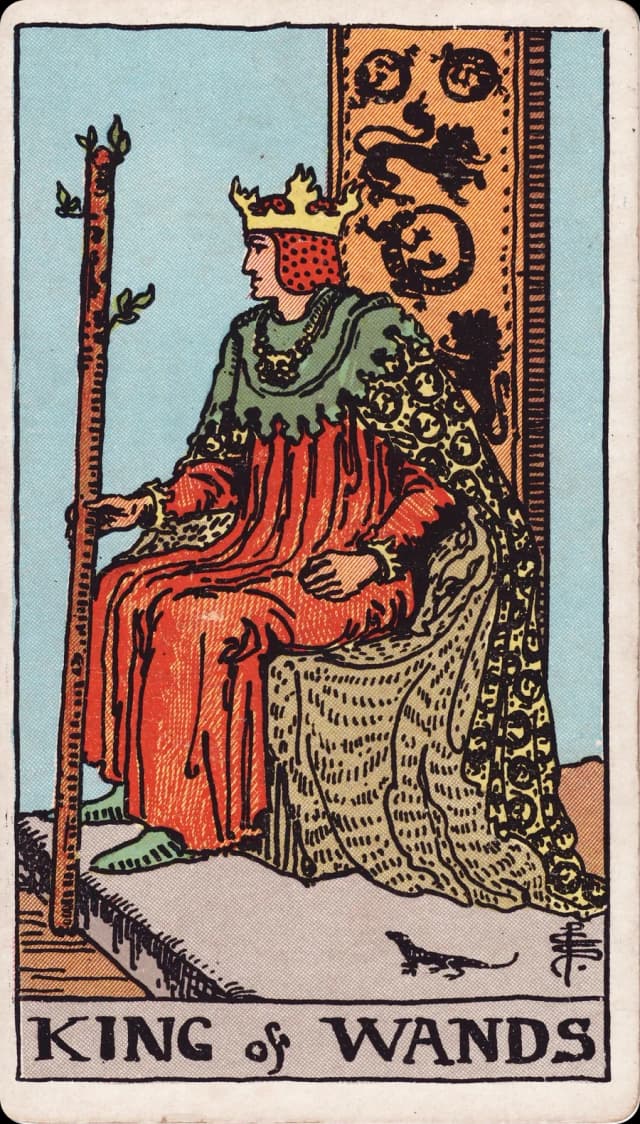
The physical and emotional nature to which this card is attributed is dark, ardent, lithe, animated, impassioned, noble. The King uplifts a flowering wand, and wears, like his three correspondences in the remaining suits, what is called a cap of maintenance beneath his crown. He connects with the symbol of the lion, which is emblazoned on the back of his throne. Divinatory Meanings: Dark man, friendly, countryman, generally married, honest and conscientious. The card always signifies honesty, and may mean news concerning an unexpected heritage to fall in before very long. Reversed: Good, but severe; austere, yet tolerant.
이 카드에 배정된 신체적·정서적 본성은 짙고, 열렬하고, 유연하고, 활기차고, 격정적이며, 고귀하다. 킹은 꽃이 핀 완드를 들어 올리고 있으며, 나머지 수트의 세 대응 인물과 마찬가지로 왕관 아래에 이른바 유지의 모자를 쓰고 있다. 그는 사자의 상징과 이어지는데, 그 사자는 그의 왕좌 등받이에 새겨져 있다. 점술 의미: 살빛이 짙은 남자, 다정하고, 시골 사람이며, 대개 기혼이고, 정직하고 양심적이다. 이 카드는 언제나 정직을 뜻하며, 머지않아 굴러들 뜻밖의 상속에 관한 소식을 뜻할 수도 있다. 역방향: 좋으나 엄격하다. 준엄하지만 너그럽다.
WANDS / Queen
완드 / 퀸
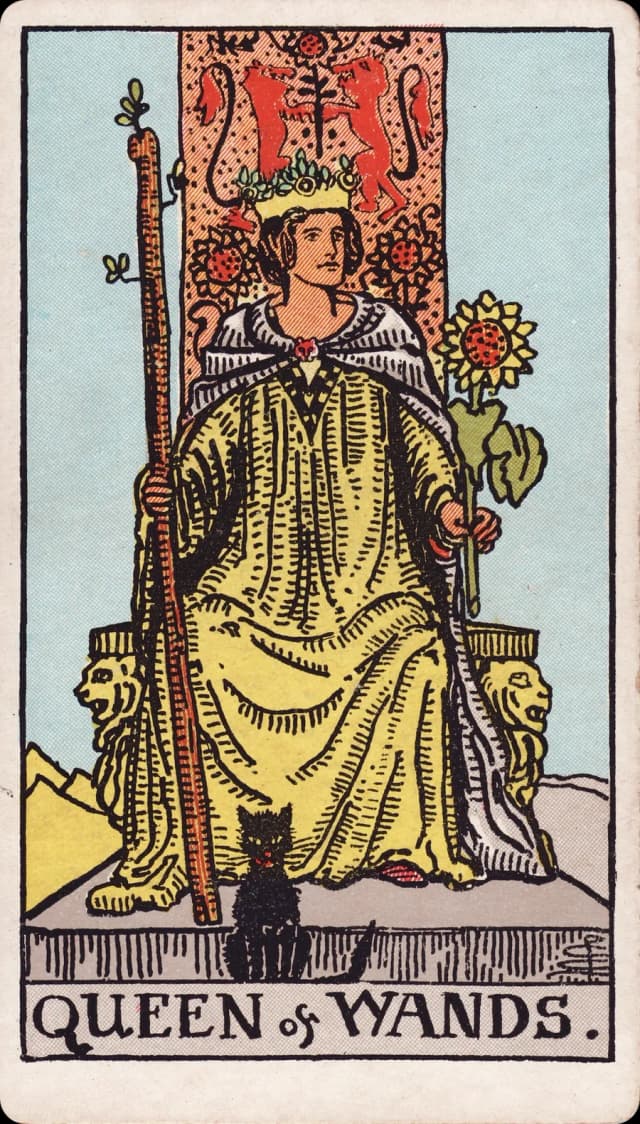
The Wands throughout this suit are always in leaf, as it is a suit of life and animation. Emotionally and otherwise, the Queen's personality corresponds to that of the King, but is more magnetic. Divinatory Meanings: A dark woman, countrywoman, friendly, chaste, loving, honourable. If the card beside her signifies a man, she is well disposed towards him; if a woman, she is interested in the Querent. Also, love of money, or a certain success in business. Reversed: Good, economical, obliging, serviceable. Signifies also—but in certain positions and in the neighbourhood of other cards tending in such directions—opposition, jealousy, even deceit and infidelity.
이 수트 전체에서 완드에는 늘 잎이 달려 있다. 생명과 활기의 수트이기 때문이다. 정서적으로도 그 밖의 면에서도 퀸의 인물됨은 킹의 그것과 대응하지만, 끌어당기는 힘이 더 강하다. 점술 의미: 살빛이 짙은 여자, 시골 여자, 다정하고, 정숙하고, 사랑이 많고, 명예롭다. 그녀 옆의 카드가 남자를 뜻한다면 그녀는 그에게 호의를 품고 있고, 여자를 뜻한다면 그녀는 질문자에게 관심이 있다. 또한 돈에 대한 애착, 또는 사업에서의 어떤 성공을 뜻하기도 한다. 역방향: 선량하고, 알뜰하고, 잘 도와주고, 쓸모가 있다. 다만 어떤 자리에서, 그리고 그런 방향으로 기우는 다른 카드들 곁에서는 반목, 질투, 나아가 기만과 부정까지 뜻하기도 한다.
WANDS / Knight
완드 / 나이트
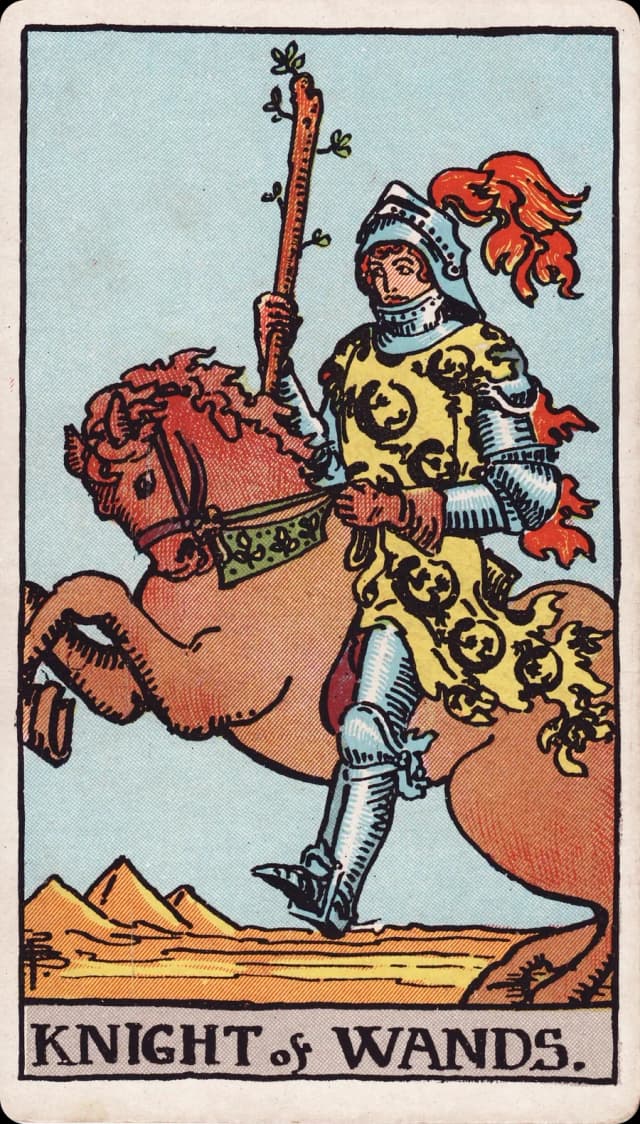
He is shewn as if upon a journey, armed with a short wand, and although mailed is not on a warlike errand. He is passing mounds or pyramids. The motion of the horse is a key to the character of its rider, and suggests the precipitate mood, or things connected therewith. Divinatory Meanings: Departure, absence, flight, emigration. A dark young man, friendly. Change of residence. Reversed: Rupture, division, interruption, discord.
그는 여정에 오른 듯한 모습으로 그려지며, 짧은 완드로 무장했고, 갑옷을 입었으나 싸우러 가는 길은 아니다. 그는 흙둔덕인지 피라미드인지를 지나고 있다. 말의 움직임이 그 기수의 성격을 여는 열쇠이며, 성급한 기분이나 그와 관련된 것들을 떠올리게 한다. 점술 의미: 떠남, 부재, 도피, 이주. 살빛이 짙은 젊은 남자로 다정하다. 거처의 변화. 역방향: 결렬, 분열, 중단, 불화.
WANDS / Page
완드 / 페이지
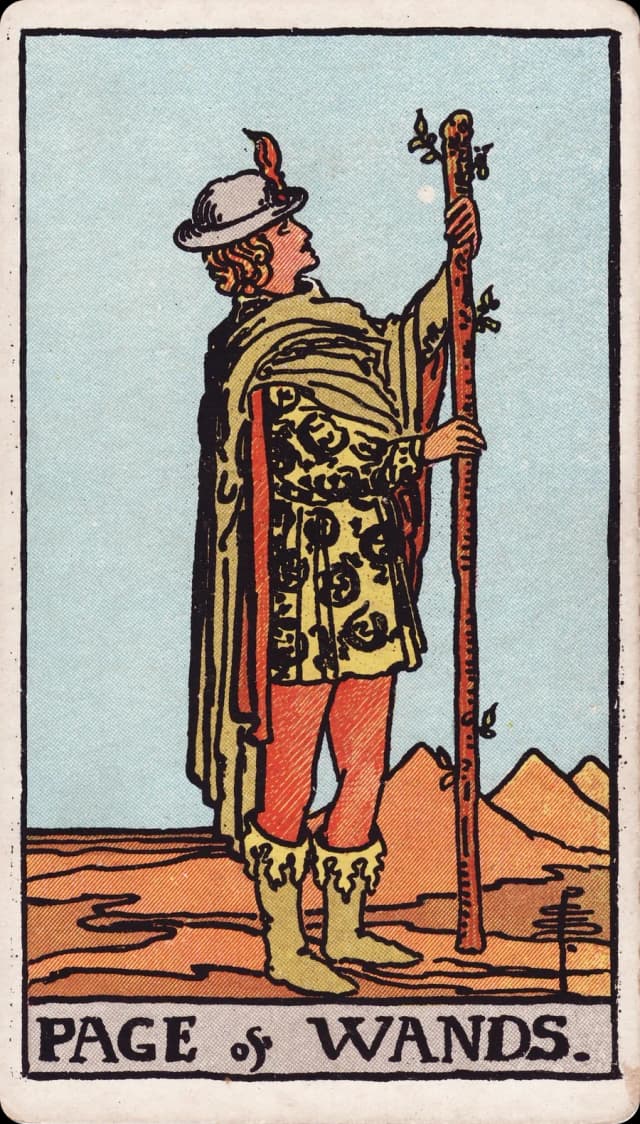
In a scene similar to the former, a young man stands in the act of proclamation. He is unknown but faithful, and his tidings are strange. Divinatory Meanings: Dark young man, faithful, a lover, an envoy, a postman. Beside a man, he will bear favourable testimony concerning him. A dangerous rival, if followed by the Page of Cups. Has the chief qualities of his suit. He may signify family intelligence. Reversed: Anecdotes, announcements, evil news. Also indecision and the instability which accompanies it.
앞과 비슷한 장면에서 한 젊은이가 무언가를 알리는 자세로 서 있다. 그는 알려지지 않았으나 신실하며, 그가 전하는 소식은 낯설다. 점술 의미: 살빛이 짙은 젊은 남자, 신실하며, 연인, 사절, 우편배달부. 남자 곁에 놓이면 그는 그 남자에 관해 호의적인 증언을 할 것이다. 컵 페이지가 뒤따르면 위험한 경쟁자다. 자기 수트의 주된 성질을 지닌다. 집안 소식을 뜻할 수도 있다. 역방향: 뜬소문, 통보, 나쁜 소식. 또한 우유부단함과 그에 따르는 불안정.
WANDS / Ten
완드 / 10
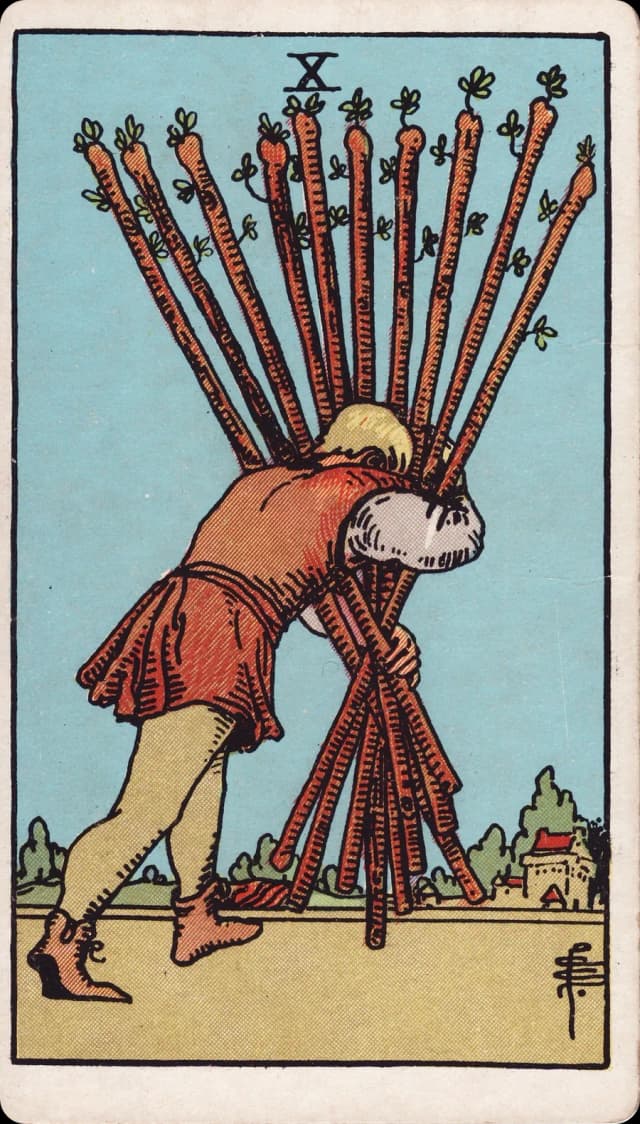
A man oppressed by the weight of the ten staves which he is carrying. Divinatory Meanings: A card of many significances, and some of the readings cannot be harmonized. I set aside that which connects it with honour and good faith. The chief meaning is oppression simply, but it is also fortune, gain, any kind of success, and then it is the oppression of these things. It is also a card of false-seeming, disguise, perfidy. The place which the figure is approaching may suffer from the rods that he carries. Success is stultified if the Nine of Swords follows, and if it is a question of a lawsuit, there will be certain loss. Reversed: Contrarieties, difficulties, intrigues, and their analogies.
한 남자가 자기가 지고 가는 열 개의 막대 무게에 짓눌려 있다. 점술 의미: 뜻이 여럿인 카드이고, 그 읽기 가운데 몇몇은 서로 조화되지 않는다. 나는 이 카드를 명예나 신의와 잇는 읽기는 제쳐 둔다. 주된 뜻은 그저 짓눌림이지만, 동시에 행운이자 이득이자 온갖 종류의 성공이기도 하며, 그럴 때는 바로 그것들에 짓눌리는 것이다. 또한 겉과 속이 다름, 위장, 배신의 카드이기도 하다. 그림 속 인물이 다가가고 있는 곳은 그가 지고 가는 막대 때문에 해를 입을 수도 있다. 소드 9가 뒤따르면 성공은 헛것이 되고, 소송이 걸린 문제라면 반드시 손실이 있을 것이다. 역방향: 어긋남, 곤란, 술책, 그리고 그와 비슷한 것들.
WANDS / Nine
완드 / 9
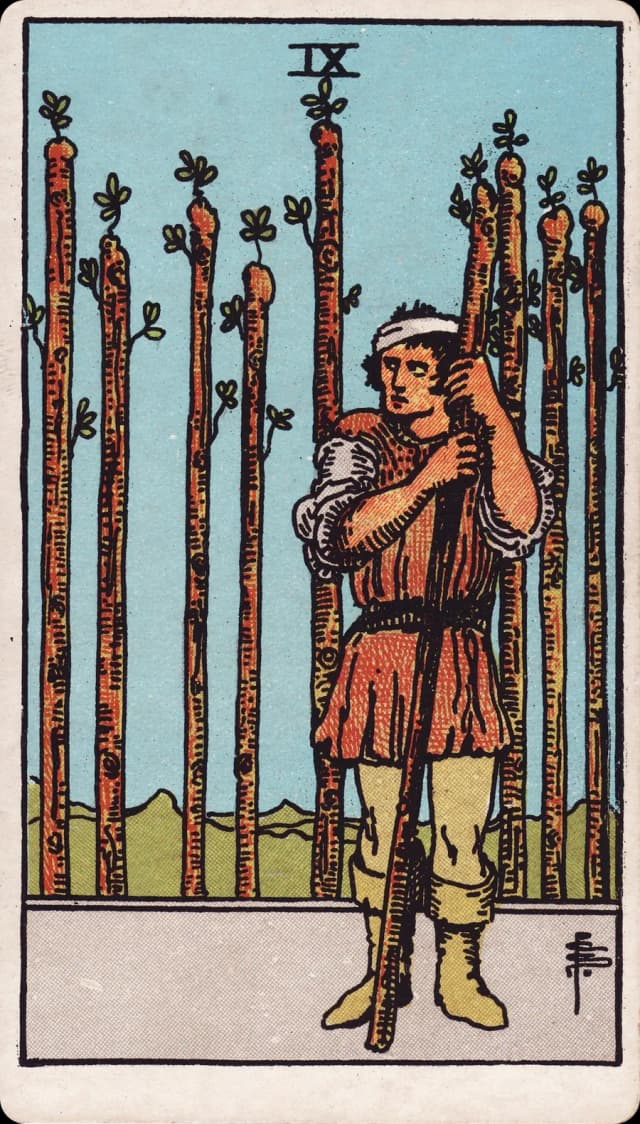
The figure leans upon his staff and has an expectant look, as if awaiting an enemy. Behind are eight other staves—erect, in orderly disposition, like a palisade. Divinatory Meanings: The card signifies strength in opposition. If attacked, the person will meet an onslaught boldly; and his build shews that he may prove a formidable antagonist. With this main significance there are all its possible adjuncts—delay, suspension, adjournment. Reversed: Obstacles, adversity, calamity.
인물은 자기 막대에 몸을 기댄 채, 적을 기다리기라도 하듯 무언가를 예상하는 표정을 짓고 있다. 뒤에는 여덟 개의 막대가 더 있는데, 곧게 서서 울타리처럼 가지런히 늘어서 있다. 점술 의미: 이 카드는 맞섬 속의 힘을 뜻한다. 공격을 받으면 그 사람은 그 공세를 담대히 맞을 것이고, 그의 체격은 그가 만만치 않은 적수임을 보여준다. 이 주된 뜻과 함께 그에 딸릴 수 있는 것들이 모두 온다 — 지연, 보류, 연기. 역방향: 장애, 역경, 재난.
WANDS / Eight
완드 / 8
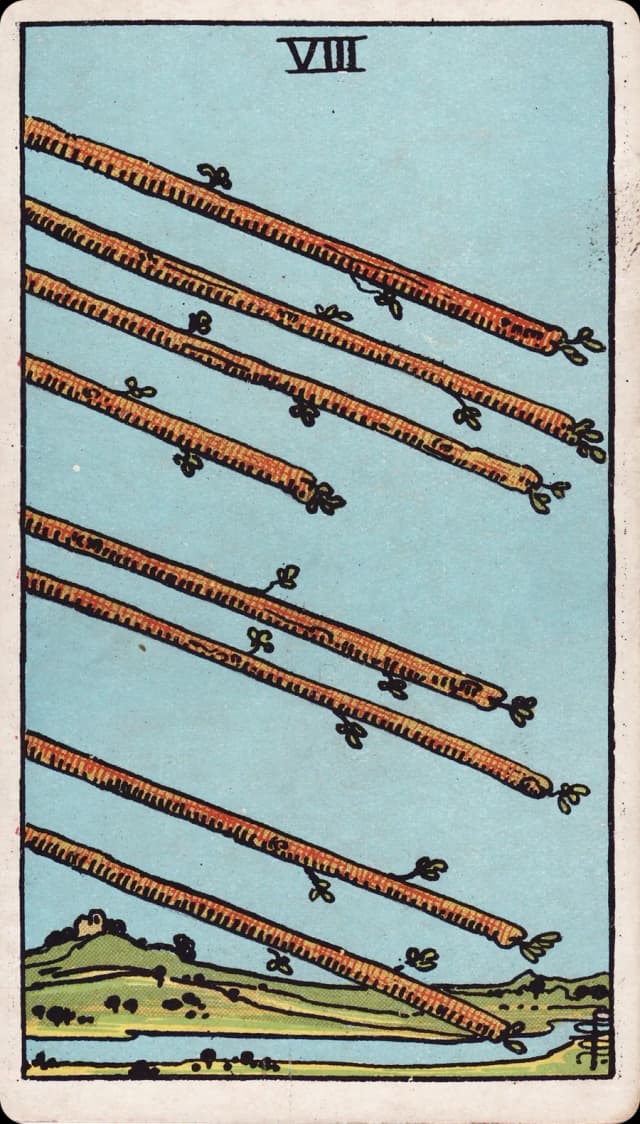
The card represents motion through the immovable—a flight of wands through an open country; but they draw to the term of their course. That which they signify is at hand; it may be even on the threshold. Divinatory Meanings: Activity in undertakings, the path of such activity, swiftness, as that of an express messenger; great haste, great hope, speed towards an end which promises assured felicity; generally, that which is on the move; also the arrows of love. Reversed: Arrows of jealousy, internal dispute, stingings of conscience, quarrels; and domestic disputes for persons who are married.
이 카드는 움직이지 않는 것을 가로지르는 움직임을 나타낸다 — 트인 들판을 지나는 완드들의 비행이다. 다만 그것들은 제 항로의 끝에 다가가고 있다. 그것들이 뜻하는 바는 가까이 와 있으며, 어쩌면 문턱에 이르렀는지도 모른다. 점술 의미: 일을 벌이는 활동, 그 활동이 나아가는 길, 신속함 — 급사(急使)의 그것처럼. 큰 서두름, 큰 희망, 확실한 행복을 약속하는 끝을 향한 속도. 대체로 움직이고 있는 것. 또한 사랑의 화살들. 역방향: 질투의 화살, 내부의 다툼, 양심의 찔림, 언쟁. 그리고 기혼자에게는 집안의 다툼.
WANDS / Seven
완드 / 7
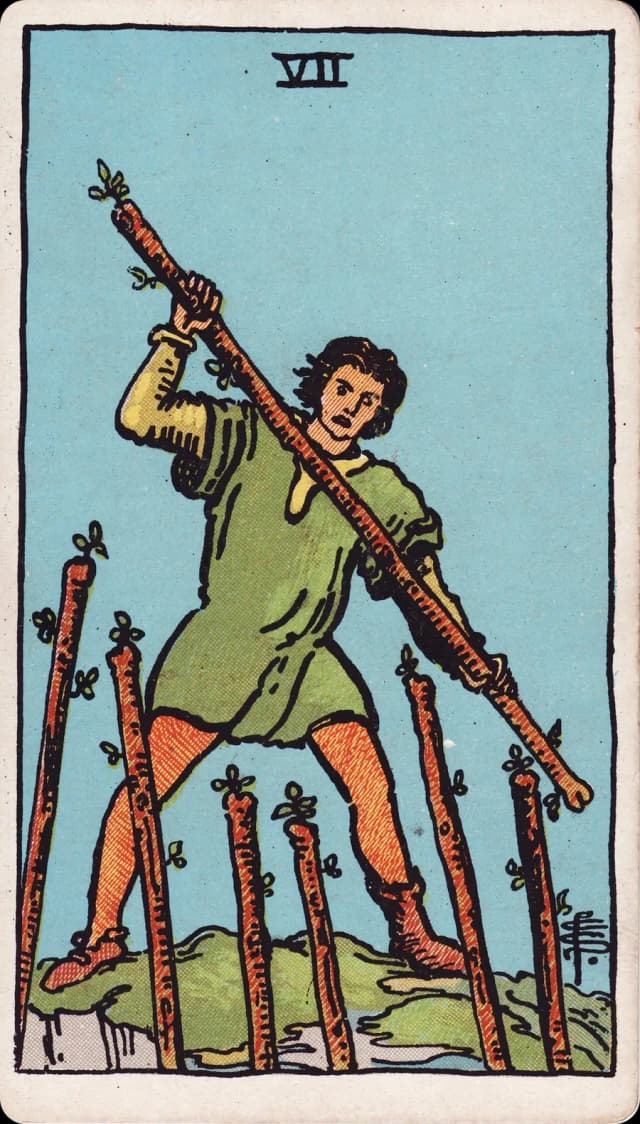
A young man on a craggy eminence brandishing a staff; six other staves are raised towards him from below. Divinatory Meanings: It is a card of valour, for, on the surface, six are attacking one, who has, however, the vantage position. On the intellectual plane, it signifies discussion, wordy strife; in business—negotiations, war of trade, barter, competition. It is further a card of success, for the combatant is on the top and his enemies may be unable to reach him. Reversed: Perplexity, embarrassments, anxiety. It is also a caution against indecision.
바위투성이 높은 곳에 선 젊은이가 막대를 휘두르고 있고, 아래에서 여섯 개의 막대가 그를 향해 치켜올려져 있다. 점술 의미: 이것은 용맹의 카드다. 겉보기로는 여섯이 하나를 치고 있지만 그 하나가 유리한 자리를 차지하고 있기 때문이다. 지성의 층위에서는 논쟁, 말싸움을 뜻하고, 사업에서는 협상, 장사의 전쟁, 흥정, 경쟁을 뜻한다. 나아가 성공의 카드이기도 한데, 싸우는 이가 꼭대기에 있어 적들이 그에게 닿지 못할 수 있기 때문이다. 역방향: 당혹, 난처함, 불안. 또한 우유부단에 대한 경고이기도 하다.
WANDS / Six
완드 / 6
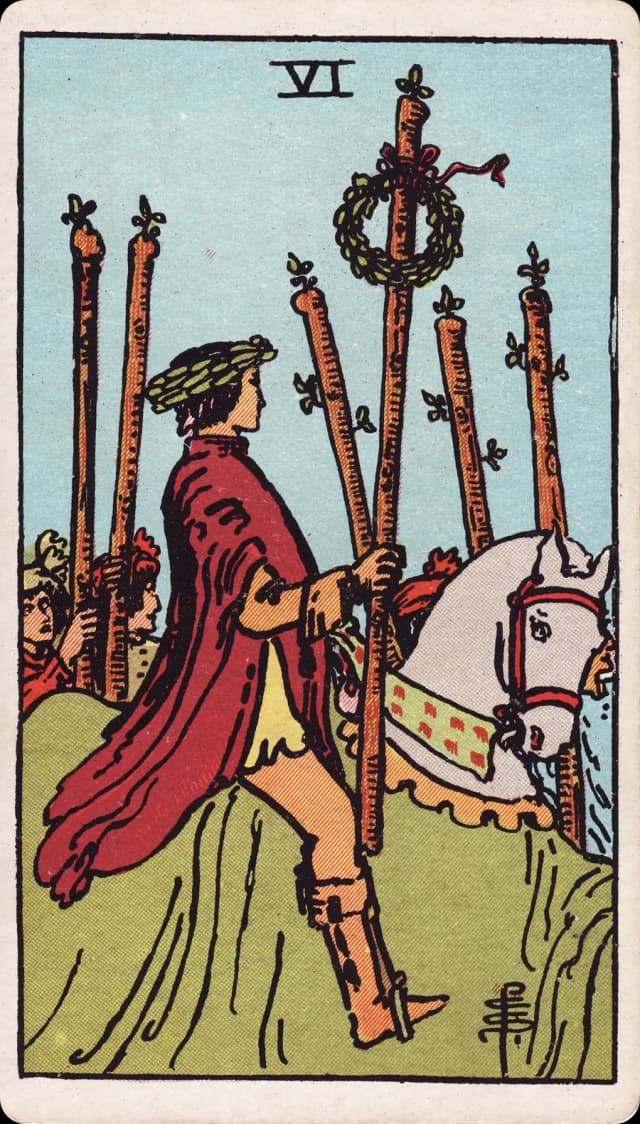
A laurelled horseman bears one staff adorned with a laurel crown; footmen with staves are at his side. Divinatory Meanings: The card has been so designed that it can cover several significations; on the surface, it is a victor triumphing, but it is also great news, such as might be carried in state by the King's courier; it is expectation crowned with its own desire, the crown of hope, and so forth. Reversed: Apprehension, fear, as of a victorious enemy at the gate; treachery, disloyalty, as of gates being opened to the enemy; also indefinite delay.
월계관을 쓴 기수가 월계관으로 장식된 막대 하나를 들고 있고, 막대를 든 보병들이 그 곁에 있다. 점술 의미: 이 카드는 여러 뜻을 아우를 수 있도록 도안되었다. 겉으로는 개선하는 승리자이지만, 동시에 왕의 전령이 격식을 갖추어 전할 법한 큰 소식이기도 하다. 제 바람으로 관을 쓴 기대, 희망의 관, 그런 것들이다. 역방향: 성문 앞에 승리한 적이 온 듯한 우려와 두려움. 성문이 적에게 열리는 듯한 배신과 불충. 또한 기약 없는 지연.
WANDS / Five
완드 / 5
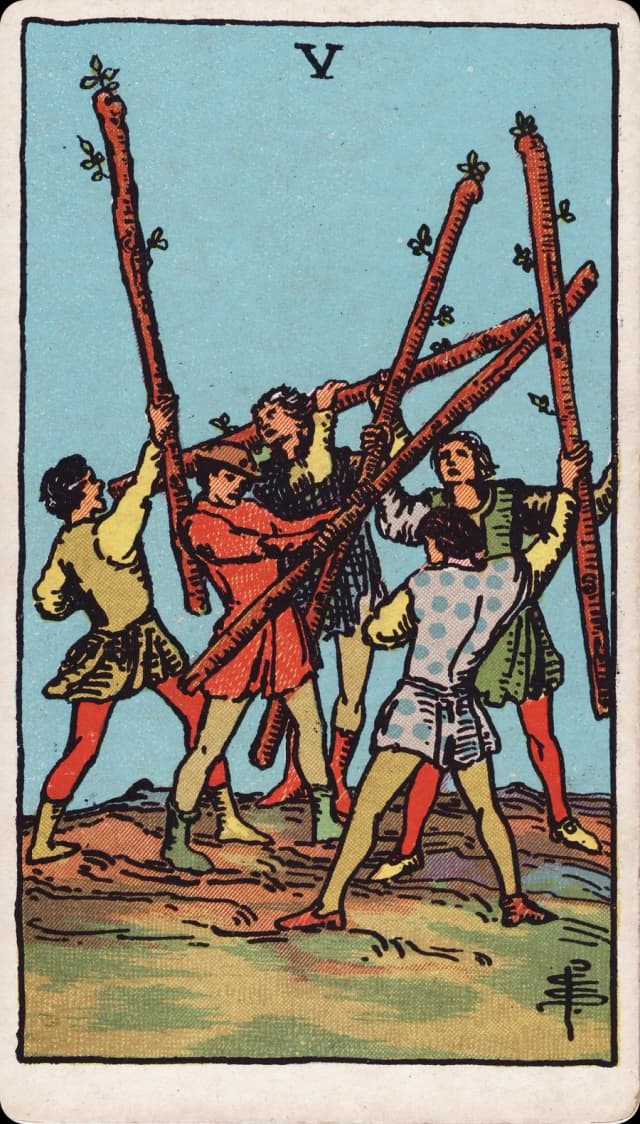
A posse of youths, who are brandishing staves, as if in sport or strife. It is mimic warfare, and hereto correspond the Divinatory Meanings: Imitation, as, for example, sham fight, but also the strenuous competition and struggle of the search after riches and fortune. In this sense it connects with the battle of life. Hence some attributions say that it is a card of gold, gain, opulence. Reversed: Litigation, disputes, trickery, contradiction.
한 무리의 젊은이들이 놀이인지 다툼인지 모를 모양으로 막대를 휘두르고 있다. 흉내 낸 싸움이며, 여기에 점술 의미: 가 대응한다. 모방 — 예컨대 모의 전투 같은 것. 그러나 부와 행운을 좇는 치열한 경쟁과 분투이기도 하다. 이런 뜻에서 그것은 삶의 싸움과 이어진다. 그래서 어떤 배정들은 이것을 금, 이득, 부유의 카드라고 말한다. 역방향: 소송, 분쟁, 속임수, 반박.
WANDS / Four
완드 / 4
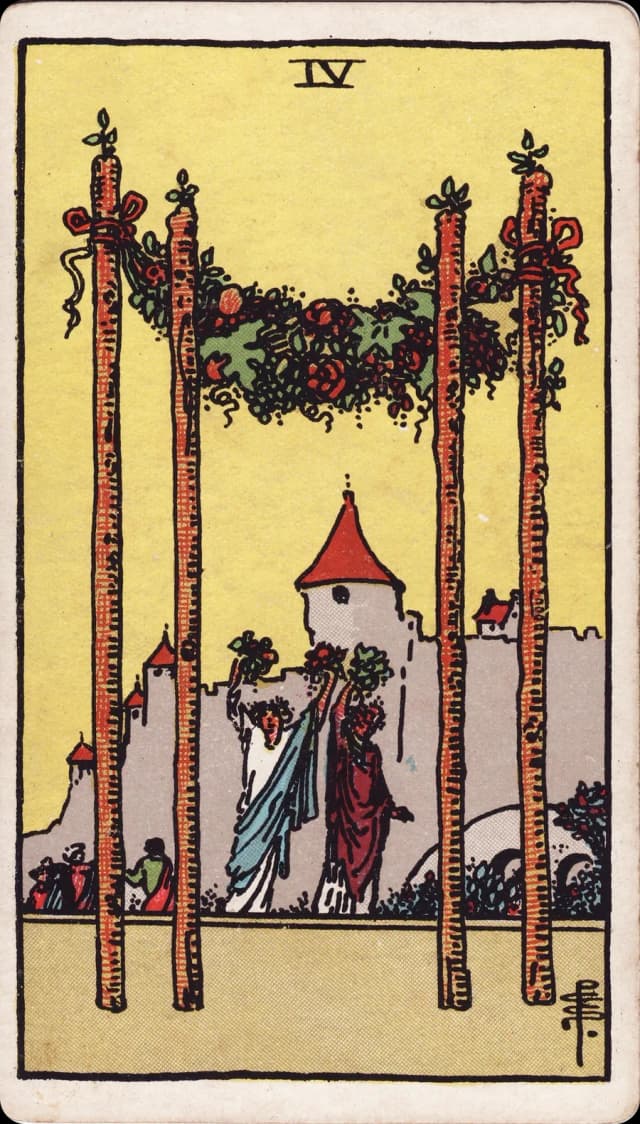
From the four great staves planted in the foreground there is a great garland suspended; two female figures uplift nose-gays; at their side is a bridge over a moat, leading to an old manorial house. Divinatory Meanings: They are for once almost on the surface—country life, haven of refuge, a species of domestic harvest-home, repose, concord, harmony, prosperity, peace, and the perfected work of these. Reversed: The meaning remains unaltered; it is prosperity, increase, felicity, beauty, embellishment.
앞쪽에 세워진 네 개의 큰 막대에 커다란 화환이 걸려 있고, 두 여인이 꽃다발을 들어 올리고 있다. 그들 옆에는 해자를 건너는 다리가 있어 오래된 장원 저택으로 이어진다. 점술 의미: 이번만은 뜻이 거의 표면에 있다 — 시골살이, 피난처, 일종의 집안 추수잔치, 쉼, 화합, 조화, 번영, 평화, 그리고 이것들이 이루어 낸 결실. 역방향: 뜻이 달라지지 않는다. 번영, 늘어남, 행복, 아름다움, 꾸밈이다.
WANDS / Three
완드 / 3
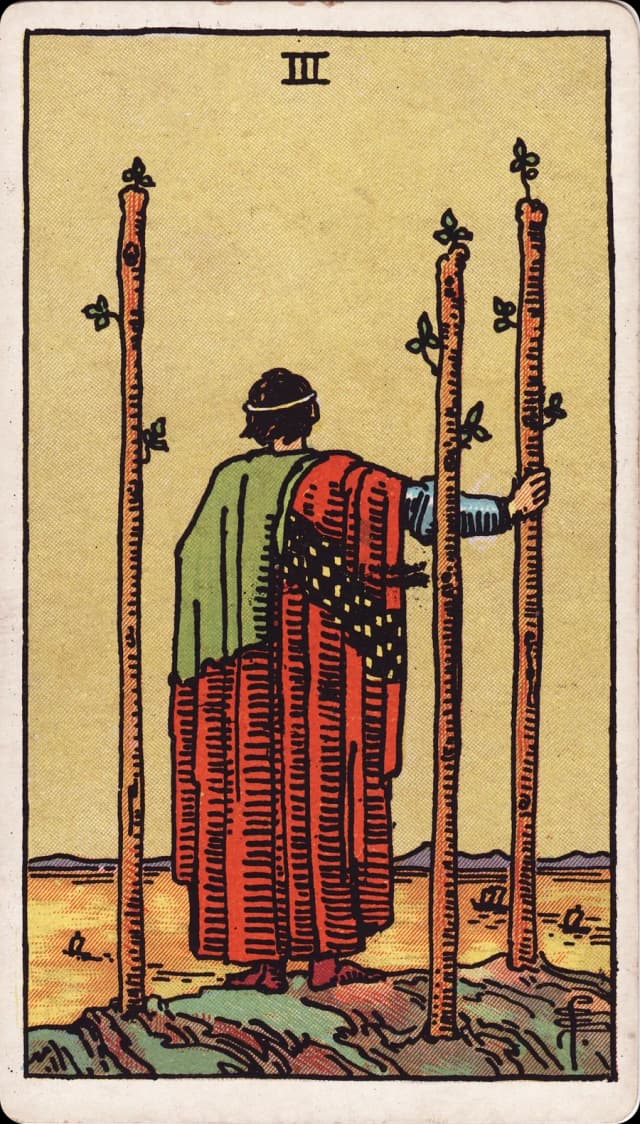
A calm, stately personage, with his back turned, looking from a cliff's edge at ships passing over the sea. Three staves are planted in the ground, and he leans slightly on one of them. Divinatory Meanings: He symbolizes established strength, enterprise, effort, trade, commerce, discovery; those are his ships, bearing his merchandise, which are sailing over the sea. The card also signifies able co-operation in business, as if the successful merchant prince were looking from his side towards yours with a view to help you. Reversed: The end of troubles, suspension or cessation of adversity, toil and disappointment.
차분하고 위엄 있는 인물이 등을 돌린 채 벼랑 끝에서 바다 위를 지나가는 배들을 바라보고 있다. 세 개의 막대가 땅에 꽂혀 있고 그는 그중 하나에 살짝 기대어 있다. 점술 의미: 그는 자리 잡은 힘, 진취, 노력, 장사, 상업, 발견을 상징한다. 바다 위를 지나는 저 배들은 그의 배이고 그의 상품을 싣고 있다. 이 카드는 사업에서의 유능한 협력을 뜻하기도 하는데, 마치 성공한 상인 군주가 제 쪽에서 당신 쪽을 바라보며 도우려 하는 것과 같다. 역방향: 곤경의 끝, 역경과 노고와 실망의 중단 또는 멎음.
WANDS / Two
완드 / 2
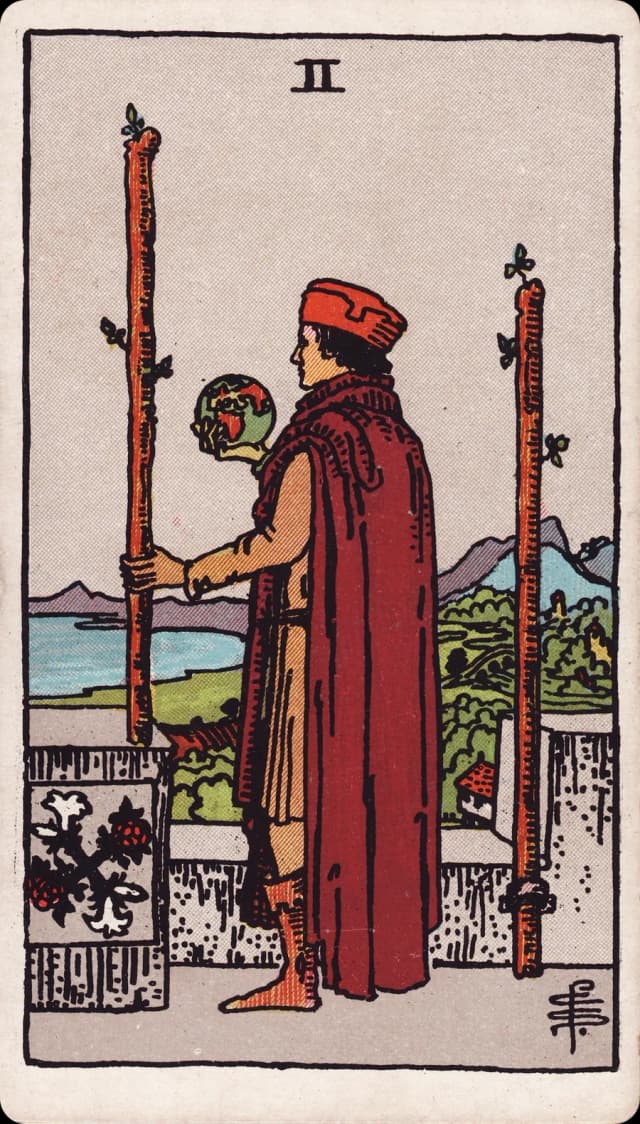
A tall man looks from a battlemented roof over sea and shore; he holds a globe in his right hand, while a staff in his left rests on the battlement; another is fixed in a ring. The Rose and Cross and Lily should be noticed on the left side. Divinatory Meanings: Between the alternative readings there is no marriage possible; on the one hand, riches, fortune, magnificence; on the other, physical suffering, disease, chagrin, sadness, mortification. The design gives one suggestion; here is a lord overlooking his dominion and alternately contemplating a globe; it looks like the malady, the mortification, the sadness of Alexander amidst the grandeur of this world's wealth. Reversed: Surprise, wonder, enchantment, emotion, trouble, fear.
키 큰 남자가 총안이 난 지붕에서 바다와 해안을 내다본다. 오른손에는 구(球)를 들고, 왼손의 막대는 흉벽에 기대어 있으며, 또 하나는 고리에 고정되어 있다. 왼편의 장미와 십자와 백합을 눈여겨봐야 한다. 점술 의미: 갈리는 두 읽기 사이에는 화해가 불가능하다. 한쪽에는 부, 행운, 화려함이 있고, 다른 쪽에는 육체의 고통, 질병, 비통, 슬픔, 굴욕이 있다. 도안은 한 가지 실마리를 준다. 여기 한 군주가 자기 영지를 내려다보며 번갈아 구를 응시한다. 이 세상 부의 웅장함 한가운데서 알렉산드로스가 겪은 병증과 굴욕과 슬픔처럼 보인다. 역방향: 놀라움, 경이, 홀림, 격정, 곤경, 두려움.
WANDS / Ace
완드 / 에이스
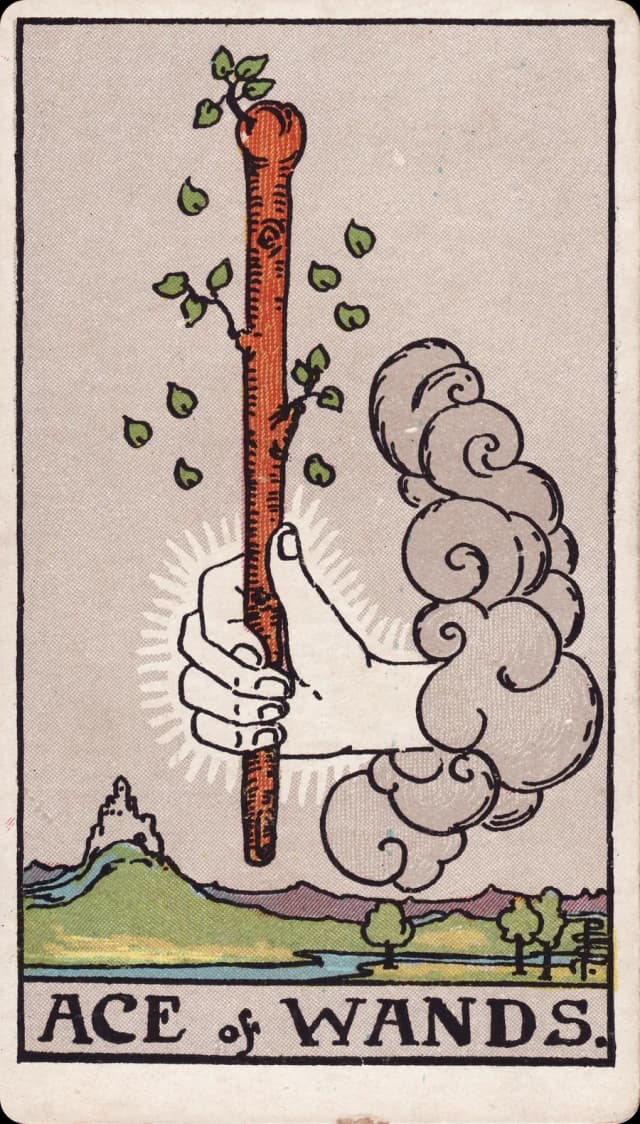
A hand issuing from a cloud grasps a stout wand or club. Divinatory Meanings: Creation, invention, enterprise, the powers which result in these; principle, beginning, source; birth, family, origin, and in a sense the virility which is behind them; the starting point of enterprises; according to another account, money, fortune, inheritance. Reversed: Fall, decadence, ruin, perdition, to perish; also a certain clouded joy.
구름에서 나온 손이 굵은 완드 또는 몽둥이를 움켜쥐고 있다. 점술 의미: 창조, 발명, 진취, 그리고 이것들을 낳는 힘들. 원리, 시작, 근원. 태어남, 가족, 기원, 그리고 어떤 뜻에서는 그 뒤에 있는 사내다움. 일을 벌이는 출발점. 다른 설명에 따르면 돈, 재산, 상속. 역방향: 몰락, 쇠퇴, 파멸, 멸망, 스러짐. 또한 어딘가 흐려진 기쁨.
THE SUIT OF CUPS / King
컵 수트 / 킹
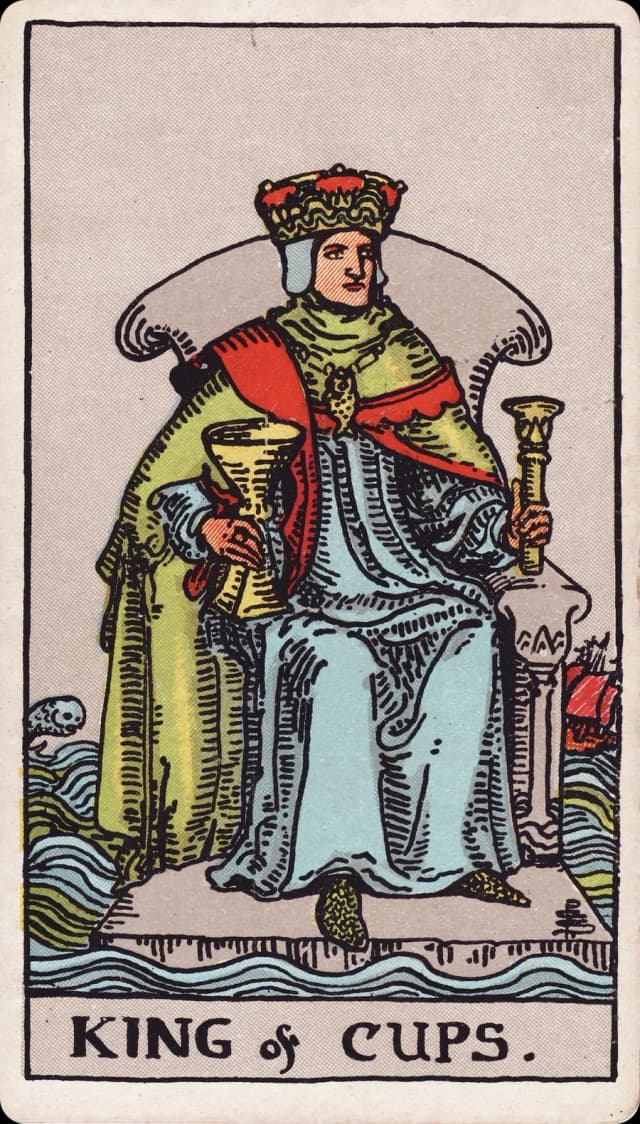
He holds a short sceptre in his left hand and a great cup in his right; his throne is set upon the sea; on one side a ship is riding and on the other a dolphin is leaping. The implicit is that the Sign of the Cup naturally refers to water, which appears in all the court cards. Divinatory Meanings: Fair man, man of business, law, or divinity; responsible, disposed to oblige the Querent; also equity, art and science, including those who profess science, law and art; creative intelligence. Reversed: Dishonest, double-dealing man; roguery, exaction, injustice, vice, scandal, pillage, considerable loss.
그는 왼손에 짧은 홀을, 오른손에 커다란 잔을 들고 있다. 그의 왕좌는 바다 위에 놓여 있고, 한쪽에서는 배가 떠 있고 다른 쪽에서는 돌고래가 뛰어오른다. 함축된 바는 컵이라는 표징이 자연히 물을 가리킨다는 것이며, 물은 모든 궁정 카드에 나타난다. 점술 의미: 살빛이 밝은 남자, 사업이나 법률 또는 신학에 종사하는 남자. 책임감이 있고 질문자에게 호의를 베풀 마음이 있다. 또한 공정, 예술과 학문, 그리고 학문·법률·예술을 업으로 삼는 이들. 창조하는 지성. 역방향: 정직하지 못하고 이중으로 처신하는 남자. 사기, 갈취, 불의, 악덕, 추문, 약탈, 상당한 손실.
CUPS / Queen
컵 / 퀸
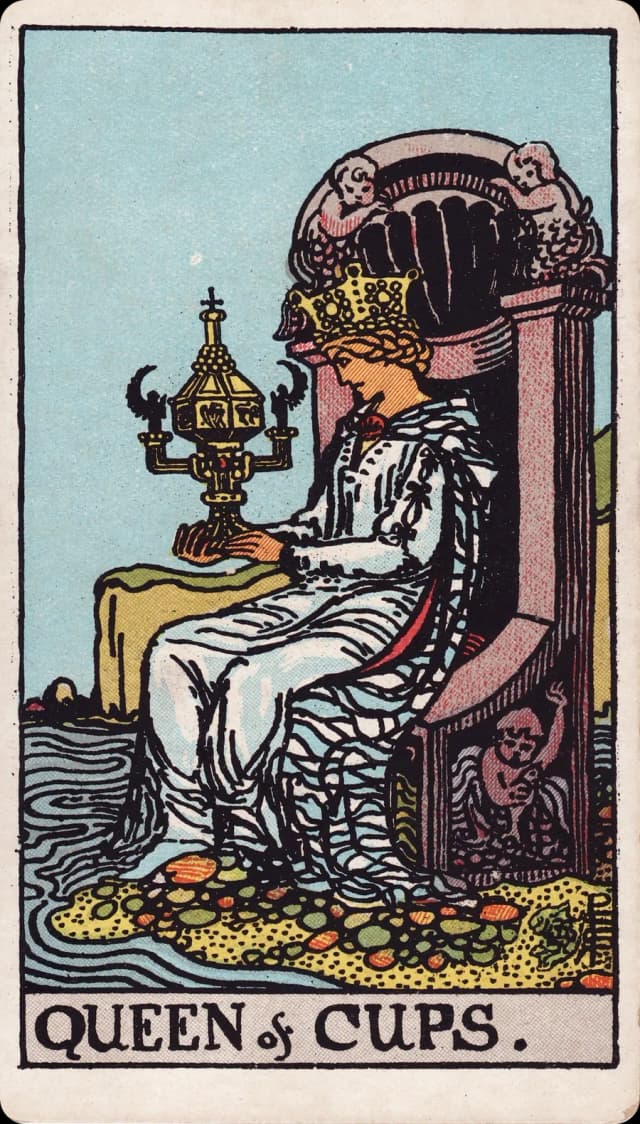
Beautiful, fair, dreamy—as one who sees visions in a cup. This is, however, only one of her aspects; she sees, but she also acts, and her activity feeds her dream. Divinatory Meanings: Good, fair woman; honest, devoted woman, who will do service to the Querent; loving intelligence, and hence the gift of vision; success, happiness, pleasure; also wisdom, virtue; a perfect spouse and a good mother. Reversed: The accounts vary; good woman; otherwise, distinguished woman but one not to be trusted; perverse woman; vice, dishonour, depravity.
아름답고, 살빛이 밝고, 꿈꾸는 듯하다 — 잔 속에서 환영을 보는 사람처럼. 다만 이것은 그녀의 여러 면 가운데 하나일 뿐이다. 그녀는 보기도 하지만 행하기도 하며, 그 행함이 그녀의 꿈을 먹여 살린다. 점술 의미: 선량하고 살빛이 밝은 여자. 정직하고 헌신적이며 질문자에게 도움이 될 여자. 사랑하는 지성, 그리고 거기서 오는 봄(見)의 재능. 성공, 행복, 즐거움. 또한 지혜와 덕. 더할 나위 없는 배우자이자 좋은 어머니. 역방향: 설명이 갈린다. 선량한 여자라고도 하고, 그렇지 않으면 뛰어나지만 믿을 수는 없는 여자, 비뚤어진 여자, 악덕, 불명예, 타락이라고도 한다.
CUPS / Knight
컵 / 나이트
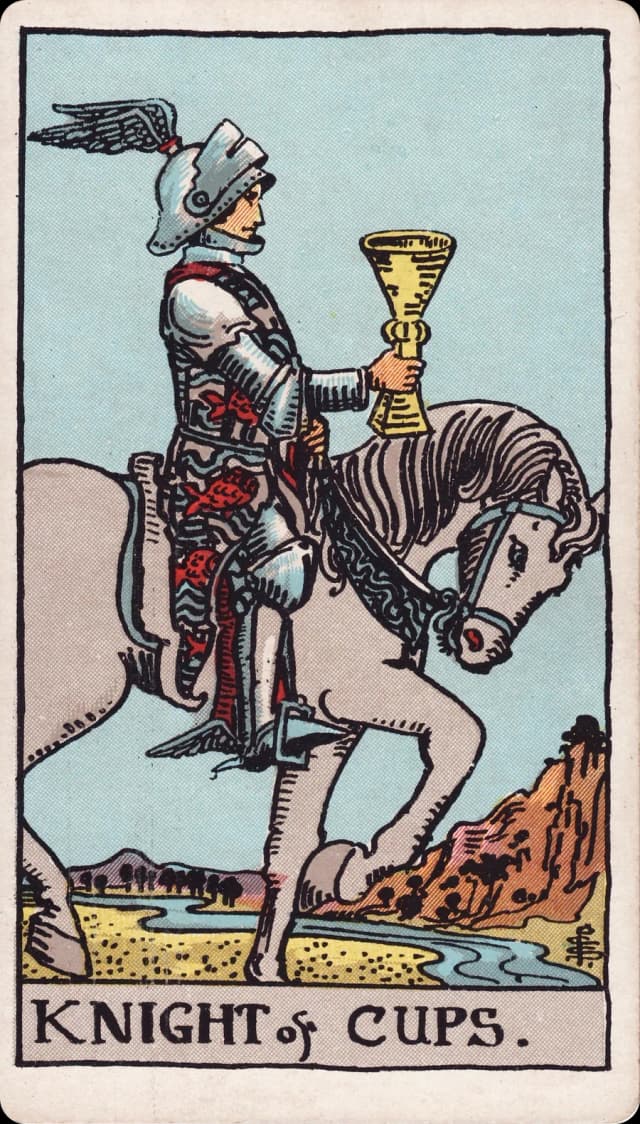
Graceful, but not warlike; riding quietly, wearing a winged helmet, referring to those higher graces of the imagination which sometimes characterize this card. He too is a dreamer, but the images of the side of sense haunt him in his vision. Divinatory Meanings: Arrival, approach—sometimes that of a messenger; advances, proposition, demeanour, invitation, incitement. Reversed: Trickery, artifice, subtlety, swindling, duplicity, fraud.
우아하되 호전적이지 않다. 조용히 말을 몰며 날개 달린 투구를 쓰고 있는데, 이는 이 카드를 이따금 특징짓는 상상력의 더 높은 우아함을 가리킨다. 그 또한 꿈꾸는 자이지만, 감각 쪽의 심상들이 그의 환영 속을 맴돈다. 점술 의미: 도착, 다가옴 — 때로는 전령의 그것. 접근, 제안, 처신, 초대, 부추김. 역방향: 속임수, 술책, 교묘함, 사취, 표리부동, 기만.
CUPS / Page
컵 / 페이지
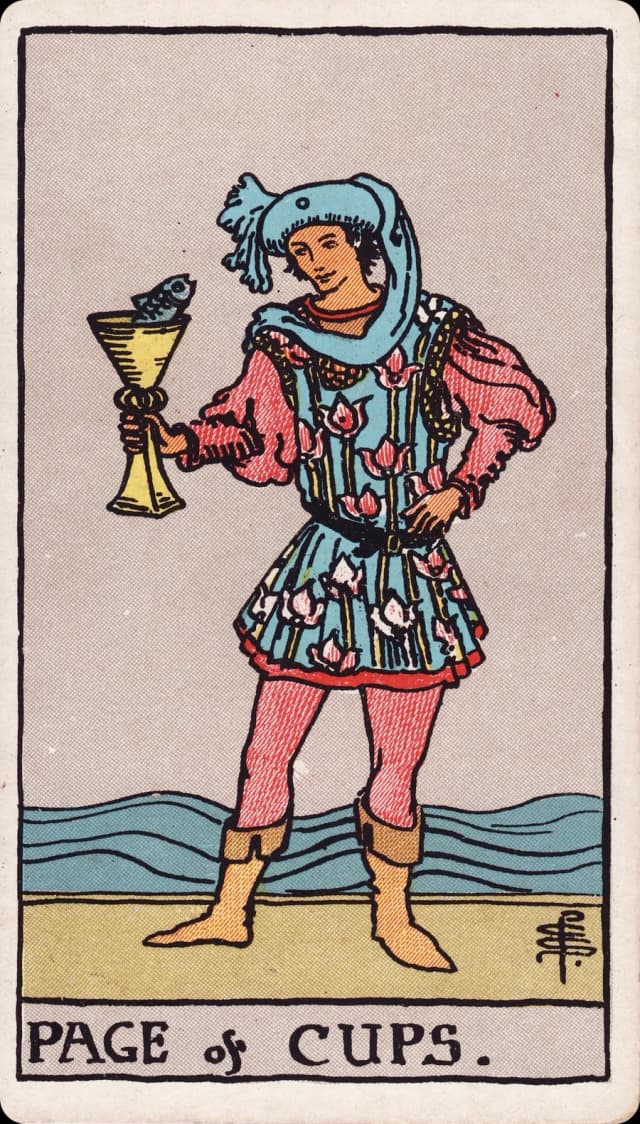
A fair, pleasing, somewhat effeminate page, of studious and intent aspect, contemplates a fish rising from a cup to look at him. It is the pictures of the mind taking form. Divinatory Meanings: Fair young man, one impelled to render service and with whom the Querent will be connected; a studious youth; news, message; application, reflection, meditation; also these things directed to business. Reversed: Taste, inclination, attachment, seduction, deception, artifice.
살빛이 밝고 보기 좋으며 다소 여성스러운 시동이 학구적이고 골똘한 표정으로, 잔에서 솟아올라 자기를 바라보는 물고기를 응시한다. 마음의 그림들이 형태를 갖추는 장면이다. 점술 의미: 살빛이 밝은 젊은 남자로, 도움을 베풀고 싶어 하며 질문자와 인연이 닿을 사람. 학구적인 젊은이. 소식, 전언. 몰두, 숙고, 명상. 또한 이것들이 사업 쪽으로 향한 것. 역방향: 취향, 끌림, 애착, 유혹, 기만, 술책.
CUPS / Ten
컵 / 10
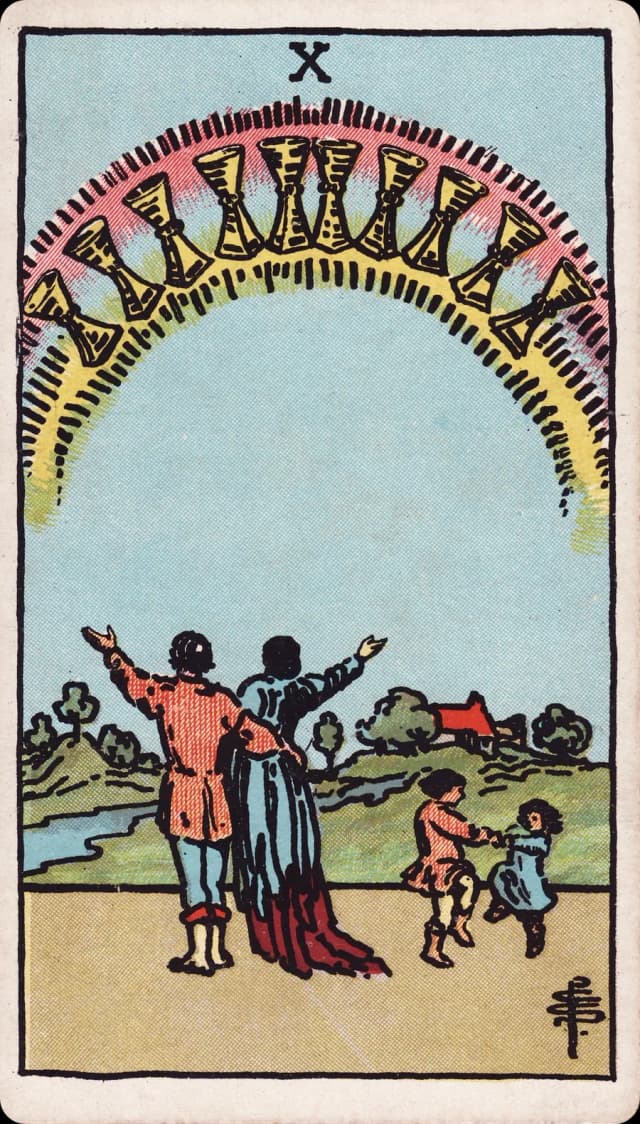
Appearance of Cups in a rainbow; it is contemplated in wonder and ecstacy by a man and woman below, evidently husband and wife. His right arm is about her; his left is raised upward; she raises her right arm. The two children dancing near them have not observed the prodigy but are happy after their own manner. There is a home-scene beyond. Divinatory Meanings: Contentment, repose of the entire heart; the perfection of that state; also perfection of human love and friendship; if with several picture-cards, a person who is taking charge of the Querent's interests; also the town, village or country inhabited by the Querent. Reversed: Repose of the false heart, indignation, violence.
무지개 속에 잔들이 나타나고, 아래에서 한 남자와 여자가 — 보아하니 부부다 — 경이와 황홀 속에 그것을 바라본다. 그의 오른팔은 그녀를 감쌌고 왼팔은 위로 들려 있으며, 그녀는 오른팔을 들어 올린다. 그들 곁에서 춤추는 두 아이는 이 신기한 광경을 보지 못했지만 저희 나름으로 행복하다. 그 너머로 살림집 풍경이 있다. 점술 의미: 흡족함, 온 마음의 쉼, 그 상태의 완성. 또한 인간의 사랑과 우정의 완성. 그림 카드가 여럿 함께 나오면 질문자의 이익을 돌보고 있는 사람. 또한 질문자가 사는 도시나 마을이나 고장. 역방향: 거짓된 마음의 쉼, 분노, 폭력.
CUPS / Nine
컵 / 9
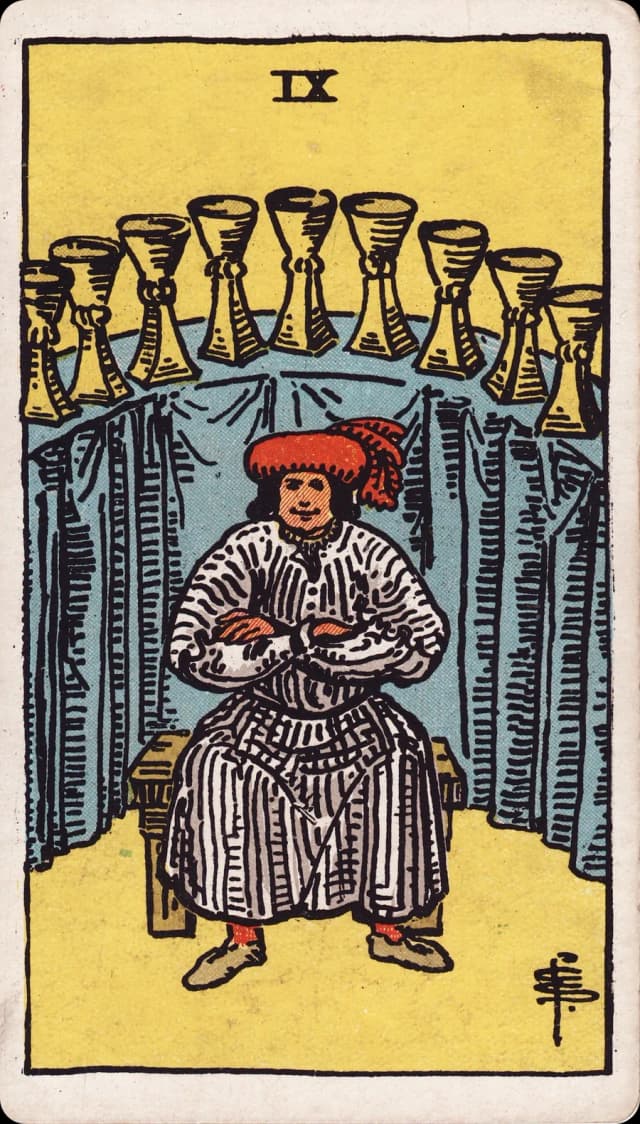
A goodly personage has feasted to his heart's content, and abundant refreshment of wine is on the arched counter behind him, seeming to indicate that the future is also assured. The picture offers the material side only, but there are other aspects. Divinatory Meanings: Concord, contentment, physical bien-être; also victory, success, advantage; satisfaction for the Querent or person for whom the consultation is made. Reversed: Truth, loyalty, liberty; but the readings vary and include mistakes, imperfections, etc.
풍채 좋은 인물이 마음껏 잔치를 벌였고, 그 뒤 아치형 대(臺) 위에는 술이 넉넉히 놓여 있어 앞날 또한 보장된 듯 보인다. 이 그림은 물질적인 면만을 내놓지만 다른 측면들도 있다. 점술 의미: 화합, 흡족함, 몸의 안락(bien-être). 또한 승리, 성공, 이득. 질문자 또는 이 문의의 당사자에게 돌아오는 만족. 역방향: 진실, 충직, 자유. 다만 읽기가 갈리며 실수와 결함 따위도 포함한다.
CUPS / Eight
컵 / 8
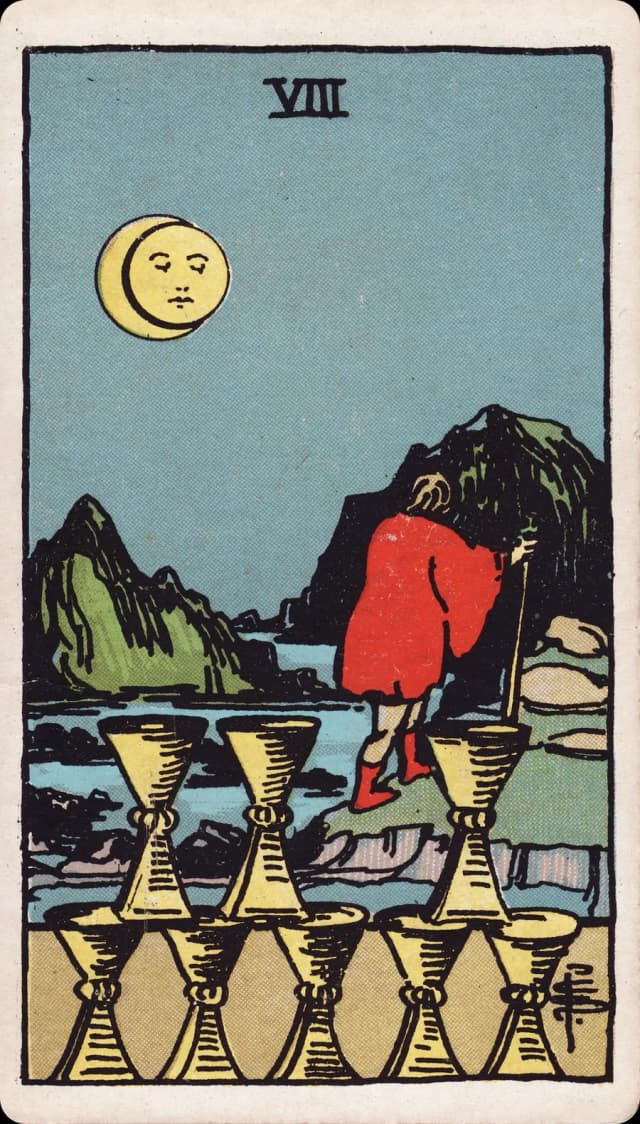
A man of dejected aspect is deserting the cups of his felicity, enterprise, under-taking or previous concern. Divinatory Meanings: The card speaks for itself on the surface, but other readings are entirely antithetical—giving joy, mildness, timidity, honour, modesty. In practice, it is usually found that the card shews the decline of a matter, or that a matter which has been thought to be important is really of slight consequence—either for good or evil. Reversed: Great joy, happiness, feasting.
낙심한 기색의 남자가 자기 행복이나 사업, 착수한 일, 혹은 이제까지의 관심사였던 잔들을 버리고 떠나고 있다. 점술 의미: 이 카드는 겉으로는 스스로 말하지만, 다른 읽기들은 정반대다 — 기쁨, 온화함, 소심함, 명예, 겸손을 준다. 실제로 다뤄 보면 이 카드는 대개 어떤 일이 사그라들고 있음을, 또는 중요하다고 여겨 온 일이 실은 — 좋은 쪽으로든 나쁜 쪽으로든 — 별것 아님을 보여준다. 역방향: 큰 기쁨, 행복, 잔치.
CUPS / Seven
컵 / 7
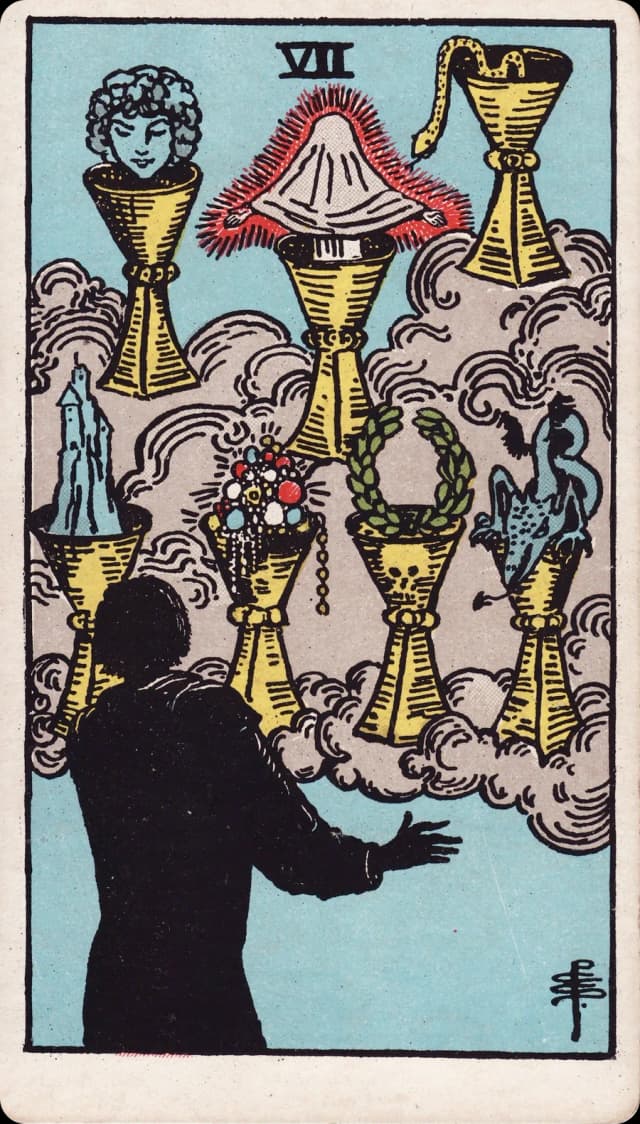
Strange chalices of vision, but the images are more especially those of the fantastic spirit. Divinatory Meanings: Fairy favours, images of reflection, sentiment, imagination, things seen in the glass of contemplation; some attainment in these degrees, but nothing permanent or substantial is suggested. Reversed: Desire, will, determination, project.
환영이 담긴 기이한 잔들이다. 다만 그 심상들은 특히 공상하는 정신의 것이다. 점술 의미: 요정의 호의, 비침의 심상들, 정감, 상상, 관상의 거울에 비친 것들. 이런 층위에서의 어떤 도달이 있으나, 지속적이거나 실질적인 것은 시사되지 않는다. 역방향: 욕구, 의지, 결단, 계획.
CUPS / Six
컵 / 6
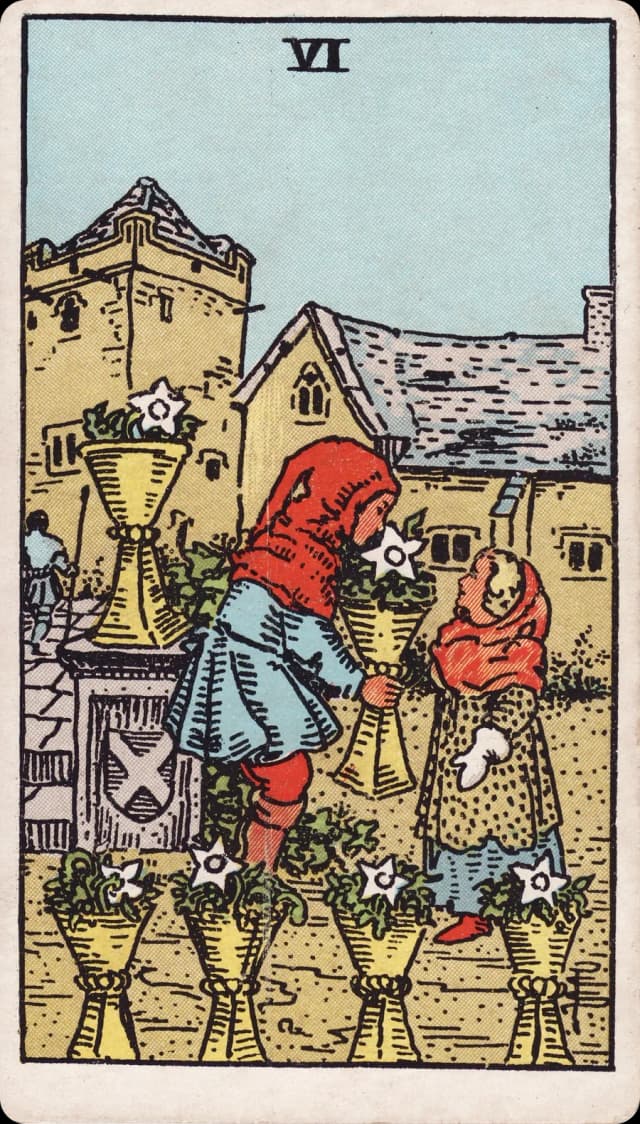
Children in an old garden, their cups filled with flowers. Divinatory Meanings: A card of the past and of memories, looking back, as—for example—on childhood; happiness, enjoyment, but coming rather from the past; things that have vanished. Another reading reverses this, giving new relations, new knowledge, new environment, and then the children are disporting in an unfamiliar precinct. Reversed: The future, renewal, that which will come to pass presently.
오래된 정원의 아이들, 그 잔에는 꽃이 담겨 있다. 점술 의미: 과거와 기억의 카드로, 이를테면 어린 시절을 돌아보는 것. 행복과 즐거움이되 오히려 과거에서 오는 것. 사라져 버린 것들. 다른 읽기는 이를 뒤집어 새로운 관계, 새로운 앎, 새로운 환경을 주며, 그러면 아이들은 낯선 구역에서 뛰노는 셈이 된다. 역방향: 앞날, 새로워짐, 머잖아 일어날 일.
CUPS / Five
컵 / 5
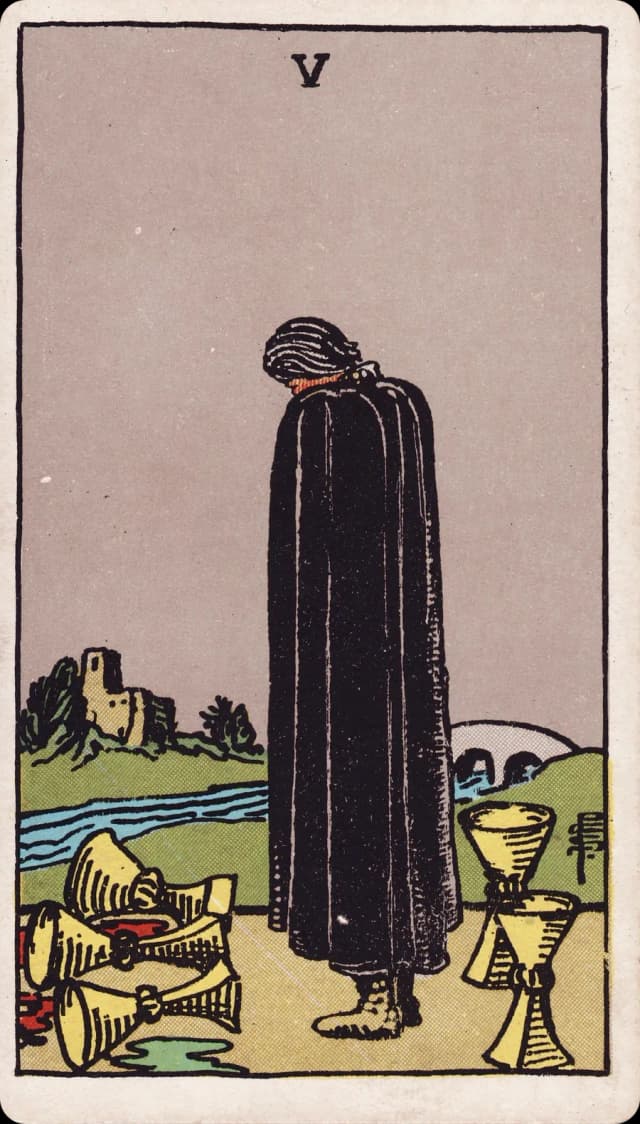
A dark, cloaked figure, looking sideways at three prone cups; two others stand upright behind him; a bridge is in the background, leading to a small keep or holding. Divinatory Meanings: It is a card of loss, but something remains over; three have been taken, but two are left; it is a card of inheritance, patrimony, transmission, but not corresponding to expectations; with some interpreters it is a card of marriage, but not without bitterness or frustration. Reversed: News, alliances, affinity, consanguinity, ancestry, return, false projects.
어둡고 망토를 두른 인물이 쓰러진 잔 셋을 곁눈질하고 있다. 그 뒤에는 다른 잔 둘이 똑바로 서 있다. 배경에는 다리가 있어 작은 성채나 영지로 이어진다. 점술 의미: 상실의 카드이지만 남는 것이 있다. 셋은 가져갔으나 둘은 남았다. 상속과 세습과 물려받음의 카드이되 기대에 미치지는 못한다. 어떤 해석자들에게는 결혼의 카드이지만 쓰라림이나 좌절이 없지 않다. 역방향: 소식, 동맹, 친연, 혈연, 혈통, 돌아옴, 그릇된 계획.
CUPS / Four
컵 / 4
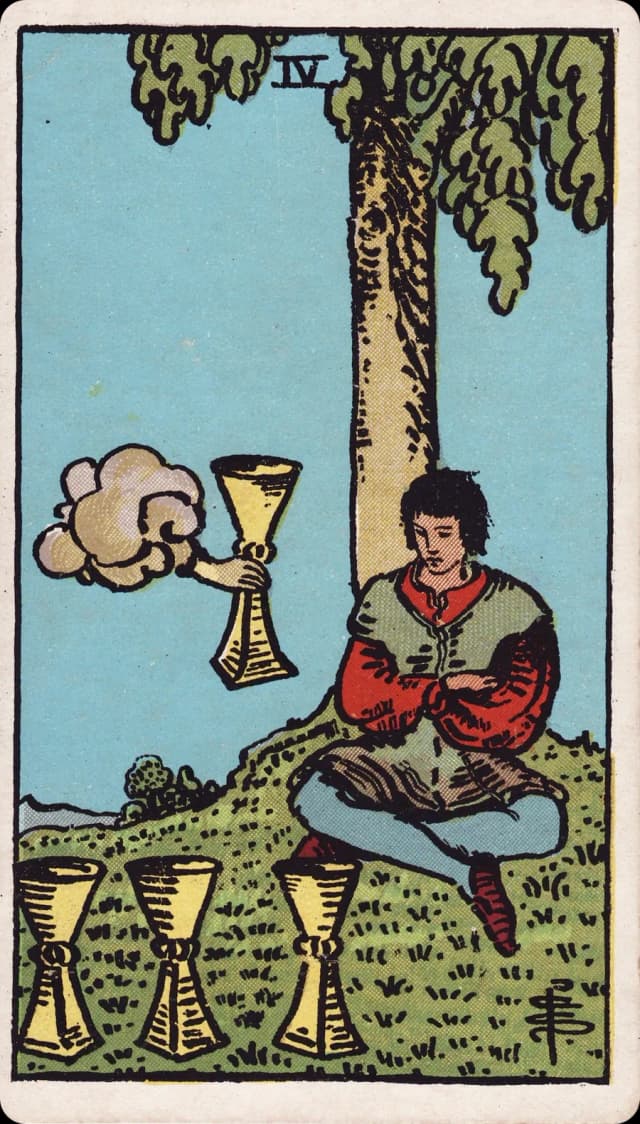
A young man is seated under a tree and contemplates three cups set on the grass before him; an arm issuing from a cloud offers him another cup. His expression notwithstanding is one of discontent with his environment. Divinatory Meanings: Weariness, disgust, aversion, imaginary vexations, as if the wine of this world had caused satiety only; another wine, as if a fairy gift, is now offered the wastrel, but he sees no consolation therein. This is also a card of blended pleasure. Reversed: Novelty, presage, new instruction, new relations.
한 젊은이가 나무 아래 앉아 제 앞 풀밭에 놓인 잔 셋을 바라보고 있다. 구름에서 나온 팔이 그에게 또 하나의 잔을 내민다. 그럼에도 그의 표정은 제 환경에 대한 불만이다. 점술 의미: 권태, 물림, 싫증, 상상으로 지어낸 짜증 — 마치 이 세상의 술이 포만만을 낳은 것처럼. 이제 요정의 선물인 양 다른 술이 이 탕아에게 건네지지만 그는 거기서 아무 위안도 보지 못한다. 이것은 또한 뒤섞인 즐거움의 카드다. 역방향: 새로움, 조짐, 새로운 가르침, 새로운 관계.
CUPS / Three
컵 / 3
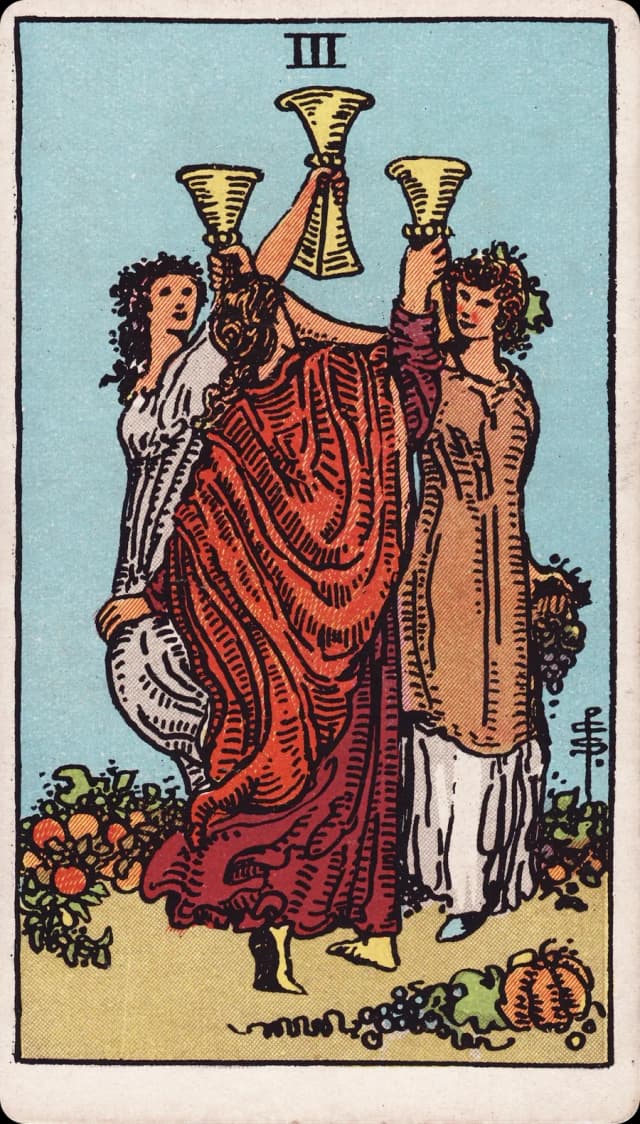
Maidens in a garden-ground with cups uplifted, as if pledging one another. Divinatory Meanings: The conclusion of any matter in plenty, perfection and merriment; happy issue, victory, fulfilment, solace, healing. Reversed: Expedition, dispatch, achievement, end. It signifies also the side of excess in physical enjoyment, and the pleasures of the senses.
정원 뜰의 처녀들이 서로에게 축배를 드는 듯 잔을 들어 올리고 있다. 점술 의미: 어떤 일이 넉넉함과 완성과 흥겨움 속에 마무리됨. 행복한 결말, 승리, 성취, 위로, 치유. 역방향: 서두름, 처리, 이룸, 끝. 또한 육체적 향락의 지나침과 감각의 쾌락 쪽을 뜻하기도 한다.
CUPS / Two
컵 / 2
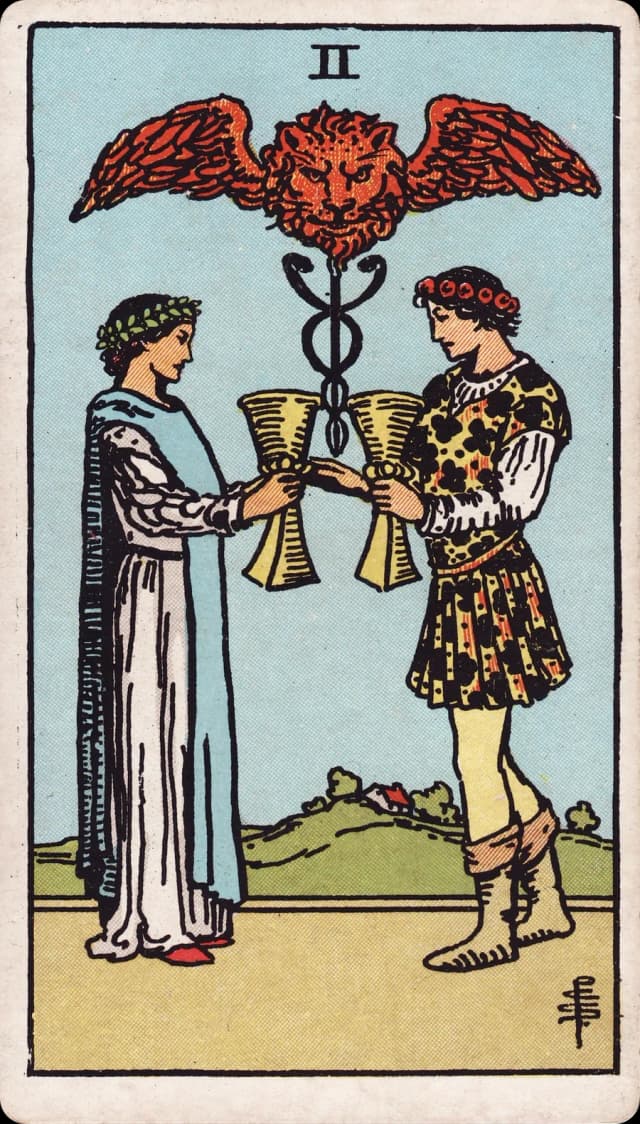
A youth and maiden are pledging one another, and above their cups rises the Caduceus of Hermes, between the great wings of which there appears a lion's head. It is a variant of a sign which is found in a few old examples of this card. Some curious emblematical meanings are attached to it, but they do not concern us in this place. Divinatory Meanings: Love, passion, friendship, affinity, union, concord, sympathy, the interrelation of the sexes, and—as a suggestion apart from all offices of divination—that desire which is not in Nature, but by which Nature is sanctified.
젊은 남자와 처녀가 서로에게 축배를 들고, 그들의 잔 위로 헤르메스의 카두케우스가 솟아 있으며, 그 커다란 날개 사이로 사자 머리가 보인다. 이 카드의 몇몇 옛 사례에서 발견되는 표징의 변형이다. 여기에는 기이한 상징적 뜻들이 붙어 있으나 이 자리에서 우리가 다룰 바는 아니다. 점술 의미: 사랑, 정열, 우정, 친연, 결합, 화합, 공감, 두 성(性) 사이의 상호 관계. 그리고 — 점술의 온갖 소임과는 별개로 하는 말이지만 — 자연 안에 있지 않으면서 그것으로 자연이 거룩해지는 그 갈망.
CUPS / Ace
컵 / 에이스
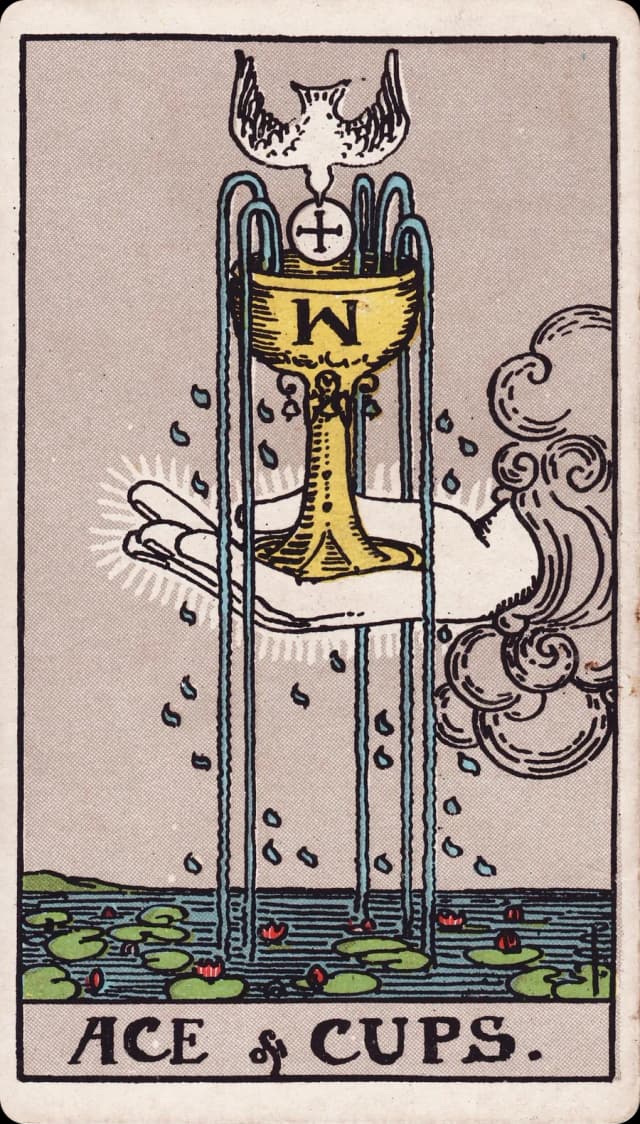
The waters are beneath, and thereon are water-lilies; the hand issues from the cloud, holding in its palm the cup, from which four streams are pouring; a dove, bearing in its bill a cross-marked Host, descends to place the Wafer in the Cup; the dew of water is falling on all sides. It is an intimation of that which may lie behind the Lesser Arcana Divinatory Meanings: House of the true heart, joy, content, abode, nourishment, abundance, fertility; Holy Table, felicity hereof. Reversed: House of the false heart, mutation, instability, revolution.
아래에는 물이 있고 그 위에 수련이 떠 있다. 구름에서 손이 나와 손바닥에 잔을 받쳐 들었고, 거기서 네 줄기가 쏟아진다. 십자가 새겨진 성체를 부리에 문 비둘기가 내려와 그 병(餠)을 잔에 놓으려 한다. 사방에 물방울이 떨어지고 있다. 이는 소아르카나 뒤에 놓여 있을지 모를 것을 넌지시 알린다. 점술 의미: 참된 마음의 집, 기쁨, 흡족함, 거처, 자양, 넉넉함, 풍요. 거룩한 상(床), 그리고 거기서 오는 행복. 역방향: 거짓된 마음의 집, 뒤바뀜, 불안정, 격변.
THE SUIT OF SWORDS / King
소드 수트 / 킹
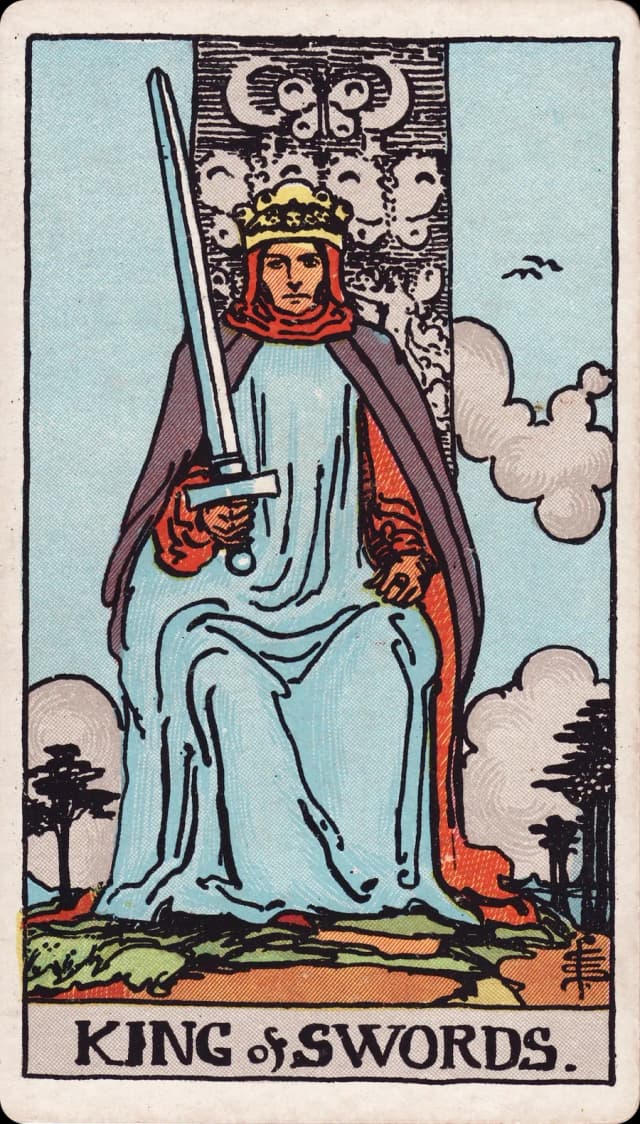
He sits in judgment, holding the unsheathed sign of his suit. He recalls, of course, the conventional Symbol of Justice in the Trumps Major, and he may represent this virtue, but he is rather the power of life and death, in virtue of his office. Divinatory Meanings: Whatsoever arises out of the idea of judgment and all its connexions—power, command, authority, militant intelligence, law, offices of the crown, and so forth. Reversed: Cruelty, perversity, barbarity, perfidy, evil intention.
그는 심판의 자리에 앉아 칼집에서 뽑은 제 수트의 표징을 들고 있다. 물론 그는 대아르카나의 통상적인 정의 상징을 떠올리게 하며 그 덕을 나타낼 수도 있지만, 그보다는 자기 직임에 힘입은 생사여탈의 권능이다. 점술 의미: 심판이라는 관념과 그에 딸린 모든 것에서 나오는 무엇이든 — 권능, 명령, 권위, 싸우는 지성, 법률, 왕실의 직무 따위. 역방향: 잔혹, 비뚤어짐, 야만, 배신, 악의.
SWORDS / Queen
소드 / 퀸
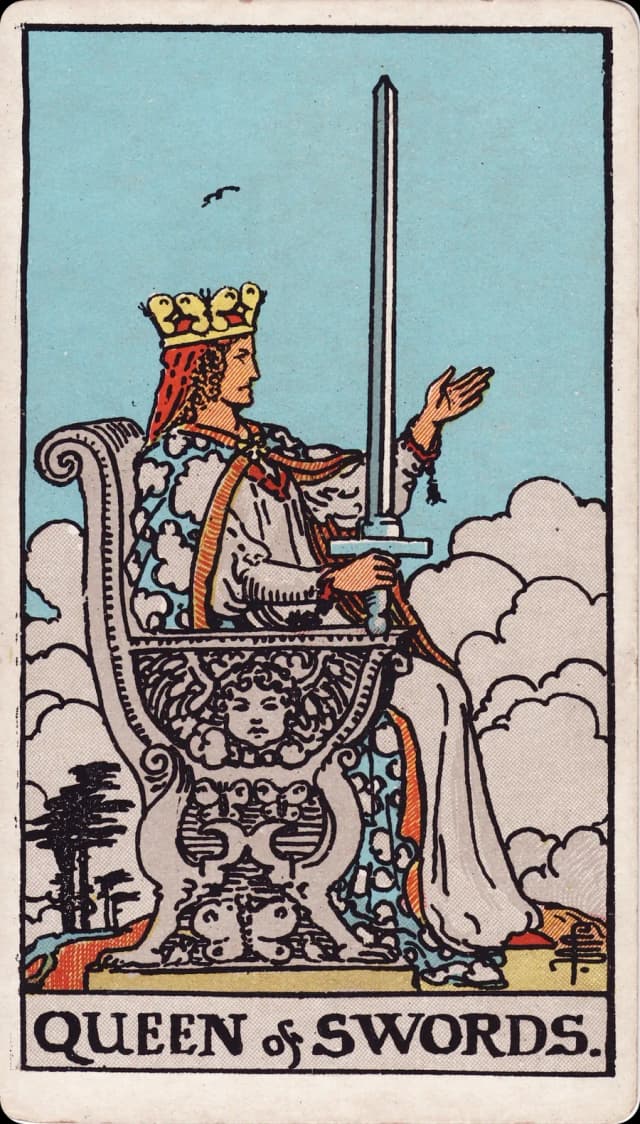
Her right hand raises the weapon vertically and the hilt rests on an arm of her royal chair; the left hand is extended, the arm raised; her countenance is severe but chastened; it suggests familiarity with sorrow. It does not represent mercy, and, her sword notwithstanding, she is scarcely a symbol of power. Divinatory Meanings: Widowhood, female sadness and embarrassment, absence, sterility, mourning, privation, separation. Reversed: Malice, bigotry, artifice, prudery, bale, deceit.
그녀의 오른손은 무기를 수직으로 들어 올리고 자루는 왕좌의 팔걸이에 놓여 있다. 왼손은 뻗어 있고 팔은 들려 있다. 얼굴빛은 준엄하지만 다듬어져 있어, 슬픔에 익숙한 사람임을 떠올리게 한다. 그것은 자비를 나타내지 않으며, 검을 들었음에도 그녀를 권능의 상징이라 하기는 어렵다. 점술 의미: 과부됨, 여자의 슬픔과 곤경, 부재, 불임, 애도, 결핍, 헤어짐. 역방향: 악의, 편협, 술책, 내숭, 재앙, 기만.
SWORDS / Knight
소드 / 나이트
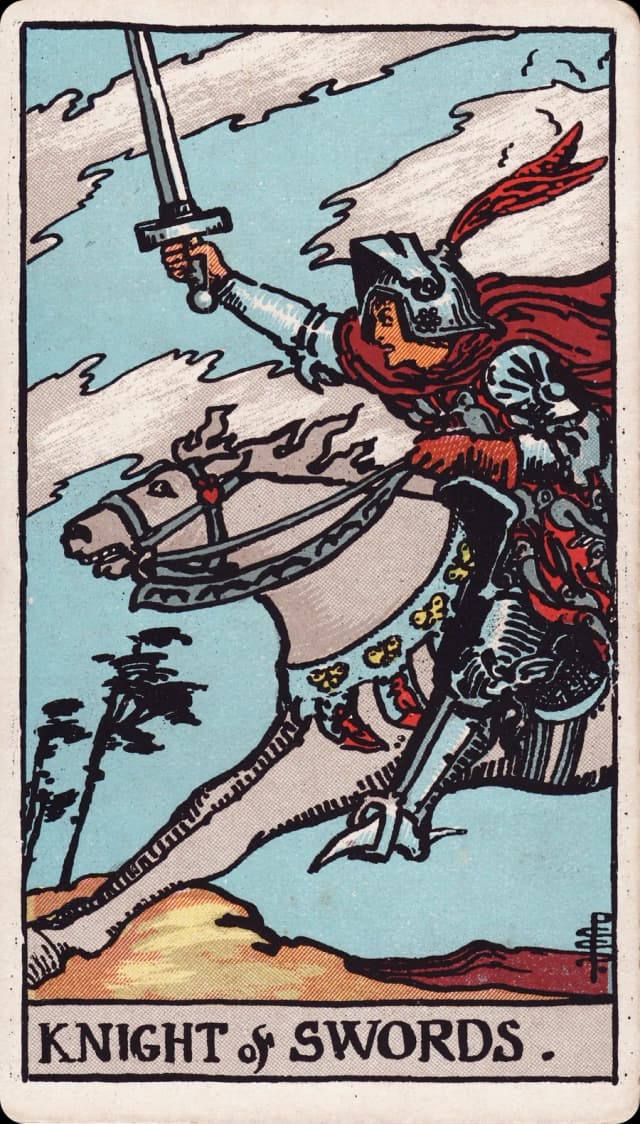
He is riding in full course, as if scattering his enemies. In the design he is really a prototypical hero of romantic chivalry. He might almost be Galahad, whose sword is swift and sure because he is clean of heart. Divinatory Meanings: Skill, bravery, capacity, defence, address, enmity, wrath, war, destruction, opposition, resistance, ruin. There is therefore a sense in which the card signifies death, but it carries this meaning only in its proximity to other cards of fatality. Reversed: Imprudence, incapacity, extravagance.
그는 적을 흩뜨리기라도 하듯 전력으로 말을 몰고 있다. 이 도안에서 그는 사실상 기사도 로맨스의 전형적 영웅이다. 그는 갈라하드라고 해도 좋을 법한데, 마음이 깨끗하기에 그의 검은 빠르고 어긋나지 않는다. 점술 의미: 기량, 용맹, 능력, 방어, 수완, 적의, 진노, 전쟁, 파괴, 반목, 저항, 파멸. 그러므로 이 카드가 죽음을 뜻하는 측면이 있기는 하나, 그 뜻은 숙명을 뜻하는 다른 카드들 곁에 있을 때만 지닌다. 역방향: 경솔, 무능, 방종.
SWORDS / Page
소드 / 페이지
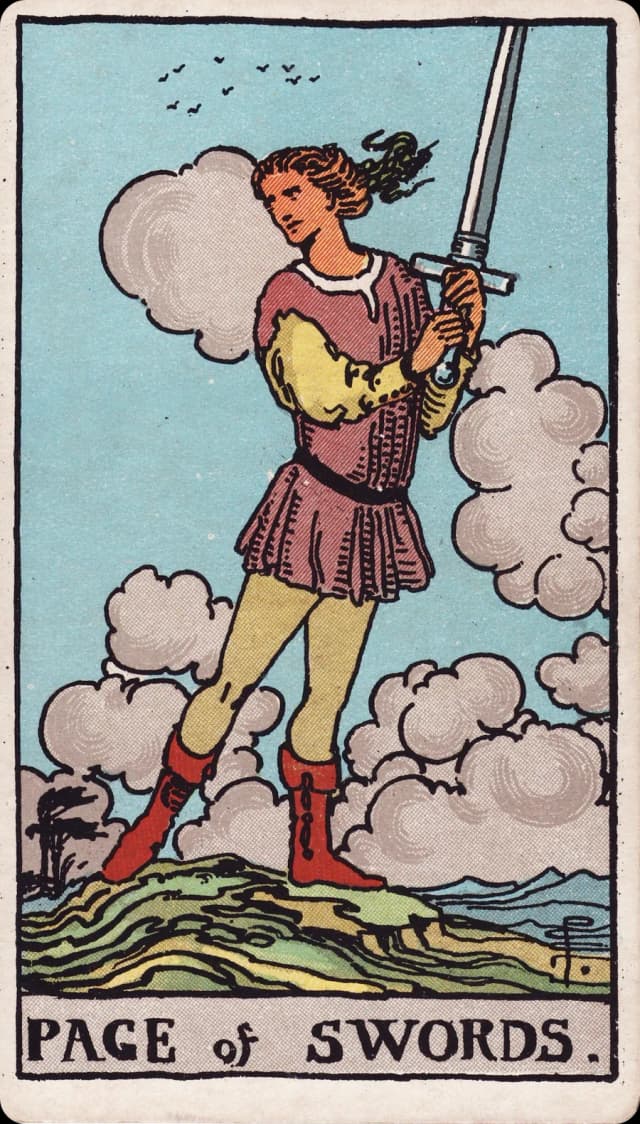
A lithe, active figure holds a sword upright in both hands, while in the act of swift walking. He is passing over rugged land, and about his way the clouds are collocated wildly. He is alert and lithe, looking this way and that, as if an expected enemy might appear at any moment. Divinatory Meanings: Authority, overseeing, secret service, vigilance, spying, examination, and the qualities thereto belonging. Reversed: More evil side of these qualities; what is unforeseen, unprepared state; sickness is also intimated.
날렵하고 활동적인 인물이 빠르게 걸으면서 두 손으로 검을 곧추세워 들고 있다. 그는 험한 땅을 지나고 있고 그 길 언저리에는 구름이 어지러이 몰려 있다. 그는 기민하고 날래며, 예상하던 적이 언제라도 나타날 듯 이쪽저쪽을 살핀다. 점술 의미: 권한, 감독, 비밀 임무, 경계, 정탐, 조사, 그리고 거기에 딸린 성질들. 역방향: 이 성질들의 더 나쁜 쪽. 예견되지 않은 것, 준비되지 않은 상태. 병 또한 넌지시 비친다.
SWORDS / Ten
소드 / 10
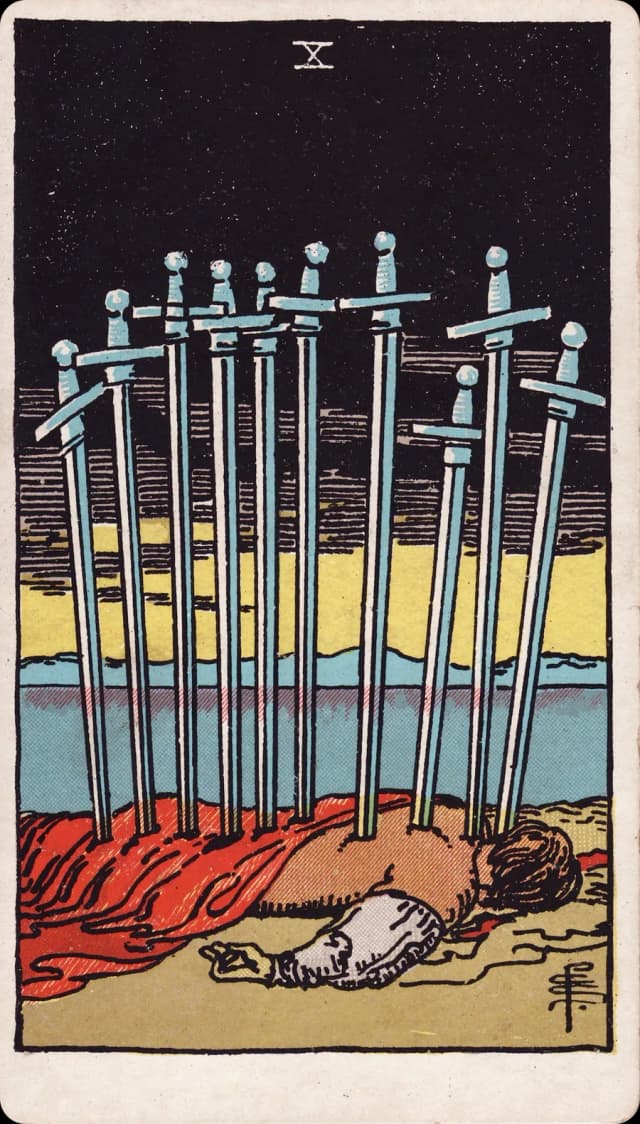
A prostrate figure, pierced by all the swords belonging to the card. Divinatory Meanings: Whatsoever is intimated by the design; also pain, affliction, tears, sadness, desolation. It is not especially a card of violent death. Reversed: Advantage, profit, success, favour, but none of these are permanent; also power and authority.
엎드러진 인물이 이 카드에 속한 검 전부에 꿰뚫려 있다. 점술 의미: 이 도안이 넌지시 알리는 무엇이든. 또한 고통, 괴로움, 눈물, 슬픔, 황폐. 특별히 횡사(橫死)의 카드는 아니다. 역방향: 이득, 이익, 성공, 호의. 다만 그 어느 것도 지속되지 않는다. 또한 권능과 권위.
SWORDS / Nine
소드 / 9
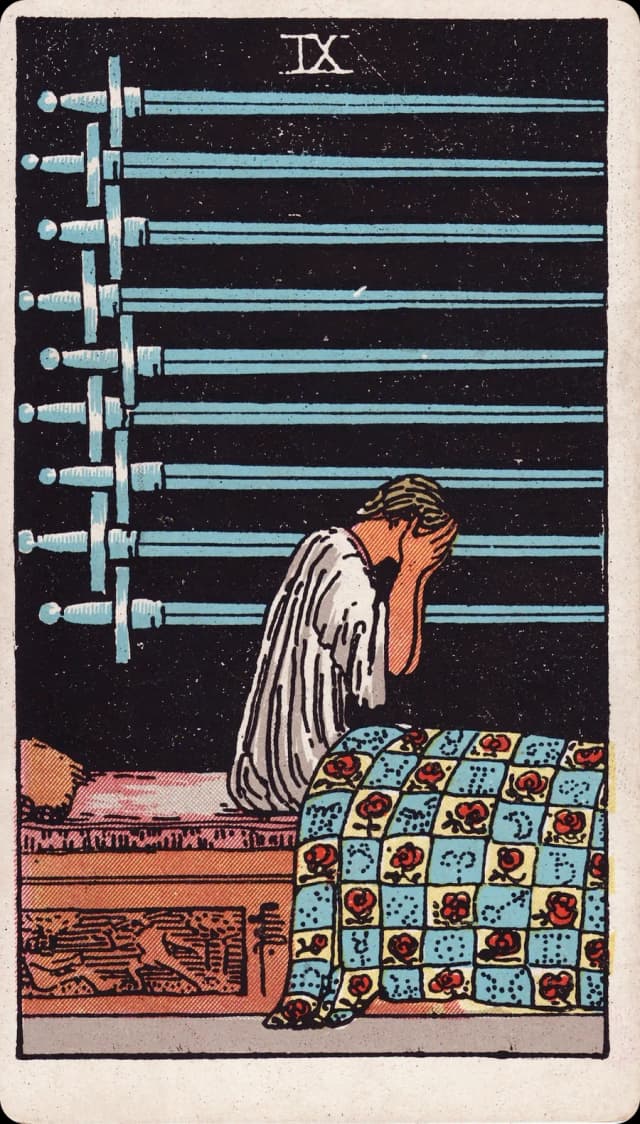
One seated on her couch in lamentation, with the swords over her. She is as one who knows no sorrow which is like unto hers. It is a card of utter desolation. Divinatory Meanings: Death, failure, miscarriage, delay, deception, disappointment, despair. Reversed: Imprisonment, suspicion, doubt, reasonable fear, shame.
한 사람이 침상에 앉아 통곡하고 있고 그 위로 검들이 걸려 있다. 그녀는 자기 것 같은 슬픔은 달리 모르는 사람과 같다. 철저한 황폐의 카드다. 점술 의미: 죽음, 실패, 유산(流産), 지연, 기만, 실망, 절망. 역방향: 갇힘, 의심, 의혹, 그럴 만한 두려움, 수치.
SWORDS / Eight
소드 / 8
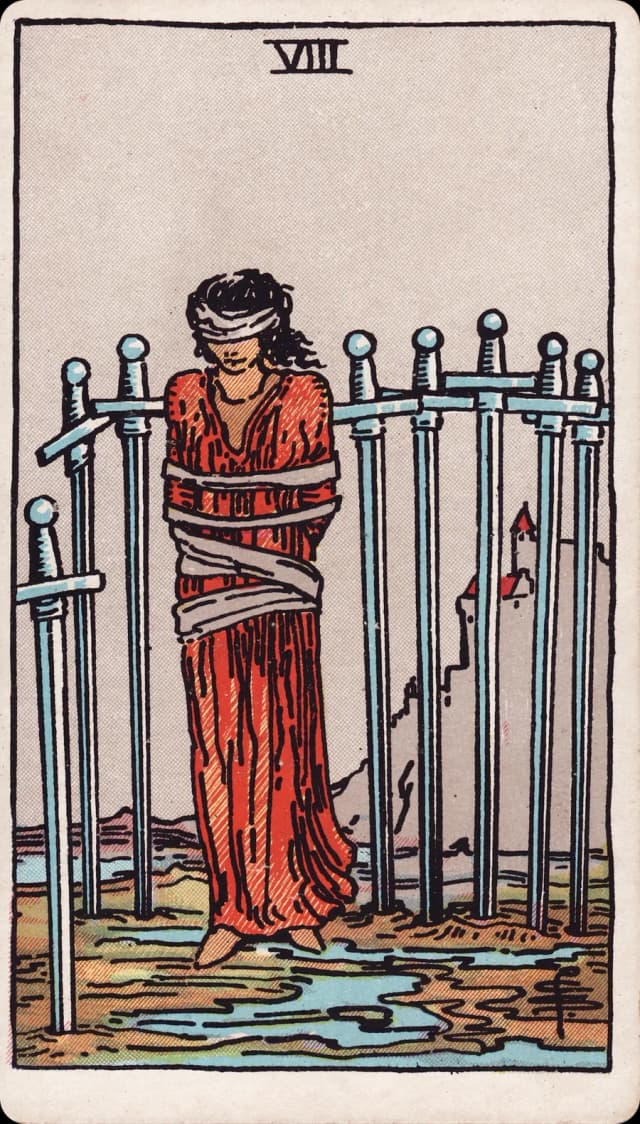
A woman, bound and hoodwinked, with the swords of the card about her. Yet it is rather a card of temporary durance than of irretrievable bondage. Divinatory Meanings: Bad news, violent chagrin, crisis, censure, power in trammels, conflict, calumny; also sickness. Reversed: Disquiet, difficulty, opposition, accident, treachery; what is unforeseen; fatality.
한 여자가 묶이고 눈이 가려진 채, 이 카드의 검들에 둘러싸여 있다. 그럼에도 이것은 돌이킬 수 없는 속박이라기보다 한때의 구금에 가까운 카드다. 점술 의미: 나쁜 소식, 격한 비통, 위기, 비난, 족쇄에 묶인 권능, 갈등, 중상. 또한 병. 역방향: 불안, 곤란, 반목, 사고, 배신. 예견되지 않은 것. 숙명.
SWORDS / Seven
소드 / 7
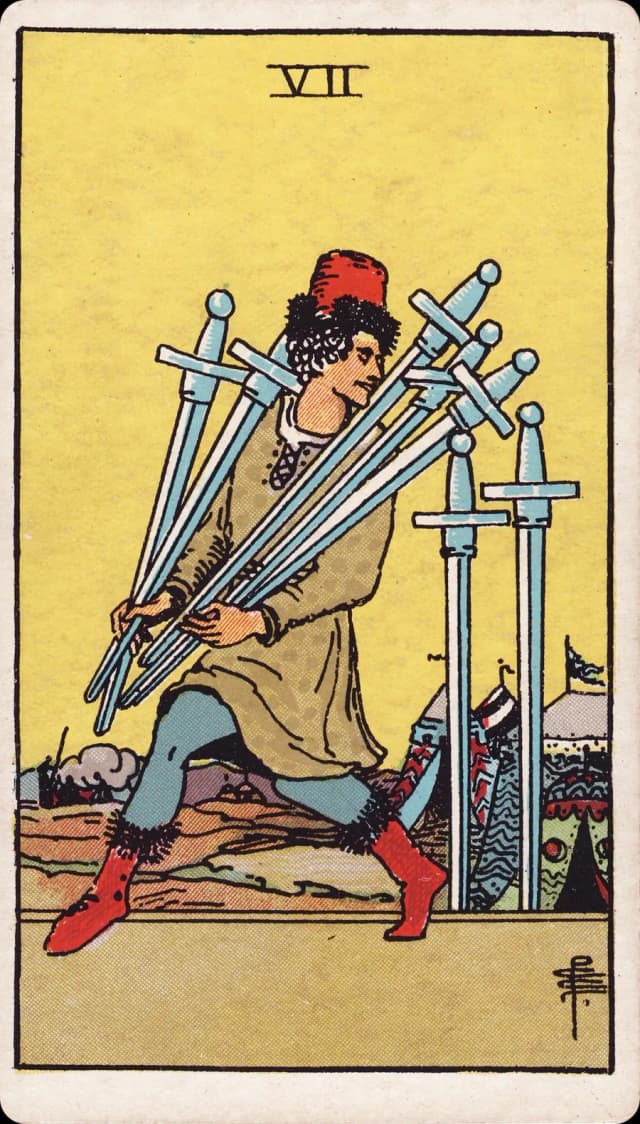
A man in the act of carrying away five swords rapidly; the two others of the card remain stuck in the ground. A camp is close at hand. Divinatory Meanings: Design, attempt, wish, hope, confidence; also quarrelling, a plan that may fail, annoyance. The design is uncertain in its import, because the significations are widely at variance with each other. Reversed: Good advice, counsel, instruction, slander, babbling.
한 남자가 검 다섯 자루를 재빨리 들고 가는 중이고, 이 카드의 나머지 둘은 땅에 꽂힌 채 남아 있다. 가까이에 야영지가 있다. 점술 의미: 계획, 시도, 바람, 희망, 자신감. 또한 다툼, 실패할 수도 있는 계획, 성가심. 이 도안은 뜻하는 바가 불분명한데, 그 의미들이 서로 크게 어긋나기 때문이다. 역방향: 좋은 조언, 충고, 가르침, 험담, 수다.
SWORDS / Six
소드 / 6
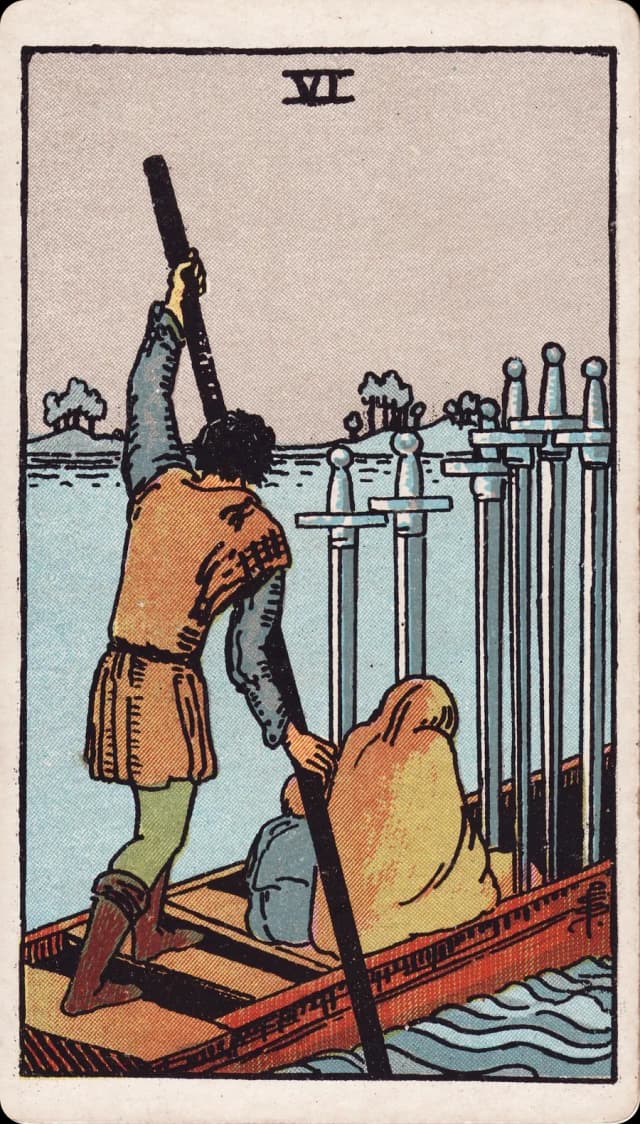
A ferryman carrying passengers in his punt to the further shore. The course is smooth, and seeing that the freight is light, it may be noted that the work is not beyond his strength. Divinatory Meanings: Journey by water, route, way, envoy, commissionary, expedient. Reversed: Declaration, confession, publicity; one account says that it is a proposal of love.
사공이 삿대배에 손님들을 태우고 건너편 물가로 나아간다. 물길은 잔잔하고, 실은 짐이 가벼운 것을 보면 그 일이 그의 힘에 부치지 않음을 알 수 있다. 점술 의미: 물길 여행, 노정, 길, 사절, 대리인, 방편. 역방향: 선언, 고백, 공표. 어떤 설명은 이것이 사랑의 청혼이라고 한다.
SWORDS / Five
소드 / 5
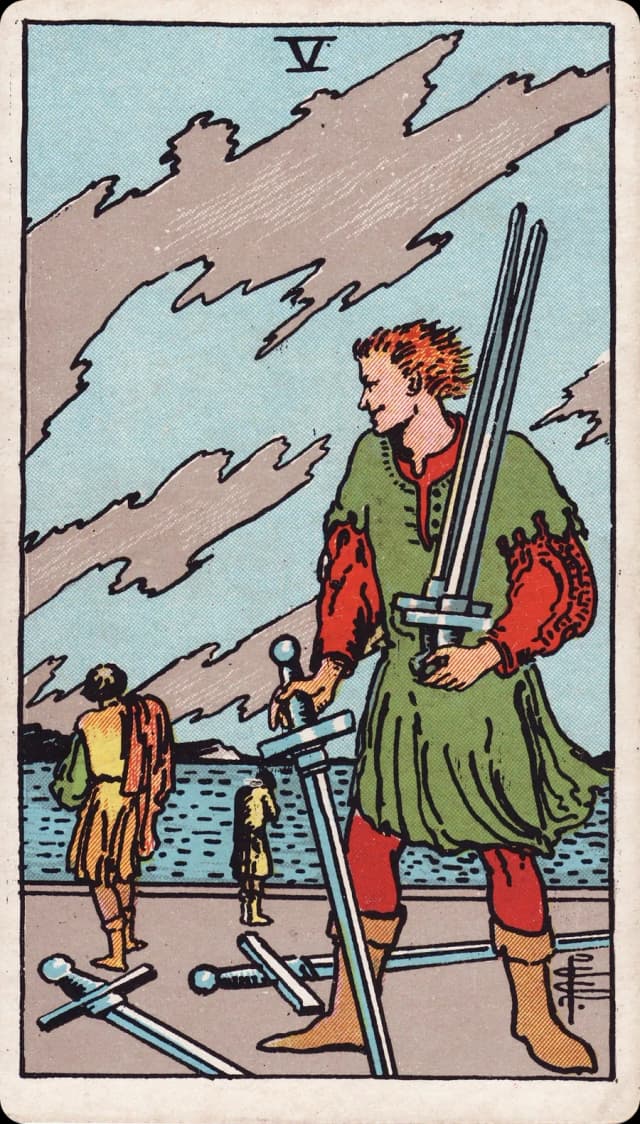
A disdainful man looks after two retreating and dejected figures. Their swords lie upon the ground. He carries two others on his left shoulder, and a third sword is in his right hand, point to earth. He is the master in possession of the field. Divinatory Meanings: Degradation, destruction, revocation, infamy, dishonour, loss, with the variants and analogues of these. Reversed: The same; burial and obsequies.
업신여기는 표정의 남자가 물러가는 두 낙심한 인물의 뒤를 바라본다. 그들의 검은 땅에 놓여 있다. 그는 왼쪽 어깨에 두 자루를 메고 오른손에 세 번째 검을 끝을 땅으로 향한 채 쥐고 있다. 그는 그 자리를 차지한 승자다. 점술 의미: 격하, 파괴, 취소, 오명, 불명예, 상실, 그리고 이것들의 변형과 유사한 것들. 역방향: 같음. 그리고 매장과 장례.
SWORDS / Four
소드 / 4
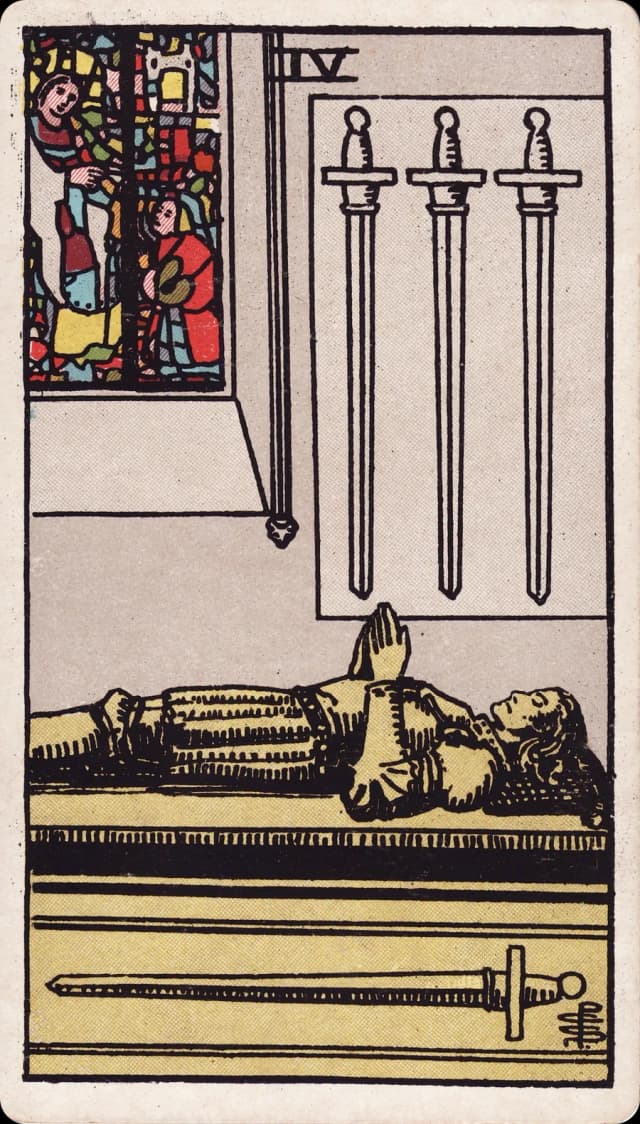
The effigy of a knight in the attitude of prayer, at full length upon his tomb. Divinatory Meanings: Vigilance, retreat, solitude, hermit's repose, exile, tomb and coffin. It is these last that have suggested the design. Reversed: Wise administration, circumspection, economy, avarice, precaution, testament.
기사의 조상(彫像)이 기도하는 자세로 제 무덤 위에 온몸을 뻗고 누워 있다. 점술 의미: 경계, 물러남, 홀로 있음, 은둔자의 쉼, 유배, 무덤과 관. 이 도안을 낳은 것은 바로 이 마지막 것들이다. 역방향: 지혜로운 경영, 신중, 절약, 인색, 조심, 유언.
SWORDS / Three
소드 / 3
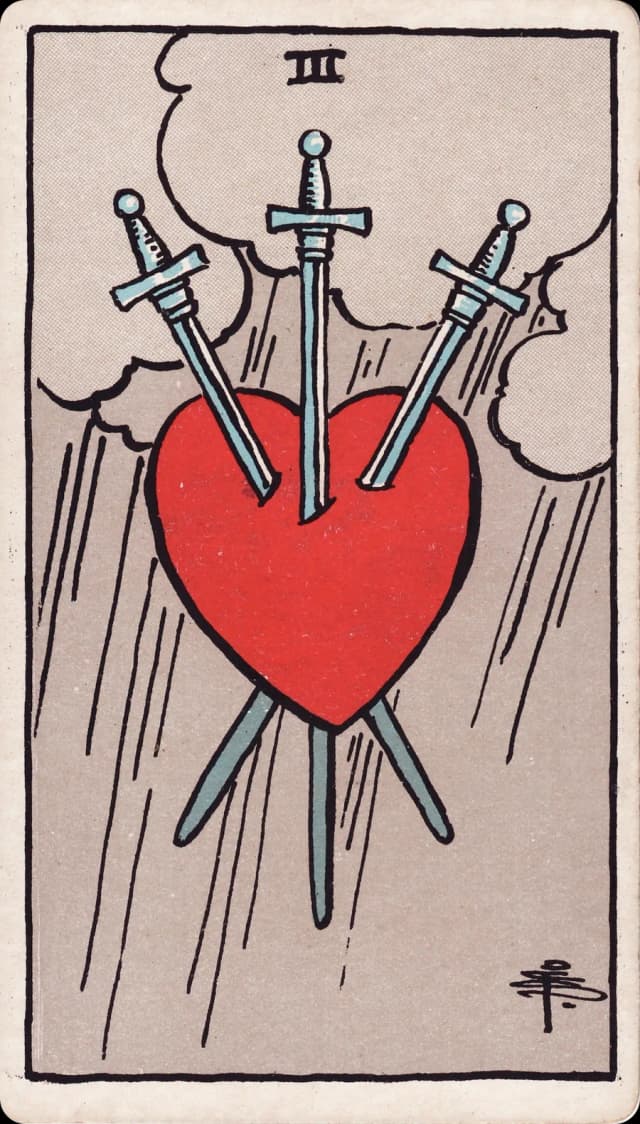
Three swords piercing a heart; cloud and rain behind. Divinatory Meanings: Removal, absence, delay, division, rupture, dispersion, and all that the design signifies naturally, being too simple and obvious to call for specific enumeration. Reversed: Mental alienation, error, loss, distraction, disorder, confusion.
검 세 자루가 심장을 꿰뚫고 있고 뒤로는 구름과 비가 있다. 점술 의미: 치워짐, 부재, 지연, 갈라짐, 결렬, 흩어짐, 그리고 이 도안이 자연히 뜻하는 모든 것. 너무 단순하고 뻔해서 따로 열거할 것도 없다. 역방향: 정신의 착란, 오류, 상실, 산만, 무질서, 혼란.
SWORDS / Two
소드 / 2
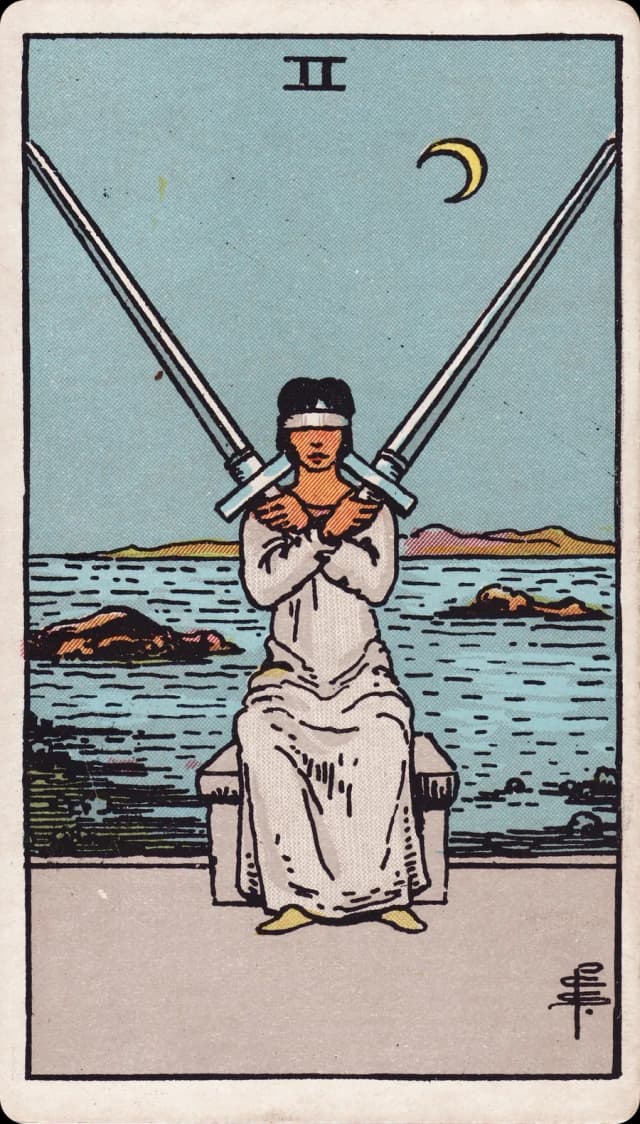
A hoodwinked female figure balances two swords upon her shoulders. Divinatory Meanings: Conformity and the equipoise which it suggests, courage, friendship, concord in a state of arms; another reading gives tenderness, affection, intimacy. The suggestion of harmony and other favourable readings must be considered in a qualified manner, as Swords generally are not symbolical of beneficent forces in human affairs. Reversed: Imposture, falsehood, duplicity, disloyalty.
눈이 가려진 여성 인물이 두 자루의 검을 어깨에 얹어 균형을 잡고 있다. 점술 의미: 순응, 그리고 그것이 떠올리게 하는 균형. 용기, 우정, 무장한 상태에서의 화합. 다른 읽기는 다정함, 애정, 친밀함을 준다. 다만 조화를 비롯한 호의적인 읽기들은 유보를 두고 헤아려야 한다. 소드는 대체로 인간사에서 이로운 힘을 상징하지 않기 때문이다. 역방향: 사칭, 거짓, 표리부동, 불충.
SWORDS / Ace
소드 / 에이스
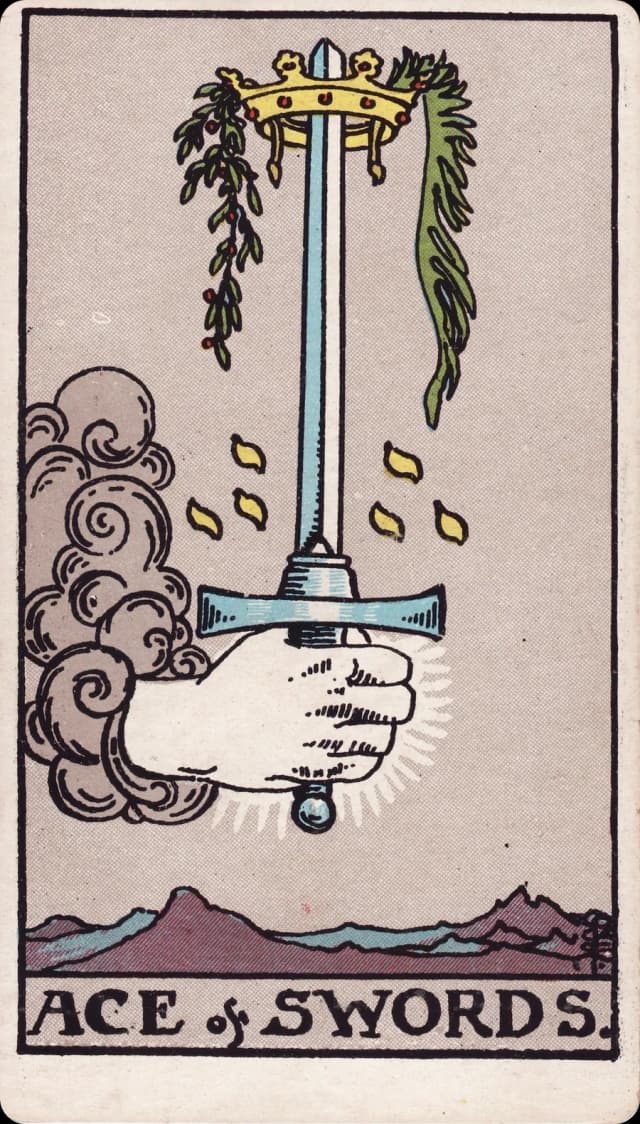
A hand issues from a cloud, grasping a sword, the point of which is encircled by a crown. Divinatory Meanings: Triumph, the excessive degree in everything, conquest, triumph of force. It is a card of great force, in love as well as in hatred. The crown may carry a much higher significance than comes usually within the sphere of fortune-telling. Reversed: The same, but the results are disastrous; another account says—conception, childbirth, augmentation, multiplicity.
구름에서 손이 나와 검을 움켜쥐고 있고, 그 끝을 왕관이 둘러싸고 있다. 점술 의미: 개가, 무엇에서든 지나친 정도, 정복, 힘의 개가. 사랑에서도 미움에서도 큰 힘의 카드다. 이 왕관은 흔히 카드점의 영역에 들어오는 것보다 훨씬 높은 뜻을 지닐 수 있다. 역방향: 같으나 그 결과가 참담하다. 다른 설명은 잉태, 출산, 늘어남, 여럿임이라 한다.
THE SUIT OF PENTACLES / King
펜타클 수트 / 킹
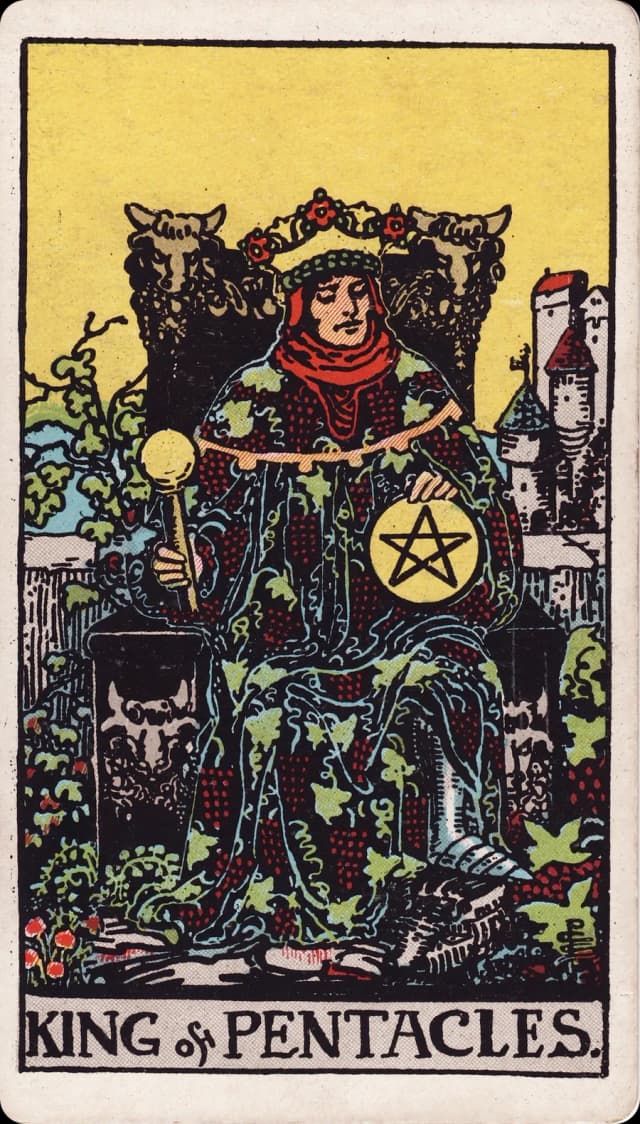
The figure calls for no special description; the face is rather dark, suggesting also courage, but somewhat lethargic in tendency. The bull's head should be noted as a recurrent symbol on the throne. The sign of this suit is represented throughout as engraved or blazoned with the pentagram, typifying the correspondence of the four elements in human nature and that by which they may be governed. In many old Tarot packs this suit stood for current coin, money, deniers. I have not invented the substitution of pentacles and I have no special cause to sustain in respect of the alternative. But the consensus of divinatory meanings is on the side of some change, because the cards do not happen to deal especially with questions of money. Divinatory Meanings: Valour, realizing intelligence, business and normal intellectual aptitude, sometimes mathematical gifts and attainments of this kind; success in these paths. Reversed: Vice, weakness, ugliness, perversity, corruption, peril.
이 인물은 따로 서술할 것이 없다. 얼굴빛은 다소 짙어 용기를 떠올리게도 하지만 기질은 어딘가 굼뜬 편이다. 왕좌에 되풀이해 나타나는 상징으로 황소 머리를 눈여겨봐야 한다. 이 수트의 표징은 어디서나 오각별이 새겨지거나 문장으로 그려진 모습으로 나타나는데, 이는 인간 본성 안에서 네 원소가 서로 대응하는 것과 그것들을 다스릴 수 있는 것을 표상한다. 많은 옛 타로 팩에서 이 수트는 통용되는 주화, 곧 돈, 드니에(deniers) 를 뜻했다. 펜타클로 바꿔 놓은 것은 내가 지어낸 일이 아니고, 그 대안을 두고 내가 특별히 옹호할 이유도 없다. 다만 점술 의미들의 합의는 얼마간의 변경 쪽에 있다. 이 카드들이 특별히 돈 문제를 다루는 것은 아니기 때문이다. 점술 의미: 용맹, 실현하는 지성, 사업과 통상적인 지적 소질, 때로는 수학적 재능과 그런 종류의 성취. 그 길에서의 성공. 역방향: 악덕, 나약, 추함, 비뚤어짐, 부패, 위험.
PENTACLES / Queen
펜타클 / 퀸
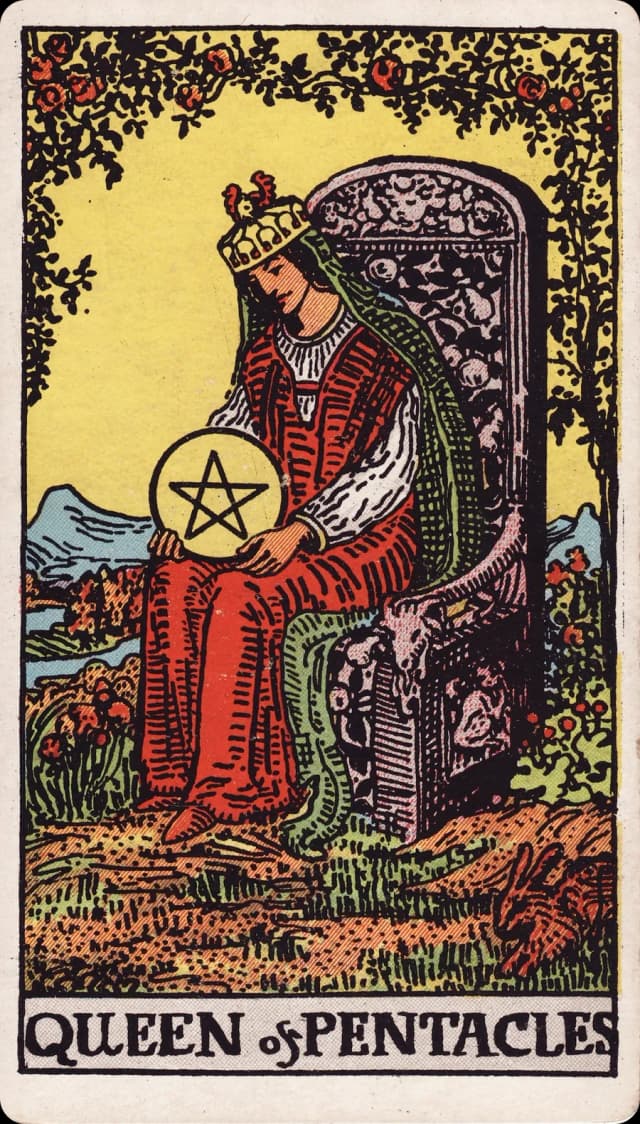
The face suggests that of a dark woman, whose qualities might be summed up in the idea of greatness of soul; she has also the serious cast of intelligence; she contemplates her symbol and may see worlds therein. Divinatory Meanings: Opulence, generosity, magnificence, security, liberty. Reversed: Evil, suspicion, suspense, fear, mistrust.
그 얼굴은 살빛이 짙은 여자의 것을 떠올리게 하며, 그 자질은 영혼의 큼이라는 관념으로 요약될 만하다. 그녀에게는 지성의 진지한 기색도 있다. 그녀는 자기 상징을 응시하고 있으며 그 안에서 여러 세계를 보고 있는지도 모른다. 점술 의미: 부유, 너그러움, 화려함, 안전, 자유. 역방향: 악, 의심, 조마조마함, 두려움, 불신.
PENTACLES / Knight
펜타클 / 나이트
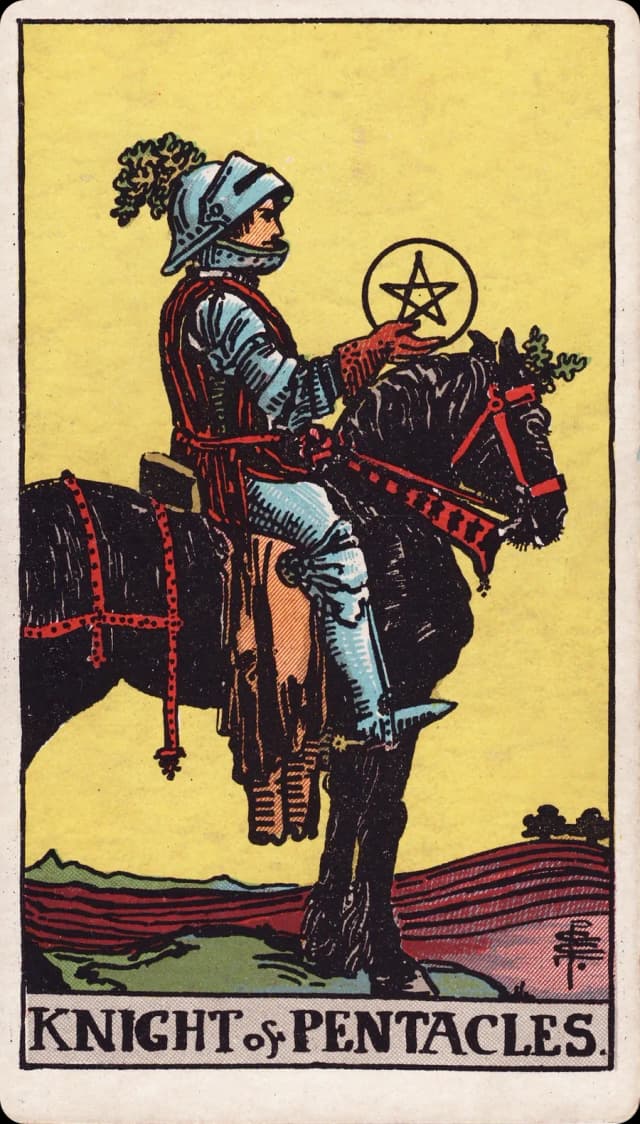
He rides a slow, enduring, heavy horse, to which his own aspect corresponds. He exhibits his symbol, but does not look therein. Divinatory Meanings: Utility, serviceableness, interest, responsibility, rectitude—all on the normal and external plane. Reversed: inertia, idleness, repose of that kind, stagnation; also placidity, discouragement, carelessness.
그는 느리고 끈질기고 육중한 말을 타고 있으며, 그 자신의 모습도 그에 걸맞다. 그는 자기 상징을 내보이지만 그 안을 들여다보지는 않는다. 점술 의미: 쓸모, 유용함, 이해관계, 책임, 올곧음 — 모두 통상적이고 외적인 층위에서. 역방향: 무기력, 게으름, 그런 종류의 쉼, 정체. 또한 무덤덤함, 낙담, 부주의.
PENTACLES / Page
펜타클 / 페이지
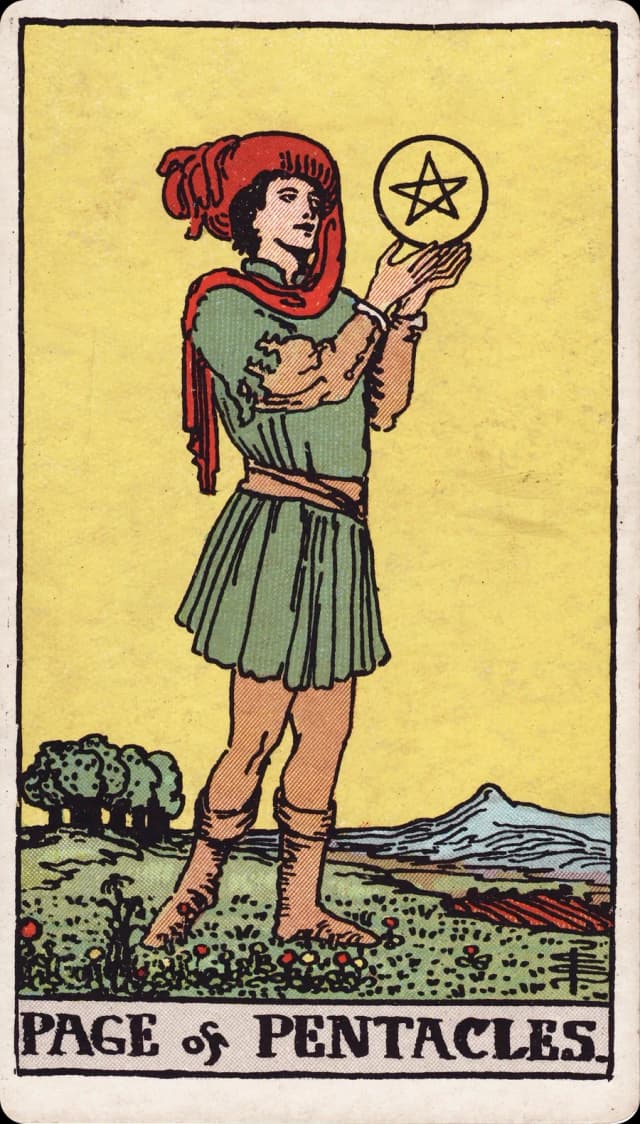
A youthful figure, looking intently at the pentacle which hovers over his raised hands. He moves slowly, insensible of that which is about him. Divinatory Meanings: Application, study, scholarship, reflection; another reading says news, messages and the bringer thereof; also rule, management. Reversed: Prodigality, dissipation, liberality. luxury; unfavourable news.
젊은 인물이 자기가 들어 올린 두 손 위에 떠 있는 펜타클을 골똘히 바라본다. 그는 천천히 움직이며 주변의 것들을 느끼지 못한다. 점술 의미: 몰두, 공부, 학식, 숙고. 다른 읽기는 소식과 전언, 그리고 그것을 가져오는 이라고 한다. 또한 다스림, 관리. 역방향: 낭비, 방탕, 헤픔, 사치. 좋지 않은 소식.
PENTACLES / Ten
펜타클 / 10
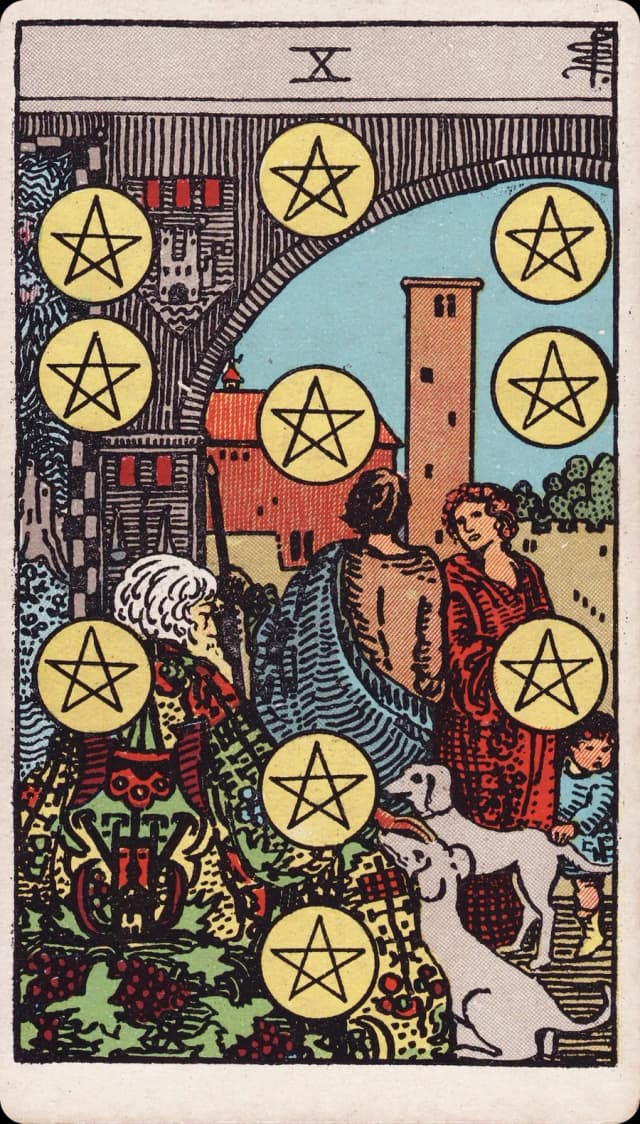
A man and woman beneath an archway which gives entrance to a house and domain. They are accompanied by a child, who looks curiously at two dogs accosting an ancient personage seated in the foreground. The child's hand is on one of them. Divinatory Meanings: Gain, riches; family matters, archives, extraction, the abode of a family. Reversed: Chance, fatality, loss, robbery, games of hazard; sometimes gift, dowry, pension.
한 남자와 여자가 집과 영지로 들어서는 아치 아래에 있다. 그들 곁에는 아이가 있는데, 앞쪽에 앉은 노인에게 다가서는 개 두 마리를 신기한 듯 바라본다. 아이의 손은 그중 한 마리에 얹혀 있다. 점술 의미: 이득, 부. 집안일, 문서, 혈통, 한 가문의 거처. 역방향: 우연, 숙명, 상실, 강도, 요행을 거는 노름. 때로는 선물, 지참금, 연금.
PENTACLES / Nine
펜타클 / 9
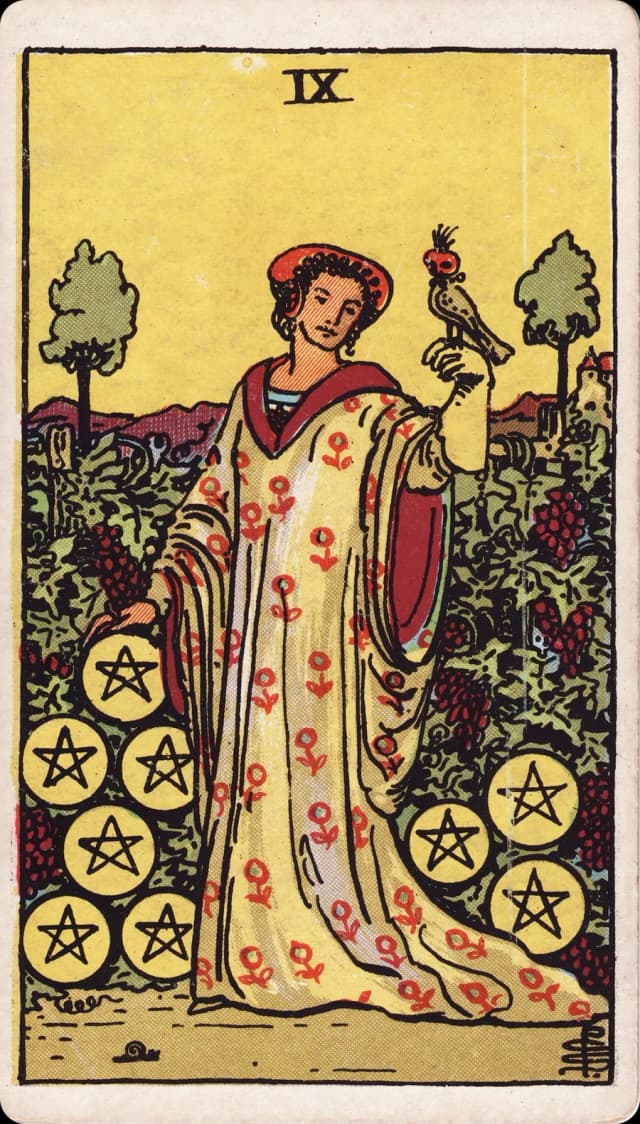
A woman, with a bird upon her wrist, stands amidst a great abundance of grapevines in the garden of a manorial house. It is a wide domain, suggesting plenty in all things. Possibly it is her own possession and testifies to material well-being. Divinatory Meanings: Prudence, safety, success, accomplishment, certitude, discernment. Reversed: Roguery, deception, voided project, bad faith.
한 여자가 손목에 새를 앉힌 채, 장원 저택의 정원에서 무성한 포도덩굴 한가운데 서 있다. 널찍한 영지로 만사의 넉넉함을 떠올리게 한다. 아마도 그녀 자신의 소유일 것이며 물질적 안녕을 증언한다. 점술 의미: 신중, 안전, 성공, 이룸, 확신, 분별. 역방향: 사기, 기만, 무산된 계획, 배신.
PENTACLES / Eight
펜타클 / 8
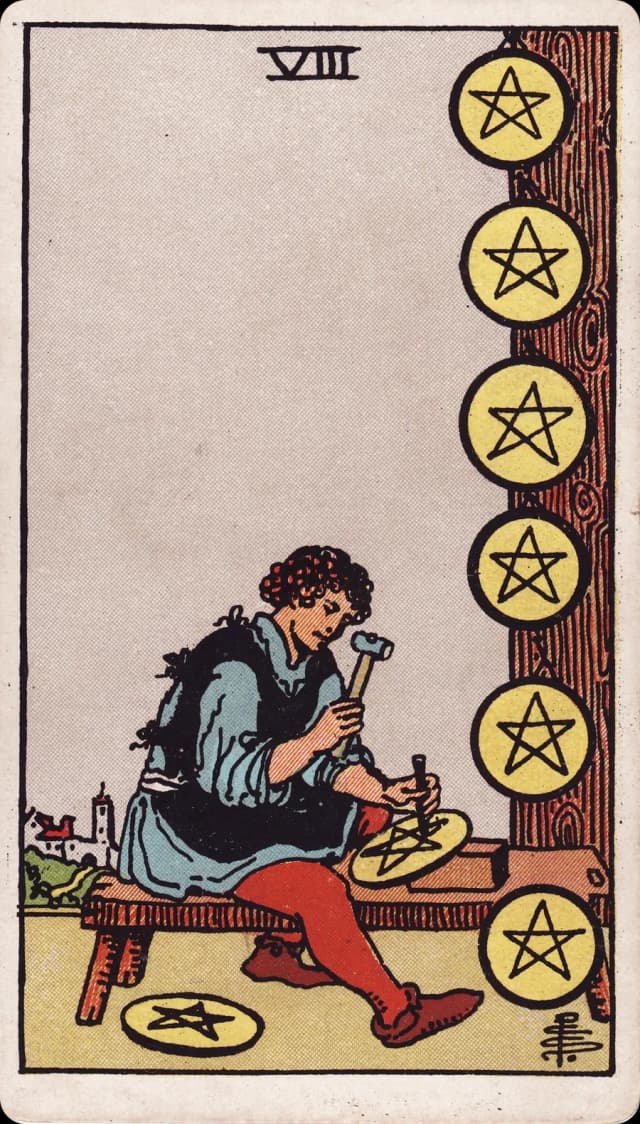
An artist in stone at his work, which he exhibits in the form of trophies. Divinatory Meanings: Work, employment, commission, craftsmanship, skill in craft and business, perhaps in the preparatory stage. Reversed: Voided ambition, vanity, cupidity, exaction, usury. It may also signify the possession of skill, in the sense of the ingenious mind turned to cunning and intrigue.
돌을 다루는 장인이 일하고 있고, 그 결과물을 전리품처럼 내걸어 보인다. 점술 의미: 일, 고용, 위탁, 장인의 솜씨, 기술과 사업에서의 기량 — 어쩌면 아직 준비 단계의 것. 역방향: 무산된 야심, 허영, 탐욕, 갈취, 고리대. 또한 재간을 지녔다는 뜻일 수도 있는데, 영리한 머리가 교활과 술책 쪽으로 돌아섰다는 뜻에서 그렇다.
PENTACLES / Seven
펜타클 / 7
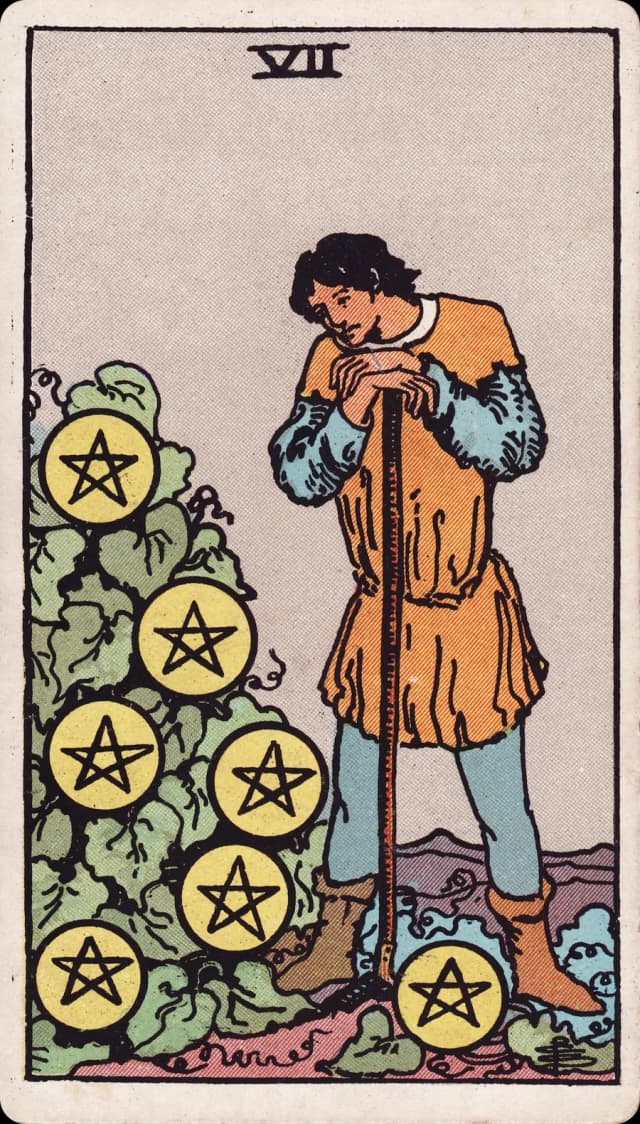
A young man, leaning on his staff, looks intently at seven pentacles attached to a clump of greenery on his right; one would say that these were his treasures and that his heart was there. Divinatory Meanings: These are exceedingly contradictory; in the main, it is a card of money, business, barter; but one reading gives altercation, quarrel—and another innocence, ingenuity, purgation. Reversed: Cause for anxiety regarding money which it may be proposed to lend.
젊은이가 자기 막대에 기대어, 오른쪽 덤불 더미에 달린 일곱 개의 펜타클을 골똘히 바라본다. 그것이 그의 보물이고 그의 마음이 거기 가 있다고 말할 법하다. 점술 의미: 이것들은 지독히도 서로 어긋난다. 대체로는 돈과 사업과 흥정의 카드다. 그러나 한 읽기는 언쟁과 다툼을 주고, 또 다른 읽기는 무구함, 재간, 정화를 준다. 역방향: 빌려주려 하는 돈을 두고 걱정할 만한 사유.
PENTACLES / Six
펜타클 / 6
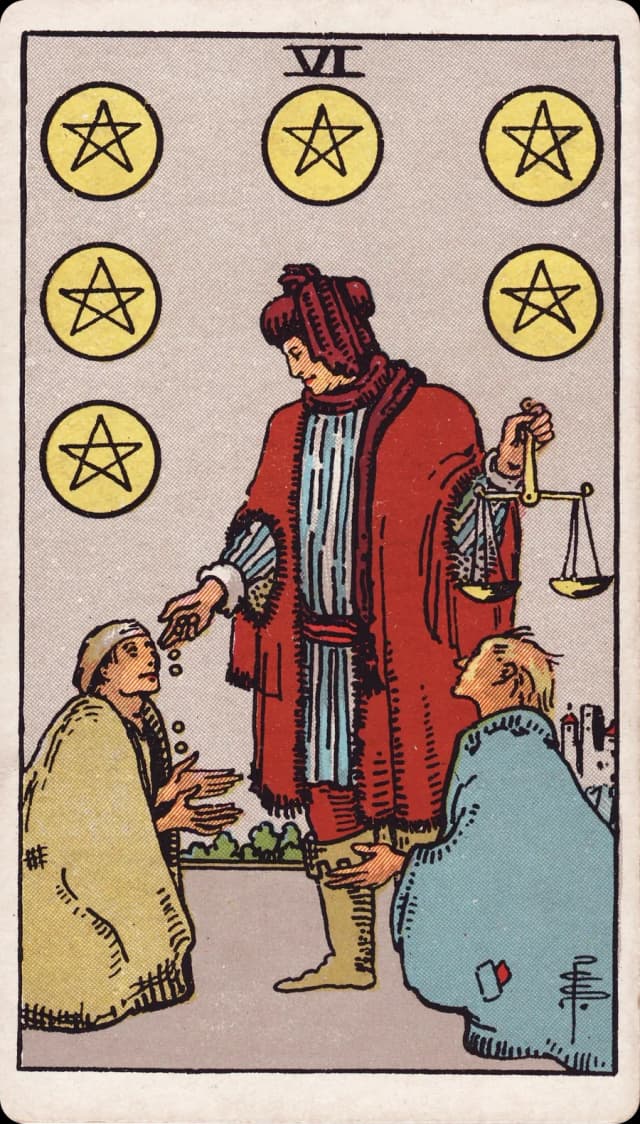
A person in the guise of a merchant weighs money in a pair of scales and distributes it to the needy and distressed. It is a testimony to his own success in life, as well as to his goodness of heart. Divinatory Meanings: Presents, gifts, gratification; another account says attention, vigilance; now is the accepted time, present prosperity, etc. Reversed: Desire, cupidity, envy, jealousy, illusion.
상인 차림의 사람이 저울로 돈을 달아 궁핍하고 어려운 이들에게 나눠 준다. 이는 그의 마음씨가 좋다는 증언이자 그가 삶에서 거둔 성공에 대한 증언이기도 하다. 점술 의미: 선물, 증여, 흡족함. 다른 설명은 주의와 경계라 한다. 지금이 바로 그때다, 현재의 번영 따위. 역방향: 욕구, 탐욕, 시기, 질투, 착각.
PENTACLES / Five
펜타클 / 5
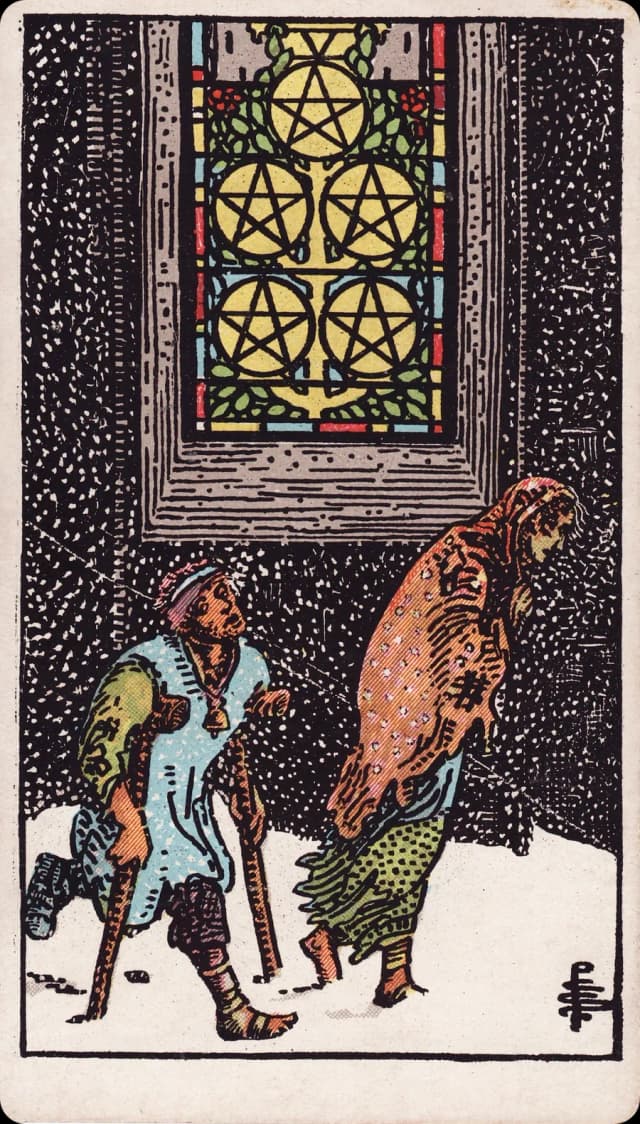
Two mendicants in a snow-storm pass a lighted casement. Divinatory Meanings: The card foretells material trouble above all, whether in the form illustrated—that is, destitution—or otherwise. For some cartomancists, it is a card of love and lovers—wife, husband, friend, mistress; also concordance, affinities. These alternatives cannot be harmonized. Reversed: Disorder, chaos, ruin, discord, profligacy.
눈보라 속의 두 걸인이 불 밝힌 여닫이창을 지나간다. 점술 의미: 이 카드는 무엇보다 물질적 곤경을 미리 알린다. 그림에 나온 형태 — 곧 궁핍 — 로든 다른 형태로든 그렇다. 어떤 카드점 술사들에게 이것은 사랑과 연인의 카드다 — 아내, 남편, 친구, 연인. 또한 어울림과 친연. 이 두 갈래는 조화될 수 없다. 역방향: 무질서, 혼돈, 파멸, 불화, 방탕.
PENTACLES / Four
펜타클 / 4
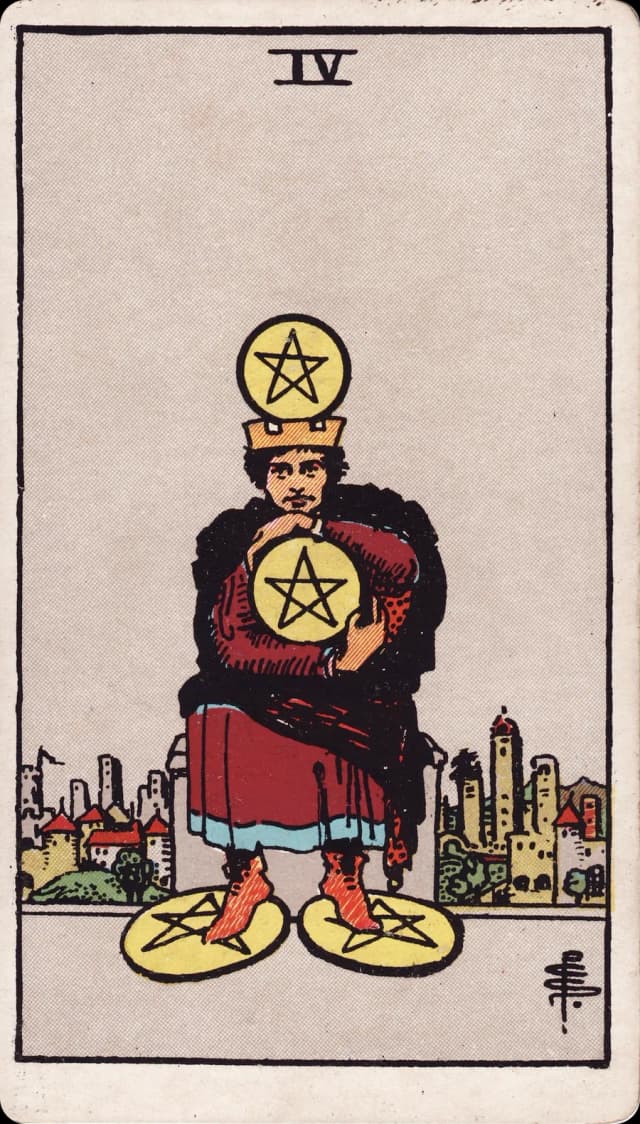
A crowned figure, having a pentacle over his crown, clasps another with hands and arms; two pentacles are under his feet. He holds to that which he has. Divinatory Meanings: The surety of possessions, cleaving to that which one has, gift, legacy, inheritance. Reversed; Suspense, delay, opposition.
왕관을 쓴 인물이 그 관 위에 펜타클 하나를 얹고, 또 하나를 두 손과 팔로 끌어안고 있다. 발밑에는 펜타클 둘이 있다. 그는 자기가 가진 것을 붙들고 있다. 점술 의미: 소유의 확실함, 가진 것에 매달림, 선물, 유증, 상속. 역방향: 조마조마함, 지연, 반목.
PENTACLES / Three
펜타클 / 3
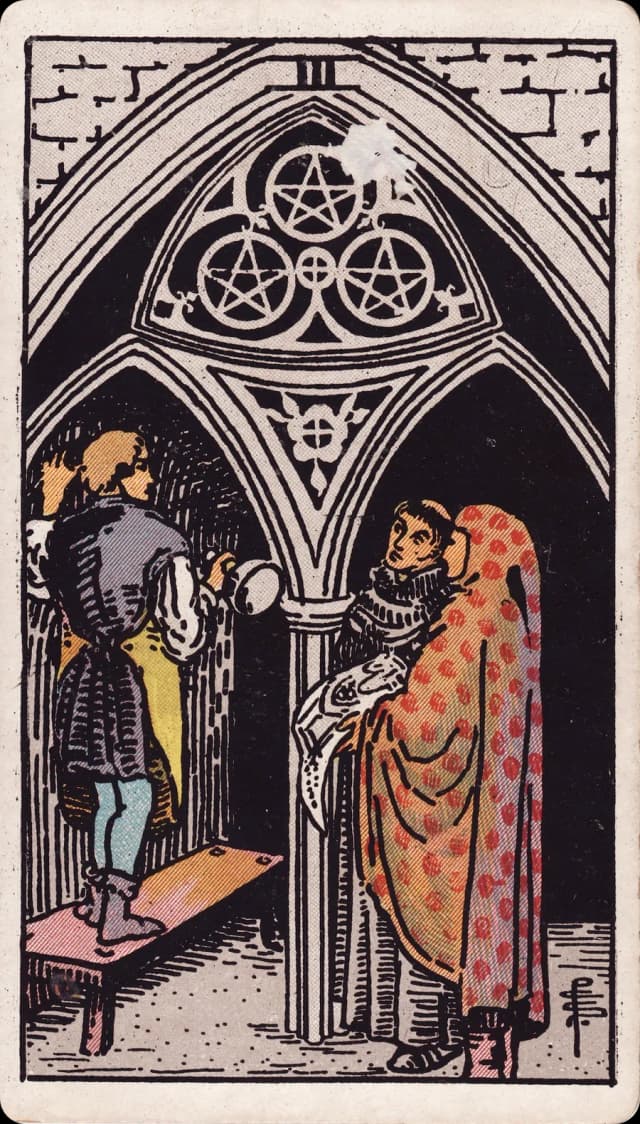
A sculptor at his work in a monastery. Compare the design which illustrates the Eight of Pentacles. The apprentice or amateur therein has received his reward and is now at work in earnest. Divinatory Meanings: Métier, trade, skilled labour; usually, how-ever, regarded as a card of nobility, aristocracy, renown, glory. Reversed: Mediocrity, in work and otherwise, puerility, pettiness, weakness.
수도원에서 조각가가 일하고 있다. 펜타클 8을 그린 도안과 견주어 보라. 거기 있던 도제 혹은 아마추어가 보상을 받았고 이제 본격적으로 일하고 있는 것이다. 점술 의미: 직능, 생업, 숙련된 노동. 다만 대개는 고귀함, 귀족, 명성, 영광의 카드로 여겨진다. 역방향: 일에서든 다른 데서든 범속함, 유치함, 좀스러움, 나약함.
PENTACLES / Two
펜타클 / 2
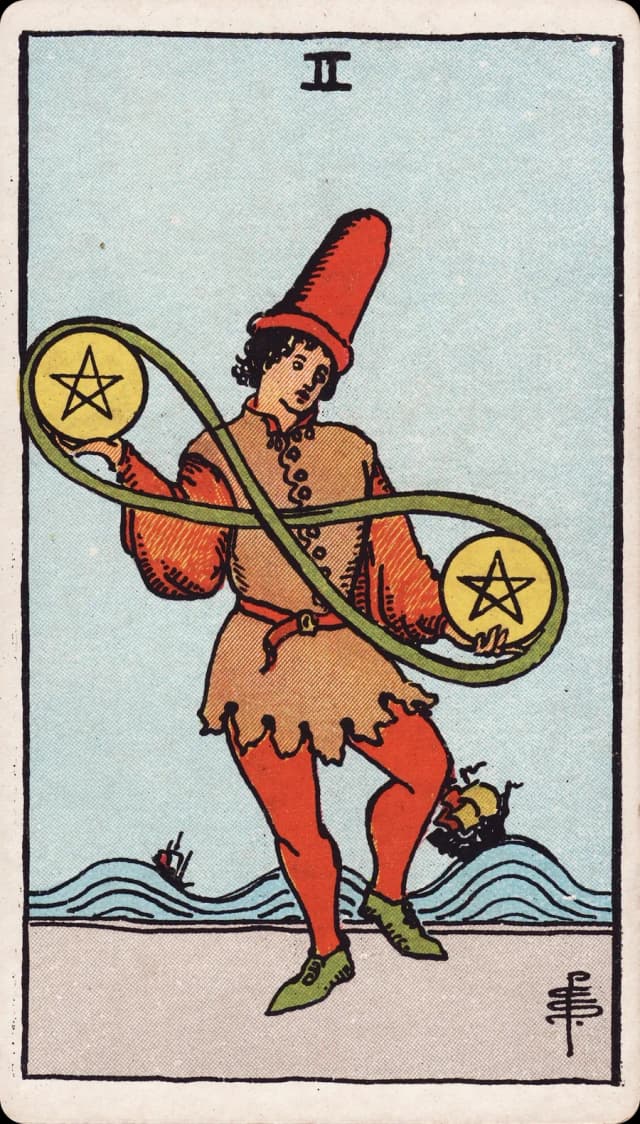
A young man, in the act of dancing, has a pentacle in either hand, and they are joined by that endless cord which is like the number 8 reversed. Divinatory Meanings: On the one hand it is represented as a card of gaiety, recreation and its connexions, which is the subject of the design; but it is read also as news and messages in writing, as obstacles, agitation, trouble, embroilment. Reversed: Enforced gaiety, simulated enjoyment, literal sense, handwriting, composition, letters of exchange.
춤추는 자세의 젊은이가 양손에 펜타클을 하나씩 들고 있고, 그 둘은 숫자 8을 옆으로 뉜 것 같은 끝없는 끈으로 이어져 있다. 점술 의미: 한편으로는 유쾌함과 놀이, 그리고 그에 딸린 것들의 카드로 제시되며 그것이 이 도안의 주제다. 그러나 글로 된 소식과 전언으로도 읽히고, 장애, 동요, 곤경, 뒤엉킴으로도 읽힌다. 역방향: 억지스러운 유쾌함, 꾸며 낸 즐거움. 글자 그대로의 뜻으로는 필적, 작문, 환어음.
PENTACLES / Ace
펜타클 / 에이스
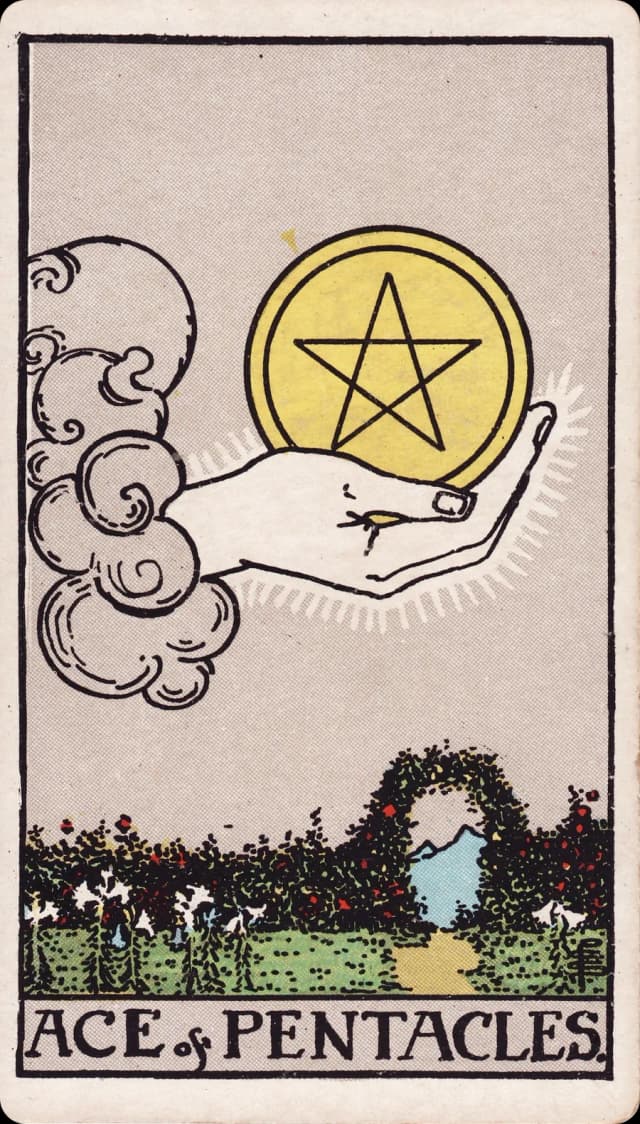
A hand—issuing, as usual, from a cloud—holds up a pentacle. Divinatory Meanings: Perfect contentment, felicity, ecstasy; also speedy intelligence; gold. Reversed: The evil side of wealth, bad intelligence; also great riches. In any case it shews prosperity, comfortable material conditions, but whether these are of advantage to the possessor will depend on whether the card is reversed or not.
여느 때처럼 구름에서 나온 손이 펜타클을 들어 올리고 있다. 점술 의미: 더할 나위 없는 흡족함, 행복, 황홀. 또한 빠른 소식. 금(金). 역방향: 부의 나쁜 쪽, 나쁜 소식. 또한 큰 재물. 어느 경우든 번영과 넉넉한 물질적 형편을 보여주지만, 그것이 가진 이에게 이로울지는 이 카드가 뒤집혔는지 아닌지에 달려 있다.
Such are the intimations of the Lesser Arcana in respect of divinatory art, the veridic nature of which seems to depend on an alternative that it may be serviceable to express briefly. The records of the art are ex hypothesi the records of findings in the past based upon experience; as such, they are a guide to memory, and those who can master the elements may—still ex hypothesi—give interpretations on their basis. It is an official and automatic working. On the other hand, those who have gifts of intuition, of second sight, of clairvoyance—call it as we choose and may—will supplement the experience of the past by the findings of their own faculty, and will speak of that which they have seen in the pretexts of the oracles. It remains to give, also briefly, the divinatory significance allocated by the same art to the Trumps Major.
소아르카나가 점술의 기예에 관해 제시하는 암시는 이상과 같으며, 그 참된 성격은 간략히 표현해 볼 만한 하나의 대안에 달려 있는 것으로 보인다. 그 기예의 기록들은 가설적으로 과거에 경험에 근거하여 얻어진 결과의 기록이다. 그런 것으로서 그것들은 기억에 대한 안내이며, 그 요소를 숙달한 이들은 — 여전히 가설적으로 — 그 토대 위에서 해석을 내놓을 수 있다. 이는 공식적이고 기계적인 작업이다. 다른 한편으로, 직관의 재능, 투시력, 천리안 — 어떻게 부르든 — 을 지닌 이들은 과거의 경험을 자기 능력의 발견으로 보충할 것이며, 신탁의 구실 안에서 자기가 본 바를 말할 것이다. 이제 같은 기예가 대아르카나에 배정한 점술 의미도 마찬가지로 간략히 제시할 차례다.
§ 3
§ 3
THE GREATER ARCANA AND THEIR DIVINATORY MEANINGS
대아르카나와 그 점술 의미
1. The Magician.—Skill, diplomacy, address, subtlety; sickness, pain, loss, disaster, snares of enemies; self-confidence, will; the Querent, if male. Reversed: Physician, Magus, mental disease, disgrace, disquiet.
1. 마법사 — 기량, 처세, 수완, 섬세함. 병, 고통, 상실, 재난, 적들의 덫. 자신감, 의지. 질문자가 남자라면 질문자 자신. 역방향: 의사, 마구스, 정신의 병, 불명예, 불안.
2. The High Priestess.—Secrets, mystery, the future as yet unrevealed; the woman who interests the Querent, if male; the Querent herself, if female; silence, tenacity; mystery, wisdom, science. Reversed: Passion, moral or physical ardour, conceit, surface knowledge.
2. 여사제 — 비밀, 신비, 아직 드러나지 않은 앞날. 질문자가 남자라면 그가 마음을 두는 여자, 여자라면 질문자 자신. 침묵, 끈질김. 신비, 지혜, 학문. 역방향: 정열, 도덕적 또는 육체적 열기, 자만, 겉핥기 지식.
3. The Empress.—Fruitfulness, action, initiative, length of days; the unknown, clandestine; also difficulty, doubt, ignorance. Reversed: Light, truth, the unravelling of involved matters, public rejoicings; according to another reading, vacillation.
3. 여황제 — 다산, 행동, 주도, 긴 날들. 알려지지 않은 것, 은밀한 것. 또한 곤란, 의심, 무지. 역방향: 빛, 진실, 얽힌 일이 풀림, 공개적인 기쁨. 다른 읽기에 따르면 흔들림.
4. The Emperor.—Stability, power, protection, realization; a great person; aid, reason, conviction; also authority and will. Reversed: Benevolence, compassion, credit; also confusion to enemies, obstruction, immaturity.
4. 황제 — 안정, 권능, 보호, 실현. 큰 인물. 도움, 이성, 확신. 또한 권위와 의지. 역방향: 자비, 연민, 신뢰. 또한 적들의 혼란, 방해, 미숙.
5. The Hierophant.—Marriage, alliance, captivity, servitude; by another account, mercy and goodness; inspiration; the man to whom the Querent has recourse. Reversed: Society, good understanding, concord, over-kindness, weakness.
5. 교황 — 결혼, 동맹, 사로잡힘, 예속. 다른 설명으로는 자비와 선함. 영감. 질문자가 의지하는 남자. 역방향: 사교, 좋은 이해, 화합, 지나친 친절, 나약.
6. The Lovers.—Attraction, love, beauty, trials overcome. Reversed: Failure, foolish designs. Another account speaks of marriage frustrated and contrarieties of all kinds.
6. 연인 — 끌림, 사랑, 아름다움, 극복한 시련. 역방향: 실패, 어리석은 계획. 다른 설명은 좌절된 결혼과 온갖 종류의 어긋남을 말한다.
7. The Chariot.—Succour, providence; also war, triumph, presumption, vengeance, trouble. Reversed: Riot, quarrel, dispute, litigation, defeat.
7. 전차 — 구원, 섭리. 또한 전쟁, 개가, 주제넘음, 복수, 곤경. 역방향: 소요, 다툼, 분쟁, 소송, 패배.
8. Fortitude.—Power, energy, action, courage, magnanimity; also complete success and honours. Reversed: Despotism, abuse of power, weakness, discord, sometimes even disgrace.
8. 불굴(힘) — 권능, 활력, 행동, 용기, 도량. 또한 완전한 성공과 명예. 역방향: 전횡, 권력 남용, 나약, 불화, 때로는 불명예까지.
9. The Hermit.—Prudence, circumspection; also and especially treason, dissimulation, roguery, corruption. Reversed: Concealment, disguise, policy, fear, unreasoned caution.
9. 은둔자 — 신중, 조심. 또한, 그리고 특히, 배반, 시치미, 사기, 부패. 역방향: 숨김, 위장, 술수, 두려움, 까닭 없는 경계.
10. Wheel of Fortune.—Destiny, fortune, success, elevation, luck, felicity. Reversed: Increase, abundance, superfluity.
10. 운명의 수레바퀴 — 운명, 행운, 성공, 높아짐, 요행, 행복. 역방향: 늘어남, 넉넉함, 남아돎.
11. Justice.—Equity, rightness, probity, executive; triumph of the deserving side in law. Reversed: Law in all its departments, legal complications, bigotry, bias, excessive severity.
11. 정의 — 공정, 올바름, 청렴, 집행. 법정에서 마땅한 쪽의 승리. 역방향: 온갖 분야의 법률, 법적 분규, 편협, 편향, 지나친 엄격.
12. The Hanged Man.—Wisdom, circumspection, discernment, trials, sacrifice, intuition, divination, prophecy. Reversed: Selfishness, the crowd, body politic.
12. 매달린 남자 — 지혜, 조심, 분별, 시련, 희생, 직관, 점술, 예언. 역방향: 이기심, 군중, 정치체.
13. Death.—End, mortality, destruction, corruption; also, for a man, the loss of a benefactor; for a woman, many contrarieties; for a maid, failure of marriage projects. Reversed: Inertia, sleep, lethargy, petrifaction, somnambulism; hope destroyed.
13. 죽음 — 끝, 죽음, 파괴, 부패. 또한 남자에게는 후원자를 잃음, 여자에게는 숱한 어긋남, 처녀에게는 혼담의 무산. 역방향: 무기력, 잠, 늘어짐, 굳어짐, 몽유. 무너진 희망.
14. Temperance.—Economy, moderation, frugality, management, accommodation. Reversed: Things connected with churches, religions, sects, the priesthood, sometimes even the priest who will marry the Querent; also disunion, unfortunate combinations, competing interests.
14. 절제 — 절약, 절도, 검약, 경영, 조정. 역방향: 교회·종교·종파·성직에 관계된 일들, 때로는 질문자의 혼인을 주례할 사제까지. 또한 분열, 불운한 결합, 이해의 충돌.
15. The Devil.—Ravage, violence, vehemence, extraordinary efforts, force, fatality; that which is predestined but is not for this reason evil. Reversed: Evil fatality, weakness, pettiness, blindness.
15. 악마 — 황폐, 폭력, 격렬함, 예사롭지 않은 분투, 힘, 숙명. 미리 정해졌으되 그렇다고 해서 악한 것은 아닌 것. 역방향: 악한 숙명, 나약, 좀스러움, 눈멂.
16. The Tower.—Misery, distress, indigence, adversity, calamity, disgrace, deception, ruin. It is a card in particular of unforeseen catastrophe. Reversed: According to one account, the same in a lesser degree; also oppression, imprisonment, tyranny.
16. 탑 — 비참, 고통, 궁핍, 역경, 재난, 불명예, 기만, 파멸. 특히 예견하지 못한 파국의 카드다. 역방향: 어떤 설명에 따르면 같은 것이되 정도가 덜하다. 또한 억압, 갇힘, 폭정.
17. The Star.—Loss, theft, privation, abandonment; another reading says—hope and bright prospects, Reversed: Arrogance, haughtiness, impotence.
17. 별 — 상실, 도둑맞음, 결핍, 버려짐. 다른 읽기는 희망과 밝은 전망이라 한다. 역방향: 오만, 거만, 무력.
18. The Moon.—Hidden enemies, danger, calumny, darkness, terror, deception, occult forces, error. Reversed: Instability, inconstancy, silence, lesser degrees of deception and error.
18. 달 — 숨은 적, 위험, 중상, 어둠, 공포, 기만, 오컬트의 힘, 오류. 역방향: 불안정, 변덕, 침묵, 정도가 덜한 기만과 오류.
19. The Sun.—Material happiness, fortunate marriage, contentment. Reversed: The same in a lesser sense.
19. 태양 — 물질적 행복, 복된 결혼, 흡족함. 역방향: 같은 것이되 뜻이 덜하다.
20. The Last Judgment.—Change of position, renewal, outcome. Another account specifies total loss though lawsuit. Reversed: Weakness, pusillanimity, simplicity; also deliberation, decision, sentence.
20. 심판 — 자리의 바뀜, 새로워짐, 결말. 다른 설명은 소송으로 인한 전면적 손실을 짚는다. 역방향: 나약, 소심, 단순함. 또한 숙고, 결정, 판결.
Zero. The Fool.—Folly, mania, extravagance, intoxication, delirium, frenzy, bewrayment. Reversed: Negligence, absence, distribution, carelessness, apathy, nullity, vanity.
영(零). 바보 — 어리석음, 광기, 방종, 취함, 헛소리, 광란, 폭로. 역방향: 태만, 부재, 흩어 놓음, 부주의, 무심, 무효, 헛됨.
21. The World.—Assured success, recompense, voyage, route, emigration, flight, change of place. Reversed: Inertia, fixity, stagnation, permanence.
21. 세계 — 확실한 성공, 보답, 항해, 노정, 이민, 도피, 자리의 옮김. 역방향: 무기력, 고착, 정체, 그대로 머묾.
It will be seen that, except where there is an irresistible suggestion conveyed by the surface meaning, that which is extracted from the Trumps Major by the divinatory art is at once artificial and arbitrary, as it seems to me, in the highest degree. But of one order are the mysteries of light and of another are those of fantasy. The allocation of a fortune-telling aspect to these cards is the story of a prolonged impertinence.
보다시피, 표면의 뜻이 거스를 수 없는 실마리를 주는 경우를 빼면, 점술이라는 기예가 대아르카나에서 뽑아낸 것은 — 내가 보기에 — 더할 나위 없이 인위적이고 자의적이다. 그러나 빛의 신비는 한 갈래이고 공상의 신비는 다른 갈래다. 이 카드들에 카드점의 측면을 배정한 일은 오래 이어진 주제넘음의 내력이다.
§ 4
§ 4
SOME ADDITIONAL MEANINGS OF THE LESSER ARCANA
소아르카나의 몇 가지 추가 의미
Wands. King.—Generally favourable; may signify a good marriage. Reversed: Advice that should be followed.
완드. 킹 — 대체로 순조롭다. 좋은 혼사를 뜻할 수 있다. 역방향: 따르는 편이 좋은 조언.
Queen.—A good harvest, which may be taken in several senses. Reversed: Good-will towards the Querent, but without the opportunity to exercise it.
퀸 — 좋은 수확. 여러 뜻으로 새길 수 있다. 역방향: 질문자를 향한 호의. 다만 그것을 베풀 기회가 없다.
Knight.—A bad card; according to some readings, alienation. Reversed: For a woman, marriage, but probably frustrated.
나이트 — 나쁜 카드. 어떤 읽기에 따르면 소원해짐. 역방향: 여자에게는 결혼. 다만 아마도 좌절될 것이다.
Page.—Young man of family in search of young lady. Reversed: Bad news.
페이지 — 참한 처녀를 찾는 좋은 집안의 젊은 남자. 역방향: 나쁜 소식.
Ten.—Difficulties and contradictions, if near a good card.
10 — 좋은 카드 곁에 있다면 곤란과 어긋남.
Nine.—Generally speaking, a bad card.
9 — 대체로 말해 나쁜 카드.
Eight.—Domestic disputes for a married person.
8 — 기혼자에게는 집안의 다툼.
Seven.—A dark child.
7 — 살빛이 짙은 아이.
Six.—Servants may lose the confidence of their masters; a young lady may be betrayed by a friend. Reversed: Fulfilment of deferred hope.
6 — 하인이 주인의 신임을 잃을 수 있다. 젊은 여자가 벗에게 배신당할 수 있다. 역방향: 미뤄졌던 희망이 이루어짐.
Five.—Success in financial speculation. Reversed: Quarrels may be turned to advantage.
5 — 재정 투기에서의 성공. 역방향: 다툼이 오히려 득이 될 수 있다.
Four.—Unexpected good fortune. Reversed: A married woman will have beautiful children.
4 — 뜻밖의 행운. 역방향: 기혼 여성이 아름다운 아이를 낳을 것이다.
Three.—A very good card; collaboration will favour enterprise.
3 — 매우 좋은 카드. 협력이 사업에 유리하게 작용할 것이다.
Two.—A young lady may expect trivial disappointments.
2 — 젊은 여자는 사소한 실망을 겪을 수 있다.
Ace.—Calamities of all kinds. Reversed: A sign of birth.
에이스 — 온갖 종류의 재난. 역방향: 출생의 조짐.
Cups. King.—Beware of ill-will on the part of a man of position, and of hypocrisy pretending to help. Reversed: Loss.
컵. 킹 — 지위 있는 남자의 악의를, 그리고 돕는 척하는 위선을 조심하라. 역방향: 상실.
Queen.—Sometimes denotes a woman of equivocal character. Reversed: A rich marriage for a man and a distinguished one for a woman.
퀸 — 때로는 성품이 모호한 여자를 가리킨다. 역방향: 남자에게는 부유한 혼사, 여자에게는 격이 높은 혼사.
Knight.—A visit from a friend, who will bring unexpected money to the Querent. Reversed: Irregularity.
나이트 — 벗의 방문. 그가 질문자에게 뜻밖의 돈을 가져올 것이다. 역방향: 어긋남.
Page.—Good augury; also a young man who is unfortunate in love. Reversed: Obstacles of all kinds.
페이지 — 좋은 조짐. 또한 사랑에 운이 없는 젊은 남자. 역방향: 온갖 종류의 장애.
Ten.—For a male Querent, a good marriage and one beyond his expectations. Reversed: Sorrow; also a serious quarrel.
10 — 남자 질문자에게는 좋은 혼사, 그것도 기대를 넘어서는 혼사. 역방향: 슬픔. 또한 심각한 다툼.
Nine.—Of good augury for military men. Reversed: Good business.
9 — 군인에게 좋은 조짐. 역방향: 좋은 사업.
Eight.—Marriage with a fair woman. Reversed: Perfect satisfaction.
8 — 살빛이 밝은 여자와의 결혼. 역방향: 더할 나위 없는 만족.
Seven.—Fair child; idea, design, resolve, movement. Reversed: Success, if accompanied by the Three of Cups.
7 — 살빛이 밝은 아이. 착상, 계획, 결심, 움직임. 역방향: 컵 3이 함께 나오면 성공.
Six.—Pleasant memories. Reversed: Inheritance to fall in quickly.
6 — 즐거운 기억. 역방향: 곧 굴러들 상속.
Five.—Generally favourable; a happy marriage; also patrimony, legacies, gifts, success in enterprise. Reversed: Return of some relative who has not been seen for long.
5 — 대체로 순조롭다. 행복한 결혼. 또한 세습 재산, 유산, 선물, 사업에서의 성공. 역방향: 오래 보지 못한 친척의 돌아옴.
Four.—Contrarieties. Reversed: Presentiment.
4 — 어긋남. 역방향: 예감.
Three.—Unexpected advancement for military man. Reversed: Consolation, cure. end of the business.
3 — 군인에게 뜻밖의 승진. 역방향: 위로, 치유. 그 일의 끝.
Two.—Favourable in things of pleasure and business, as well as love; also wealth and honour. Reversed: Passion.
2 — 즐거움과 사업의 일에서, 그리고 사랑에서도 순조롭다. 또한 부와 명예. 역방향: 정열.
Ace.—Inflexible will, unalterable law. Reversed: Unexpected change of position.
에이스 — 굽히지 않는 의지, 바뀌지 않는 법. 역방향: 뜻밖의 자리 변동.
Swords. King.—A lawyer, senator, doctor. Reversed: A bad man; also a caution to put an end to a ruinous lawsuit.
소드. 킹 — 법률가, 의원, 의사. 역방향: 나쁜 남자. 또한 파멸을 부르는 소송을 끝내라는 경고.
Queen.—A widow. Reversed: A bad woman, with ill-will towards the Querent.
퀸 — 과부. 역방향: 질문자에게 악의를 품은 나쁜 여자.
Knight.—A soldier, man of arms, satellite, stipendiary; heroic action predicted for soldier. Reversed: Dispute with an imbecile person; for a woman, struggle with a rival, who will be conquered.
나이트 — 군인, 무인, 수하, 봉급받는 자. 군인에게는 영웅적 행동이 예고된다. 역방향: 아둔한 자와의 분쟁. 여자에게는 경쟁자와의 싸움이되 그 경쟁자는 꺾일 것이다.
Page.—An indiscreet person will pry into the Querent's secrets. Reversed: Astonishing news.
페이지 — 입이 가벼운 자가 질문자의 비밀을 캐낼 것이다. 역방향: 놀라운 소식.
Ten.—Followed by Ace and King, imprisonment; for girl or wife, treason on the part of friends. Reversed: Victory and consequent fortune for a soldier in war.
10 — 에이스와 킹이 뒤따르면 갇힘. 처녀나 아내에게는 벗들의 배신. 역방향: 전장의 군인에게는 승리와 그에 따르는 행운.
Nine.—An ecclesiastic, a priest; generally, a card of bad omen. Reversed: Good ground for suspicion against a doubtful person.
9 — 성직자, 사제. 대체로 나쁜 조짐의 카드. 역방향: 미심쩍은 사람을 의심할 만한 충분한 근거.
Eight.—For a woman, scandal spread in her respect. Reversed: Departure of a relative.
8 — 여자에게는 자기에 관해 퍼지는 추문. 역방향: 친척의 떠남.
Seven.—Dark girl; a good card; it promises a country life after a competence has been secured. Reversed: Good advice, probably neglected.
7 — 살빛이 짙은 처녀. 좋은 카드다. 살림이 넉넉해진 뒤의 시골살이를 약속한다. 역방향: 좋은 조언이되 아마도 흘려들을 것이다.
Six.—The voyage will be pleasant. Reversed: Unfavourable issue of lawsuit.
6 — 항해가 순조로울 것이다. 역방향: 소송의 불리한 결말.
Five.—An attack on the fortune of the Querent. Reversed: A sign of sorrow and mourning.
5 — 질문자의 재산에 대한 공격. 역방향: 슬픔과 애도의 조짐.
Four.—A bad card, but if reversed a qualified success may be expected by wise administration of affairs. Reversed: A certain success following wise administration.
4 — 나쁜 카드. 다만 뒤집히면 일을 지혜롭게 처리함으로써 제한된 성공을 기대할 수 있다. 역방향: 지혜로운 처리에 뒤따르는 확실한 성공.
Three.—For a woman, the flight of her lover. Reversed: A meeting with one whom the Querent has compromised; also a nun.
3 — 여자에게는 연인의 달아남. 역방향: 질문자가 곤란하게 만든 사람과의 만남. 또한 수녀.
Two.—Gifts for a lady, influential protection for a man in search of help. Reversed: Dealings with rogues.
2 — 여자에게는 선물, 도움을 구하는 남자에게는 힘 있는 보호. 역방향: 사기꾼들과 얽힘.
Ace.—Great prosperity or great misery. Reversed: Marriage broken off, for a woman, through her own imprudence.
에이스 — 큰 번영 아니면 큰 비참. 역방향: 파혼. 여자에게는 제 경솔함 때문에.
Pentacles. King.—A rather dark man, a merchant, master, professor. Reversed: An old and vicious man.
펜타클. 킹 — 살빛이 다소 짙은 남자, 상인, 주인, 교수. 역방향: 늙고 사악한 남자.
Queen.—Dark woman; presents from a rich relative; rich and happy marriage for a young man. Reversed: An illness.
퀸 — 살빛이 짙은 여자. 부유한 친척에게서 오는 선물. 젊은 남자에게는 부유하고 행복한 혼사. 역방향: 병.
Knight.—An useful man; useful discoveries. Reversed: A brave man out of employment.
나이트 — 쓸모 있는 남자. 유용한 발견. 역방향: 일자리를 잃은 용감한 남자.
Page.—A dark youth; a young officer or soldier; a child. Reversed: Sometimes degradation and sometimes pillage.
페이지 — 살빛이 짙은 젊은이. 젊은 장교나 병사. 아이. 역방향: 때로는 격하, 때로는 약탈.
Ten.—Represents house or dwelling, and derives its value from other cards. Reversed: An occasion which may be fortunate or otherwise.
10 — 집이나 거처를 나타내며, 그 값은 다른 카드들에서 나온다. 역방향: 복이 될 수도 아닐 수도 있는 계기.
Nine.—Prompt fulfilment of what is presaged by neighbouring cards. Reversed: Vain hopes.
9 — 이웃한 카드들이 예고하는 바가 곧 이루어짐. 역방향: 헛된 희망.
Eight.—A young man in business who has relations with the Querent; a dark girl. Reversed: The Querent will be compromised in a matter of money-lending.
8 — 질문자와 거래가 있는 사업하는 젊은 남자. 살빛이 짙은 처녀. 역방향: 질문자가 돈을 빌려주는 일로 곤란해질 것이다.
Seven.—Improved position for a lady's future husband. Reversed: Impatience, apprehension, suspicion.
7 — 여자의 장래 남편이 될 사람의 형편이 나아짐. 역방향: 조바심, 우려, 의심.
Six.—The present must not be relied on. Reversed: A check on the Querent's ambition.
6 — 지금을 믿고 기대서는 안 된다. 역방향: 질문자의 야심에 걸리는 제동.
Five.—Conquest of fortune by reason. Reversed: Troubles in love.
5 — 이성으로 재물을 얻음. 역방향: 사랑의 곤경.
Four.—For a bachelor, pleasant news from a lady. Reversed: Observation, hindrances.
4 — 미혼 남자에게는 여자에게서 오는 반가운 소식. 역방향: 주시, 방해.
Three.—If for a man, celebrity for his eldest son. Reversed: Depends on neighbouring cards.
3 — 남자의 일이라면 맏아들의 명성. 역방향: 이웃한 카드들에 달려 있다.
Two.—Troubles are more imaginary than real. Reversed: Bad omen, ignorance, injustice.
2 — 곤경은 실제라기보다 상상에 가깝다. 역방향: 나쁜 조짐, 무지, 불의.
Ace.—The most favourable of all cards. Reversed: A share in the finding of treasure.
에이스 — 모든 카드 가운데 가장 순조로운 것. 역방향: 보물을 찾는 일에 한몫 끼임.
It will be observed (1) that these additamenta have little connexion with the pictorial designs of the cards to which they refer, as these correspond with the more important speculative values; (2) and further that the additional meanings are very often in disagreement with those previously given. All meanings are largely independent of one another and all are reduced, accentuated or subject to modification and sometimes almost reversal by their place in a sequence. There is scarcely any canon of criticism in matters of this kind. I suppose that in proportion as any system descends from generalities to details it becomes naturally the more precarious; and in the records of professional fortune-telling, it offers more of the dregs and lees of the subject. At the same time, divinations based on intuition and second sight are of little practical value unless they come down from the region of universals to that of particulars; but in proportion as this gift is present in a particular case, the specific meanings recorded by past cartomancists will be disregarded in favour of the personal appreciation of card values.
눈여겨볼 것은 (1) 이 추가분(additamenta) 이 그것이 가리키는 카드의 도안과 별 연관이 없다는 점이다. 도안은 더 중요한 사변적 값들과 대응하기 때문이다. (2) 나아가 이 추가 의미들이 앞서 제시한 의미들과 매우 자주 어긋난다는 점이다. 모든 의미는 대체로 서로 독립적이며, 배열 속의 자리에 따라 줄어들기도 하고 강조되기도 하며 수정되거나 때로는 거의 뒤집히기까지 한다. 이런 종류의 일에는 비평의 기준이랄 것이 거의 없다. 어떤 체계든 일반론에서 세부로 내려갈수록 자연히 더 위태로워지는 법이고, 직업적 카드점의 기록에서는 이 주제의 찌꺼기와 앙금이 더 많이 드러난다고 나는 생각한다. 그와 동시에, 직관과 영시(靈視)에 기댄 점은 보편의 영역에서 개별의 영역으로 내려오지 않는 한 실질적 가치가 거의 없다. 다만 그 재능이 어떤 경우에 있는 만큼, 지난 카드점 술사들이 기록해 둔 특정한 의미들은 카드 값에 대한 그 사람 자신의 판단에 밀려 무시될 것이다.
This has been intimated already. It seems necessary to add the following speculative readings.
이것은 이미 넌지시 말한 바다. 다음의 사변적 읽기들을 덧붙여 두는 것이 필요해 보인다.
§ 5
§ 5
THE RECURRENCE OF CARDS IN DEALING
패를 돌릴 때 카드가 겹쳐 나오는 경우
In the Natural Position
정방향일 때
4 Kings = great honour; 3 Kings = consultation; 2 Kings = minor counsel.
킹 4장 = 큰 명예. 킹 3장 = 상의. 킹 2장 = 가벼운 조언.
4 Queens = great debate; 3 Queens = deception by women; 2 Queens = sincere friends.
퀸 4장 = 큰 논쟁. 퀸 3장 = 여자들에게 속음. 퀸 2장 = 진실한 벗.
4 Knights = serious matters; 3 Knights = lively debate; 2 Knights = intimacy.
나이트 4장 = 중대한 일. 나이트 3장 = 활발한 논쟁. 나이트 2장 = 친밀함.
4 Pages = dangerous illness; 3 Pages = dispute; 2 Pages = disquiet.
페이지 4장 = 위중한 병. 페이지 3장 = 분쟁. 페이지 2장 = 불안.
4 Tens = condemnation; 3 Tens = new condition; 2 Tens = change.
10 4장 = 단죄. 10 3장 = 새로운 형편. 10 2장 = 변화.
4 Nines = a good friend; 3 Nines = success; 2 Nines = receipt.
9 4장 = 좋은 벗. 9 3장 = 성공. 9 2장 = 받음.
4 Eights = reverse; 3 Eights = marriage; 2 Eights = new knowledge.
8 4장 = 뒤집힘. 8 3장 = 결혼. 8 2장 = 새로운 앎.
4 Sevens = intrigue; 3 Sevens = infirmity; 2 Sevens = news.
7 4장 = 술책. 7 3장 = 병약. 7 2장 = 소식.
4 Sixes = abundance; 3 Sixes = success; 2 Sixes = irritability.
6 4장 = 넉넉함. 6 3장 = 성공. 6 2장 = 짜증.
4 Fives = regularity; 3 Fives = determination; 2 Fives = vigils.
5 4장 = 규칙적임. 5 3장 = 결단. 5 2장 = 뜬눈으로 새움.
4 Fours = journey near at hand; 3 Fours = a subject of reflection; 2 Fours = insomnia.
4 4장 = 머지않은 여행. 4 3장 = 곱씹을 거리. 4 2장 = 불면.
4 Threes = progress; 3 Threes = unity; 2 Threes = calm.
3 4장 = 진전. 3 3장 = 하나 됨. 3 2장 = 평온.
4 Twos = contention; 3 Twos = security; 2 Twos = accord.
2 4장 = 다툼. 2 3장 = 안전. 2 2장 = 합의.
4 Aces = favourable chance; 3 Aces = small success; 2 Aces = trickery.
에이스 4장 = 순조로운 기회. 에이스 3장 = 작은 성공. 에이스 2장 = 속임수.
Reversed
역방향일 때
4 Kings = celerity; 3 Kings = commerce; 2 Kings = projects.
킹 4장 = 신속. 킹 3장 = 상거래. 킹 2장 = 계획.
4 Queens = bad company; 3 Queens = gluttony; 2 Queens = work.
퀸 4장 = 나쁜 무리. 퀸 3장 = 탐식. 퀸 2장 = 일.
4 Knights = alliance; 3 Knights = a duel, or personal encounter; 2 Knights = susceptibility.
나이트 4장 = 동맹. 나이트 3장 = 결투, 또는 개인 간의 맞붙음. 나이트 2장 = 예민함.
4 Pages = privation; 3 Pages = idleness; 2 Pages = society.
페이지 4장 = 결핍. 페이지 3장 = 게으름. 페이지 2장 = 사교.
4 Tens = event, happening; 3 Tens = disappointment; 2 Tens = expectation justified.
10 4장 = 사건, 일어남. 10 3장 = 실망. 10 2장 = 기대가 들어맞음.
4 Nines = usury; 3 Nines = imprudence; 2 Nines = a small profit.
9 4장 = 고리대. 9 3장 = 경솔. 9 2장 = 작은 이익.
4 Eights = error; 3 Eights = a spectacle; 2 Eights = misfortune.
8 4장 = 오류. 8 3장 = 구경거리. 8 2장 = 불운.
4 Sevens = quarrellers; 3 Sevens = joy; 2 Sevens = women of no repute.
7 4장 = 다투는 자들. 7 3장 = 기쁨. 7 2장 = 평판이 좋지 않은 여자들.
4 Sixes = care; 3 Sixes = satisfaction; 2 Sixes = downfall.
6 4장 = 근심. 6 3장 = 만족. 6 2장 = 몰락.
4 Fives = order; 3 Fives = hesitation; 2 Fives = reverse.
5 4장 = 질서. 5 3장 = 망설임. 5 2장 = 뒤집힘.
4 Fours = walks abroad; 3 Fours = disquiet; 2 Fours = dispute.
4 4장 = 바깥나들이. 4 3장 = 불안. 4 2장 = 분쟁.
4 Threes = great success; 3 Threes = serenity; 2 Threes = safety.
3 4장 = 큰 성공. 3 3장 = 고요함. 3 2장 = 안전.
4 Twos = reconciliation; 3 Twos = apprehension; 2 Twos = mistrust.
2 4장 = 화해. 2 3장 = 우려. 2 2장 = 불신.
4 Aces = dishonour; 3 Aces = debauchery; 2 Aces = enemies.
에이스 4장 = 불명예. 에이스 3장 = 방탕. 에이스 2장 = 적들.
§ 6
§ 6
THE ART OF TAROT DIVINATION
타로 점의 기예
We come now to the final and practical part of this division of our subject, being the way to consult and obtain oracles by means of Tarot cards. The modes of operation are rather numerous, and some of them are exceedingly involved. I set aside those last mentioned, because persons who are versed in such questions believe that the way of simplicity is the way of truth. I set aside also the operations which have been republished recently in that section of The Tarot of the Bohemians which is entitled "The Divining Tarot"; it may be recommended at its proper value to readers who wish to go further than the limits of this handbook. I offer in the first place a short process which has been used privately for many years past in England, Scotland and Ireland. I do not think that it has been published—certainly not in connexion with Tarot cards; I believe that it will serve all purposes, but I will add—by way of variation—in the second place what used to be known in France as the Oracles of Julia Orsini.
이제 이 갈래의 마지막이자 실제적인 부분에 이르렀다. 곧 타로 카드로 신탁을 묻고 얻는 방법이다. 운용 방식은 꽤 여러 가지이고 그중 몇몇은 지독히 얽혀 있다. 나는 그 얽힌 것들을 제쳐 둔다. 이런 문제에 밝은 이들은 단순함의 길이 진리의 길이라고 믿기 때문이다. 또한 『보헤미안의 타로』 가운데 "점치는 타로"라는 제목이 붙은 대목에 최근 다시 실린 운용법들도 제쳐 둔다. 이 안내서의 범위보다 더 나아가고 싶은 독자에게는 그것이 제값만큼 권할 만하다. 나는 먼저, 지난 여러 해 동안 잉글랜드와 스코틀랜드와 아일랜드에서 사사로이 쓰여 온 짧은 절차를 내놓는다. 그것이 출간된 적은 없다고 생각하며 — 적어도 타로 카드와 관련해서는 분명히 없다 — 모든 쓰임에 충분하리라 믿는다. 다만 변형 삼아 두 번째로, 프랑스에서 쥘리아 오르시니의 신탁이라 불리던 것을 덧붙이겠다.
§ 7
§ 7
An Ancient Celtic Method of Divination
고대 켈트식 점법
This mode of divination is the most suitable for obtaining an answer to a definite question. The Diviner first selects a card to represent the person or matter about which inquiry is made. This card is called the Significator. Should he wish to ascertain something in connexion with himself he takes the one which corresponds to his personal description. A Knight should be chosen as the Significator if the subject of inquiry is a man of forty years old and upward; a King should be chosen for any male who is under that age; a Queen for a woman who is over forty years; and a Page for any female of less age.
이 점법은 분명한 질문에 대한 답을 얻는 데 가장 알맞다. 점치는 이는 먼저 물음의 대상이 되는 사람이나 사안을 나타낼 카드를 하나 고른다. 이 카드를 지시자(Significator)라 부른다. 자기 자신에 관해 무언가를 알아보려 한다면 자기 인상에 들어맞는 카드를 고른다. 물음의 대상이 마흔 살 이상의 남자라면 나이트를 지시자로 골라야 하고, 그 아래 나이의 남자라면 킹을, 마흔이 넘은 여자라면 퀸을, 그보다 어린 여자라면 페이지를 골라야 한다.
The four Court Cards in Wands represent very fair people, with yellow or auburn hair, fair complexion and blue eyes. The Court Cards in Cups signify people with light brown or dull fair hair and grey or blue eyes. Those in Swords stand for people having hazel or grey eyes, dark brown hair and dull complexion. Lastly, the Court Cards in Pentacles are referred to persons with very dark brown or black hair, dark eyes and sallow or swarthy complexions. These allocations are subject, however, to the following reserve, which will prevent them being taken too conventionally. You can be guided on occasion by the known temperament of a person; one who is exceedingly dark may be very energetic, and would be better represented by a Sword card than a Pentacle. On the other hand, a very fair subject who is indolent and lethargic should be referred to Cups rather than to Wands.
완드의 궁정 카드 넷은 살빛이 매우 밝고 머리가 노랗거나 적갈색이며 눈이 푸른 사람을 나타낸다. 컵의 궁정 카드는 밝은 갈색이나 흐린 금발 머리에 회색 또는 푸른 눈을 지닌 사람을 뜻한다. 소드의 것들은 담갈색이나 회색 눈, 짙은 갈색 머리, 칙칙한 살빛을 지닌 사람을 가리킨다. 끝으로 펜타클의 궁정 카드는 아주 짙은 갈색이나 검은 머리, 검은 눈, 누렇거나 거무스름한 살빛을 지닌 사람에게 배정된다. 다만 이 배정에는 다음과 같은 유보가 따르며, 그 덕분에 이를 너무 관례적으로 받아들이지 않게 된다. 때로는 알고 있는 그 사람의 기질을 따라도 된다. 살빛이 아주 짙은 사람이 대단히 활동적일 수 있고, 그렇다면 펜타클보다 소드 카드로 나타내는 편이 낫다. 반대로 살빛이 매우 밝은 사람이 굼뜨고 무기력하다면 완드보다 컵에 배정해야 한다.
If it is more convenient for the purpose of a divination to take as the Significator the matter about which inquiry is to be made, that Trump or small card should be selected which has a meaning corresponding to the matter. Let it be supposed that the question is: Will a lawsuit be necessary? In this case, take the Trump No. 11, or Justice, as the Significator. This has reference to legal affairs. But if the question is: Shall I be successful in my lawsuit? one of the Court Cards must be chosen as the Significator. Subsequently, consecutive divinations may be performed to ascertain the course of the process itself and its result to each of the parties concerned.
점을 치는 데 물음의 대상이 되는 사안 자체를 지시자로 삼는 편이 편하다면, 그 사안에 들어맞는 뜻을 지닌 대아르카나나 작은 카드를 고르면 된다. 물음이 "소송이 필요할까?"라고 해 보자. 이 경우에는 11번 대아르카나, 곧 정의를 지시자로 삼는다. 이 카드가 법률 문제와 관계있기 때문이다. 그러나 물음이 "내 소송에서 이길까?"라면 궁정 카드 가운데 하나를 지시자로 골라야 한다. 그다음에는 점을 잇달아 쳐서 소송 과정 자체와, 관련된 당사자 각각에게 돌아갈 결과를 알아볼 수 있다.
Having selected the Significator, place it on the table, face upwards. Then shuffle and cut the rest of the pack three times, keeping the faces of the cards downwards.
지시자를 고른 뒤 그것을 탁자 위에 앞면이 보이도록 놓는다. 그런 다음 나머지 패를 카드 앞면이 아래를 향하게 한 채 세 번 섞고 세 번 뗀다.
Turn up the top or First Card of the pack; cover the Significator with it, and say: This covers him. This card gives the influence which is affecting the person or matter of inquiry generally, the atmosphere of it in which the other currents work.
패의 맨 위 카드, 곧 첫 번째 카드를 뒤집는다. 그것으로 지시자를 덮으며 말한다. "이것이 그를 덮는다." 이 카드는 물음의 대상이 되는 사람이나 사안에 전반적으로 작용하는 영향을, 곧 다른 흐름들이 그 안에서 움직이는 분위기를 준다.
Turn up the Second Card and lay it across the First, saying: This crosses him. It shews the nature of the obstacles in the matter. If it is a favourable card, the opposing forces will not be serious, or it may indicate that something good in itself will not be productive of good in the particular connexion.
두 번째 카드를 뒤집어 첫 번째 카드 위에 가로질러 놓으며 말한다. "이것이 그를 가로지른다." 그것은 이 사안에서 장애가 어떤 성질인지를 보여준다. 순조로운 카드라면 맞서는 힘이 심각하지 않을 것이고, 또는 그 자체로는 좋은 무언가가 이 특정한 맥락에서는 좋은 결과를 낳지 못하리라는 뜻일 수도 있다.
Turn up the Third Card; place it above the Significator, and say: This crowns him. It represents (a) the Querent's aim or ideal in the matter; (b) the best that can be achieved under the circumstances, but that which has not yet been made actual.
세 번째 카드를 뒤집어 지시자 위에 놓으며 말한다. "이것이 그에게 관을 씌운다." 그것은 (a) 이 사안에서 질문자의 목표나 이상, (b) 지금 형편에서 이룰 수 있는 최선이되 아직 실제가 되지 않은 것을 나타낸다.
Turn up the Fourth Card; place it below the Significator, and say: This is beneath him. It shews the foundation or basis of the matter, that which has already passed into actuality and which the Significator has made his own.
네 번째 카드를 뒤집어 지시자 아래에 놓으며 말한다. "이것이 그의 밑에 있다." 그것은 이 사안의 토대나 바탕을, 곧 이미 실제가 되었고 지시자가 자기 것으로 삼은 것을 보여준다.
Turn up the Fifth Card; place it on the side of the Significator from which he is looking, and say: This is behind him. It gives the influence that is just passed, or is now passing away.
다섯 번째 카드를 뒤집어 지시자가 바라보는 쪽의 반대편에 놓으며 말한다. "이것이 그의 뒤에 있다." 그것은 막 지나갔거나 지금 지나가고 있는 영향을 준다.
N.B.—If the Significator is a Trump or any small card that cannot be said to face either way, the Diviner must decide before beginning the operation which side he will take it as facing.
주의 — 지시자가 대아르카나이거나 어느 쪽을 향한다고 말할 수 없는 작은 카드라면, 점치는 이는 시작하기 전에 그것이 어느 쪽을 향하는 것으로 볼지 정해 두어야 한다.
Turn up the Sixth Card; place it on the side that the Significator is facing, and say: This is before him. It shews the influence that is coming into action and will operate in the near future.
여섯 번째 카드를 뒤집어 지시자가 바라보는 쪽에 놓으며 말한다. "이것이 그의 앞에 있다." 그것은 이제 작용하기 시작해 가까운 앞날에 움직일 영향을 보여준다.
The cards are now disposed in the form of a cross, the Significator—covered by the First Card—being in the centre.
이제 카드는 십자 모양으로 놓였고, 첫 번째 카드에 덮인 지시자가 그 한가운데에 있다.
The next four cards are turned up in succession and placed one above the other in a line, on the right hand side of the cross.
다음 네 장을 차례로 뒤집어 십자의 오른편에 위아래로 한 줄을 이루도록 놓는다.
The first of these, or the Seventh Card of the operation, signifies himself—that is, the Significator—whether person or thing—and shews its position or attitude in the circumstances.
그중 첫 번째, 곧 이 운용의 일곱 번째 카드는 그 자신 — 사람이든 사물이든 지시자 — 을 뜻하며, 지금 형편에서 그것이 놓인 자리나 태도를 보여준다.
The Eighth Card signifies his house, that is, his environment and the tendencies at work therein which have an effect on the matter—for instance, his position in life, the influence of immediate friends, and so forth.
여덟 번째 카드는 그의 집, 곧 그의 환경과 그 안에서 이 사안에 영향을 미치며 작동하는 경향들을 뜻한다. 이를테면 그의 삶에서의 처지, 가까운 벗들의 영향 따위다.
The Ninth Card gives his hopes or fears in the matter.
아홉 번째 카드는 이 사안에 대한 그의 희망 또는 두려움을 준다.
The Tenth is what will come, the final result, the culmination which is brought about by the influences shewn by the other cards that have been turned up in the divination.
열 번째는 앞으로 올 것, 곧 최종 결과이며, 이 점에서 뒤집힌 다른 카드들이 보여준 영향들로 말미암아 이루어지는 귀결이다.
It is on this card that the Diviner should especially concentrate his intuitive faculties and his memory in respect of the official divinatory meanings attached thereto. It should embody whatsoever you may have divined from the other cards on the table, including the Significator itself and concerning him or it, not excepting such lights upon higher significance as might fall like sparks from heaven if the card which serves for the oracle, the card for reading, should happen to be a Trump Major.
점치는 이가 자기 직관의 능력과, 거기 붙은 공인된 점술 의미에 대한 기억을 특별히 집중해야 할 카드가 바로 이것이다. 그것은 탁자 위의 다른 카드들에서 — 지시자 자체를 포함해, 그리고 그 사람이나 사물에 관해 — 당신이 헤아려 낸 무엇이든 담아내야 한다. 신탁 노릇을 하는 카드, 곧 읽어야 할 그 카드가 마침 대아르카나라면 하늘에서 불티처럼 떨어질 법한 더 높은 뜻의 빛까지도 빼놓지 않고 말이다.
The operation is now completed; but should it happen that the last card is of a dubious nature, from which no final decision can be drawn, or which does not appear to indicate the ultimate conclusion of the affair, it may be well to repeat the operation, taking in this case the Tenth Card as the Significator, instead of the one previously used. The pack must be again shuffled and cut three times and the first ten cards laid out as before. By this a more detailed account of "What will come" may be obtained.
이제 운용은 끝났다. 다만 마지막 카드가 모호한 성질의 것이어서 최종 판단을 끌어낼 수 없거나 그 일의 궁극적 결말을 가리키는 것으로 보이지 않는다면, 이번에는 앞서 쓴 것 대신 열 번째 카드를 지시자로 삼아 운용을 되풀이하는 편이 좋을 수 있다. 패를 다시 세 번 섞고 세 번 뗀 다음 앞서처럼 열 장을 늘어놓는다. 이렇게 하면 "앞으로 올 것"에 대한 더 자세한 설명을 얻을 수 있다.
If in any divination the Tenth Card should be a Court Card, it shews that the subject of the divination falls ultimately into the hands of a person represented by that card, and its end depends mainly on him. In this event also it is useful to take the Court Card in question as the Significator in a fresh operation, and discover what is the nature of his influence in the matter and to what issue he will bring it.
어떤 점에서든 열 번째 카드가 궁정 카드로 나온다면, 그것은 이 점의 대상이 결국 그 카드가 나타내는 사람의 손에 들어가며 그 결말이 주로 그에게 달려 있음을 보여준다. 이 경우에도 문제의 그 궁정 카드를 지시자로 삼아 새로 운용해서, 그가 이 사안에서 어떤 성질의 영향을 미치는지, 그리고 그것을 어떤 결말로 이끌지 알아보는 것이 유익하다.
Great facility may be obtained by this method in a comparatively short time, allowance being always made for the gifts of the operator—that is to say, his faculty of insight, latent or developed—and it has the special advantage of being free from all complications.
이 방법으로는 비교적 짧은 기간에 상당한 능숙함을 얻을 수 있다 — 물론 다루는 이의 재능, 곧 잠재된 것이든 계발된 것이든 그의 통찰력을 늘 감안해야 한다. 그리고 이 방법에는 온갖 얽힘에서 자유롭다는 각별한 장점이 있다.
I here append a diagram of the cards as laid out in this mode of divination. The Significator is here facing to the left.
여기에 이 점법으로 늘어놓은 카드의 배치도를 덧붙인다. 여기서 지시자는 왼쪽을 향하고 있다.
§ 8
§ 8
An Alternative Method of Reading the Tarot Cards
타로 카드를 읽는 또 하나의 방법
Shuffle the entire pack and turn some of the cards round, so as to invert their tops.
패 전체를 섞고 일부 카드를 돌려 위아래를 뒤집는다.
Let them be cut by the Querent with his left hand.
질문자가 왼손으로 패를 떼게 한다.
Deal out the first forty-two cards in six packets of seven cards each, face upwards, so that the first seven cards form the first packet, the following seven the second, and so on—as in the following diagram:—
처음 마흔두 장을 일곱 장씩 여섯 묶음으로 앞면이 보이게 돌린다. 처음 일곱 장이 첫 묶음, 다음 일곱 장이 둘째 묶음이 되는 식이다 — 아래 그림처럼.
Take up the first packet; lay out the cards on the table in a row, from right to left; place the cards of the second packet upon them and then the packets which remain. You will thus have seven new packets of six cards each, arranged as follows—
첫 묶음을 집어 카드를 오른쪽에서 왼쪽으로 한 줄로 늘어놓는다. 그 위에 둘째 묶음의 카드를 얹고, 이어서 남은 묶음들을 얹는다. 그러면 여섯 장씩 일곱 개의 새 묶음이 다음과 같이 생긴다 —
Take the top card of each packet, shuffle them and lay out from right to left, making a line of seven cards.
각 묶음의 맨 위 카드를 집어 섞은 뒤 오른쪽에서 왼쪽으로 늘어놓아 일곱 장의 줄을 만든다.
Then take up the two next cards from each packet, shuffle and lay them out in two lines under the first line.
그다음 각 묶음에서 두 장씩을 집어 섞은 뒤 첫 줄 아래에 두 줄로 늘어놓는다.
Take up the remaining twenty-one cards of the packets, shuffle and lay them out in three lines below the others.
묶음에 남은 스물한 장을 집어 섞은 뒤 앞의 것들 아래에 세 줄로 늘어놓는다.
You will thus have six horizontal lines of seven cards each, arranged after the following manner.
그러면 일곱 장씩 여섯 개의 가로줄이 다음과 같은 모양으로 생긴다.
In this method, the Querent—if of the male sex—is represented by the Magician, and if female by the High Priestess; but the card, in either case, is not taken from the pack until the forty-two cards have been laid out, as above directed. If the required card is not found among those placed upon the table, it must be sought among the remaining thirty-six cards, which have not been dealt, and should be placed a little distance to the right of the first horizontal line. On the other hand, if it is among them, it is also taken out, placed as stated, and a card is drawn haphazard from the thirty-six cards undealt to fill the vacant position, so that there are still forty-two cards laid out on the table.
이 방법에서 질문자는 남자라면 마법사로, 여자라면 여사제로 나타낸다. 다만 어느 경우든 그 카드는 위에서 지시한 대로 마흔두 장을 다 늘어놓기 전까지 패에서 빼내지 않는다. 필요한 카드가 탁자에 놓인 것들 가운데 없다면, 돌리지 않고 남은 서른여섯 장에서 찾아내어 첫 가로줄의 오른쪽으로 조금 떨어진 자리에 놓아야 한다. 반대로 그것이 놓인 카드들 가운데 있다면, 그 역시 빼내어 말한 자리에 놓고, 비게 된 자리는 돌리지 않은 서른여섯 장에서 아무렇게나 한 장을 뽑아 채운다. 그래야 탁자 위에 여전히 마흔두 장이 놓여 있게 된다.
The cards are then read in succession, from right to left throughout, beginning at card No. 1 of the top line, the last to be read being that on the extreme left, or No. 7, of the bottom line.
그런 다음 카드를 처음부터 끝까지 오른쪽에서 왼쪽으로 차례로 읽는다. 맨 윗줄 1번 카드에서 시작해, 마지막으로 읽는 것은 맨 아랫줄의 가장 왼쪽, 곧 7번이다.
This method is recommended when no definite question is asked—that is, when the Querent wishes to learn generally concerning the course of his life and destiny. If he wishes to know what may befall within a certain time, this time should be clearly specified before the cards are shuffled.
이 방법은 분명한 질문이 없을 때, 곧 질문자가 자기 삶과 운명의 흐름을 두루 알고 싶어 할 때 권할 만하다. 어느 기간 안에 무슨 일이 닥칠지 알고 싶다면 카드를 섞기 전에 그 기간을 분명히 정해 두어야 한다.
With further reference to the reading, it should be remembered that the cards must be interpreted relatively to the subject, which means that all official and conventional meanings of the cards may and should be adapted to harmonize with the conditions of this particular case in question—the position, time of life and sex of the Querent, or person for whom the consultation is made.
읽기에 관해 덧붙이자면, 카드는 반드시 그 대상에 견주어 해석해야 한다는 점을 기억해야 한다. 곧 카드의 공인되고 관례적인 뜻은 모두 지금 문제가 되는 이 개별 사례의 조건에 어울리도록 맞춰질 수 있고 또 맞춰져야 한다는 뜻이다 — 질문자, 또는 이 문의의 당사자가 놓인 처지와 인생의 시기와 성별에 말이다.
Thus, the Fool may indicate the whole range of mental phases between mere excitement and madness, but the particular phase in each divination must be judged by considering the general trend of the cards, and in this naturally the intuitive faculty plays an important part.
이를테면 바보는 단순한 들뜸에서 광기에 이르기까지 정신 상태의 전 범위를 가리킬 수 있지만, 각각의 점에서 어느 국면인지는 카드 전체가 향하는 방향을 헤아려 판단해야 하며, 여기서 직관의 능력이 자연히 중요한 몫을 한다.
It is well, at the beginning of a reading, to run through the cards quickly, so that the mind may receive a general impression of the subject—the trend of the destiny—and afterwards to start again—reading them one by one and interpreting in detail.
읽기를 시작할 때는 카드를 빠르게 훑어 마음이 그 대상에 대한 — 곧 운명이 향하는 방향에 대한 — 전반적인 인상을 받게 한 다음, 다시 시작해 하나하나 읽으며 자세히 해석하는 것이 좋다.
It should be remembered that the Trumps represent more powerful and compelling forces—by the Tarot hypothesis—than are referable to the small cards.
대아르카나는 — 타로의 전제에 따르면 — 작은 카드들에 돌릴 수 있는 것보다 더 강하고 더 거스르기 어려운 힘을 나타낸다는 점을 기억해야 한다.
The value of intuitive and clairvoyant faculties is of course assumed in divination. Where these are naturally present or have been developed by the Diviner, the fortuitous arrangement of cards forms a link between his mind and the atmosphere of the subject of divination, and then the rest is simple. Where intuition fails, or is absent, concentration, intellectual observation and deduction must be used to the fullest extent to obtain a satisfactory result. But intuition, even if apparently dormant, may be cultivated by practice in these divinatory processes. If in doubt as to the exact meaning of a card in a particular connexion, the Diviner is recommended, by those who are versed in the matter, to place his hand on it, try to refrain from thinking of what it ought to be, and note the impressions that arise in his mind. At the beginning this will probably resolve itself into mere guessing and may prove incorrect, but it becomes possible with practice to distinguish between a guess of the conscious mind and an impression arising from the mind which is sub-conscious.
점에서 직관과 투시의 능력이 지니는 값어치는 물론 전제되어 있다. 그것이 타고나기를 갖춰져 있거나 점치는 이가 계발해 둔 경우, 우연히 놓인 카드의 배치가 그의 마음과 점의 대상이 지닌 분위기 사이의 고리를 이루며, 그다음은 간단하다. 직관이 듣지 않거나 없는 경우에는 만족스러운 결과를 얻기 위해 집중과 지적 관찰과 추론을 최대한 끌어 써야 한다. 그러나 직관은 겉보기에 잠들어 있더라도 이런 점의 절차를 익히는 가운데 길러질 수 있다. 어떤 맥락에서 카드의 정확한 뜻이 미심쩍다면, 이 문제에 밝은 이들은 점치는 이에게 그 카드에 손을 얹고 그것이 무엇이어야 하는지 생각하지 않으려 애쓰면서 마음에 떠오르는 인상을 눈여겨보라고 권한다. 처음에는 이것이 아마 그저 짐작에 그치고 틀린 것으로 드러날 수도 있다. 그러나 익히다 보면 의식하는 마음의 짐작과 잠재의식에서 올라오는 인상을 가려낼 수 있게 된다.
It is not within my province to offer either theoretical or practical suggestions on this subject, in which I have no part, but the following additamenta have been contributed by one who has more titles to speak than all the cartomancists of Europe, if they could shuffle with a single pair of hands and divine with one tongue.
이 주제에 관해 이론적인 제언이든 실제적인 제언이든 내놓는 것은 내 몫이 아니며 나는 여기에 관여한 바가 없다. 다만 다음의 추가분(additamenta) 은, 유럽의 카드점 술사들이 한 쌍의 손으로 다 같이 패를 섞고 한 혀로 다 같이 점을 친다 해도 그들 전부보다 말할 자격이 많은 한 사람이 보태 준 것이다.
Notes on the Practice of Divination
점을 칠 때의 유의점
1. Before beginning the operation, formulate your question definitely, and repeat it aloud.
1. 시작하기 전에 질문을 분명하게 벼려 두고, 소리 내어 되뇌라.
2. Make your mind as blank as possible while shuffling the cards.
2. 카드를 섞는 동안 마음을 되도록 비워 두라.
3. Put out of the mind personal bias and preconceived ideas as far as possible, or your judgment will be tinctured thereby.
3. 개인적인 치우침과 미리 품은 생각을 되도록 마음에서 몰아내라. 그러지 않으면 당신의 판단이 그것에 물든다.
4. On this account it is more easy to divine correctly for a stranger than for yourself or a friend.
4. 이런 까닭에 자기 자신이나 친구보다 낯선 사람에 대해 올바로 점치기가 더 쉽다.
§ 9
§ 9
The Method of Reading by Means of Thirty-five Cards
서른다섯 장으로 읽는 방법
When the reading is over, according to the scheme set forth in the last method, it may happen—as in the previous case—that something remains doubtful, or it may be desired to carry the question further, which is done as follows.
앞의 방법에 제시된 얼개대로 읽기를 마쳤을 때, 앞선 경우와 마찬가지로 무언가가 미심쩍은 채로 남을 수 있고, 또는 질문을 더 밀고 나가고 싶어질 수 있다. 그럴 때는 다음과 같이 한다.
Take up the undealt cards which remain over, not having been used in the first operation with 42 cards. The latter are set aside in a heap, with the Querent, face upwards, on the top. The thirty-five cards, being shuffled and cut as before, are divided by dealing into six packets thus:—
마흔두 장을 쓴 첫 운용에 들지 않고 남은, 돌리지 않은 카드를 집어 든다. 앞서 쓴 카드들은 질문자 카드를 앞면이 보이게 맨 위에 얹은 채 한 무더기로 치워 둔다. 서른다섯 장을 앞서처럼 섞고 뗀 다음, 돌려서 여섯 묶음으로 나눈다 —
Packet I consists of the first Seven Cards; Packet II consists of the Six Cards next following in order; Packet III consists of the Five Cards following; Packet IV contains the next Four Cards; Packet V contains Two Cards; and Packet VI contains the last Eleven Cards. The arrangement will then be as follows:—
묶음 I 은 처음 일곱 장, 묶음 II 는 그다음 여섯 장, 묶음 III 은 그다음 다섯 장, 묶음 IV 는 그다음 네 장, 묶음 V 는 두 장, 묶음 VI 은 마지막 열한 장으로 이루어진다. 그러면 배치는 다음과 같이 된다 —
Take up these packets successively; deal out the cards which they contain in six lines, which will be necessarily of unequal length.
이 묶음들을 차례로 집어, 각 묶음에 든 카드를 여섯 줄로 늘어놓는다. 줄 길이는 필연적으로 고르지 않게 된다.
The First Line stands for the house, the environment and so forth.
첫째 줄은 집과 환경 따위를 나타낸다.
The Second Line stands for the person or subject of the divination.
둘째 줄은 점의 대상이 되는 사람이나 사안을 나타낸다.
The Third Line stands for what is passing outside, events, persons, etc.
셋째 줄은 바깥에서 벌어지고 있는 일, 사건, 사람 따위를 나타낸다.
The Fourth Line stands for a surprise, the unexpected, etc.
넷째 줄은 놀랄 일, 뜻밖의 것 따위를 나타낸다.
The Fifth Line stands for consolation, and may moderate all that is unfavourable in the preceding lines.
다섯째 줄은 위로를 나타내며, 앞선 줄들에서 순조롭지 못한 모든 것을 누그러뜨릴 수 있다.
The Sixth Line is that which must be consulted to elucidate the enigmatic oracles of the others; apart from them it has no importance.
여섯째 줄은 다른 줄들의 수수께끼 같은 신탁을 밝히기 위해 참조해야 하는 줄이다. 그것들과 떼어 놓으면 아무 중요성도 없다.
These cards should all be read from left to right, beginning with the uppermost line.
이 카드들은 모두 맨 윗줄부터 시작해 왼쪽에서 오른쪽으로 읽어야 한다.
It should be stated in conclusion as to this divinatory part that there is no method of interpreting Tarot cards which is not applicable to ordinary playing-cards, but the additional court cards, and above all the Trumps Major, are held to increase the elements and values of the oracles.
이 점술 부분을 마무리하며 밝혀 둘 것은, 타로 카드를 해석하는 방법 가운데 보통의 놀이 카드에 적용할 수 없는 것은 없다는 점이다. 다만 늘어난 궁정 카드들, 그리고 무엇보다 대아르카나가 신탁의 요소와 값어치를 늘려 준다고 여겨진다.
And now in conclusion as to the whole matter, I have left for these last words—as if by way of epilogue—one further and final point. It is the sense in which I regard the Trumps Major as containing Secret Doctrine. I do not here mean that I am acquainted with orders and fraternities in which such doctrine reposes and is there found to be part of higher Tarot knowledge. I do not mean that such doctrine, being so preserved and transmitted, can be constructed as imbedded independently in the Trumps Major. I do not mean that it is something apart from the Tarot. Associations exist which have special knowledge of both kinds; some of it is deduced from the Tarot and some of it is apart therefrom; in either case, it is the same in the root-matter. But there are also things in reserve which are not in orders or societies, but are transmitted after another manner. Apart from all inheritance of this kind, let any one who is a mystic consider separately and in combination the Magician, the Fool, the High Priestess, the Hierophant, the Empress, the Emperor, the Hanged Man and the Tower. Let him then consider the card called the Last Judgment. They contain the legend of the soul. The other Trumps Major are the details and—as one might say—the accidents. Perhaps such a person will begin to understand what lies far behind these symbols, by whomsoever first invented and however preserved. If he does, he will see also why I have concerned myself with the subject, even at the risk of writing about divination by cards.
이제 이 모든 문제를 마무리하며, 맺음말 삼아 마지막 한 가지를 남겨 두었다. 내가 대아르카나를 비밀 교의를 담은 것으로 여기는 그 뜻에 관해서다. 여기서 내가 말하려는 것은, 그런 교의가 깃들어 있고 거기서 더 높은 타로 지식의 일부로 발견되는 결사와 형제단을 내가 안다는 뜻이 아니다. 그런 교의가 그렇게 보존되고 전해졌으니 대아르카나 안에 독립적으로 박혀 있는 것으로 짜 맞출 수 있다는 뜻도 아니다. 그것이 타로와 별개의 무엇이라는 뜻도 아니다. 두 종류 모두에 관해 특별한 지식을 지닌 모임들이 있고, 그중 얼마간은 타로에서 끌어낸 것이고 얼마간은 그와 별개의 것이다. 어느 쪽이든 뿌리가 되는 문제에서는 같다. 그러나 결사나 단체에 있지 않고 다른 방식으로 전해지는, 따로 간직된 것들도 있다. 이런 종류의 물려받음을 다 제쳐 두고, 신비를 좇는 이라면 누구든 마법사, 바보, 여사제, 교황, 여황제, 황제, 매달린 남자, 탑을 따로따로 그리고 함께 놓고 헤아려 보라. 그런 다음 심판이라 불리는 카드를 헤아려 보라. 그것들은 영혼의 이야기를 담고 있다. 나머지 대아르카나는 세부이며 — 말하자면 — 부수적인 것들이다. 아마 그런 사람은 이 상징들 훨씬 뒤에 무엇이 놓여 있는지 이해하기 시작할 것이다. 누가 처음 고안했든, 어떻게 보존되어 왔든 말이다. 그렇게 된다면 그는 또한, 내가 왜 카드로 치는 점에 관해 쓰는 위험을 무릅쓰면서까지 이 주제에 매달렸는지도 알게 될 것이다.
참고문헌Bibliography
Bibliography
번역 준비 중 — 아래는 원문입니다.
A CONCISE BIBLIOGRAPHY OF THE CHIEF WORKS DEALING WITH THE TAROT AND ITS CONNEXIONS
As in spite of its modest pretensions, this monograph is, so far as I am aware, the first attempt to provide in English a complete synoptic account of the Tarot, with its archæological position defined, its available symbolism developed, and—as matter of curiosity in occultism—with its divinatory meanings and modes of operation sufficiently exhibited, it is my wish, from the literate standpoint, to enumerate those text-books of the subject, and the most important incidental references thereto, which have come under my notice. The bibliographical particulars that follow lay no claim to completeness, as I have cited nothing that I have not seen with my own eyes; but I can understand that most of my readers will be surprised at the extent of the literature—if I may so term it conventionally—which has grown up in the course of the last 120 years. Those who desire to pursue their inquiries further will find ample materials herein, though it is not a course which I am seeking to commend especially, as I deem that enough has been said upon the Tarot in this place to stand for all that has preceded it. The bibliography itself is representative after a similar manner. I should add that there is a considerable catalogue of cards and works on card-playing in the British Museum, but I have not had occasion to consult it to any extent for the purposes of the present list.
번역 준비 중 — 아래는 원문입니다.
I
Monde Primitif, analysé et comparé avec le Monde Moderne. Par M. Court de Gebelin. Vol. 8, 4to, Paris, 1781.
번역 준비 중 — 아래는 원문입니다.
The articles on the Jeu des Tarots will be found at pp. 365 to 410. The plates at the end shew the Trumps Major and the Aces of each suit. These are valuable as indications of the cards at the close of the eighteenth century. They were presumably then in circulation in the South of France, as it is said that at the period in question they were practically unknown at Paris. I have dealt with the claims of the papers in the body of the present work. Their speculations were tolerable enough for their mazy period; but that they are suffered still, and accepted indeed without question, by French occult writers is the most convincing testimony that one can need to the qualifications of the latter for dealing with any question of historical research.
번역 준비 중 — 아래는 원문입니다.
II
The Works of Etteilla. Les Septs Nuances de l'œuvre philosophique Hermétique; Manière dese récréer avec le Jeu de Cartes, nommeés Tarots; Fragments sur les Hautes Sciences; Philosophie des Hautes Sciences; Jeu des Tarots, ou le Livre de Thoth; Leçons Théoriques et Pratiques du Livre de Thoth—all published between 1783 and 1787.
번역 준비 중 — 아래는 원문입니다.
These are exceedingly rare and were frankly among the works of colportage of their particular period. They contain the most curious fragments on matters within and without the main issue, lucubrations on genii, magic, astrology, talismans, dreams, etc. I have spoken sufficiently in the text of the author's views on the Tarot and his place in its modern history. He regarded it as a work of speaking hieroglyphics, but to translate it was not easy. He, however, accomplished the task—that is to say, in his own opinion.
번역 준비 중 — 아래는 원문입니다.
III
An Inquiry into the Antient Greek Game, supposed to have been invented by Palamedes. [By James Christie.] London: 4to, 1801.
번역 준비 중 — 아래는 원문입니다.
I mention this collection of curious dissertations because it has been cited by writers on the Tarot. It seeks to establish a close connexion between early games of antiquity and modern chess. It is suggested that the invention attributed to Palamedes, prior to the Siege of Troy, was known in China from a more remote period of antiquity. The work has no reference to cards of any kind whatsoever.
번역 준비 중 — 아래는 원문입니다.
IV
Researches into the History of Playing Cards. By Samuel Weller Singer. 4to, London, 1816.
번역 준비 중 — 아래는 원문입니다.
The Tarot is probably of Eastern origin and high antiquity, but the rest of Court de Gebelin's theory is vague and unfounded. Cards were known in Europe prior to the appearance of the Egyptians. The work has a good deal of curious information and the appendices are valuable, but the Tarot occupies comparatively little of the text and the period is too early for a tangible criticism of its claims. There are excellent reproductions of early specimen designs. Those of Court de Gebelin are also given in extenso.
번역 준비 중 — 아래는 원문입니다.
Facts and Speculations on Playing Cards. By W. A. Chatto. 8vo, London, 1848.
번역 준비 중 — 아래는 원문입니다.
The author suggested that the Trumps Major and the numeral cards were once separate, but were afterwards combined. The oldest specimens of Tarot cards are not later than 1440. But the claims and value of the volume have been sufficiently described in the text.
번역 준비 중 — 아래는 원문입니다.
VI
Les Cartes à Jouer et la Cartomancie. Par D. R. P. Boiteau d'Ambly. 4to, Paris, 1854.
번역 준비 중 — 아래는 원문입니다.
There are some interesting illustrations of early Tarot cards, which are said to be of Oriental origin; but they are not referred to Egypt. The early gipsy connexion is affirmed, but there is no evidence produced. The cards came with the gipsies from India, where they were designed to shew forth the intentions of "the unknown divinity" rather than to be the servants of profane amusement.
번역 준비 중 — 아래는 원문입니다.
VII
Dogme et Rituel de la Haute Magic. Par Éliphas Lévi, 2 vols., demy 8vo, Paris, 1854.
번역 준비 중 — 아래는 원문입니다.
This is the first publication of Alphonse Louis Constant on occult philosophy, and it is also his magnum opus. It is constructed in both volumes on the major Keys of the Tarot and has been therefore understood as a kind of development of their implicits, in the way that these were presented to the mind of the author. To supplement what has been said of this work in the text of the present monograph, I need only add that the section on transmutations in the second volume contains what is termed the Key of Thoth. The inner circle depicts a triple Tau, with a hexagram where the bases join, and beneath is the Ace of Cups. Within the external circle are the letters TARO, and about this figure as a whole are grouped the symbols of the Four Living Creatures, the Ace of Wands, Ace of Swords, the letter Shin, and a magician's candle, which is identical, according to Lévi, with the lights used in the Goetic Circle of Black Evocations and Pacts. The triple Tau may be taken to represent the Ace of Pentacles. The only Tarot card given in the volumes is the Chariot, which is drawn by two sphinxes; the fashion thus set has been followed in later days. Those who interpret the work as a kind of commentary on the Trumps Major are the conventional occult students and those who follow them will have only the pains of fools.
번역 준비 중 — 아래는 원문입니다.
VIII
Les Rômes. Par J. A. Vaillant. Demy 8vo, Paris, 1857.
번역 준비 중 — 아래는 원문입니다.
The author tells us how he met with the cards, but the account is in a chapter of anecdotes. The Tarot is the sidereal book of Enoch, modelled on the astral wheel of Athor. There is a description of the Trumps Major, which are evidently regarded as an heirloom, brought by the gipsies from Indo-Tartary. The publication of Lévi's Dogme et Rituel must, I think, have impressed Vaillant very much, and although in this, which was the writer's most important work, the anecdote that I have mentioned is practically his only Tarot reference, he seems to have gone much further in a later publication—Clef Magique de la Fiction et du Fait, but I have not been able to see it, nor do I think, from the reports concerning it, that I have sustained a loss.
번역 준비 중 — 아래는 원문입니다.
IX
Histoire de la Magie. Par Éliphas Lévi. 8vo, Paris, 1860.
번역 준비 중 — 아래는 원문입니다.
The references to the Tarot are few in this brilliant work, which will be available shortly in English. It gives the 21st Trump Major, commonly called the Universe, or World, under the title of Yinx Pantomorphe—a seated figure wearing the crown of Isis. This has been reproduced by Papus in Le Tarot Divinatoire. The author explains that the extant Tarot has come down to us through the Jews, but it passed somehow into the hands of the gipsies, who brought it with them when they first entered France in the early part of the fifteenth century. The authority here is Vaillant.
번역 준비 중 — 아래는 원문입니다.
X
La Clef des Grands Mystères. Par Éliphas Lévi. 8vo, Paris, 1861.
번역 준비 중 — 아래는 원문입니다.
The frontispiece to this work represents the absolute Key of the occult sciences, given by William Postel and completed by the writer. It is reproduced in The Tarot of the Bohemians, and in the preface which I have prefixed thereto, as indeed elsewhere, I have explained that Postel never constructed a hieroglyphical key. Éliphas Lévi identifies the Tarot as that sacred alphabet which has been variously referred to Enoch, Thoth, Cadmus and Palamedes. It consists of absolute ideas attached to signs and numbers. In respect of the latter, there is an extended commentary on these as far as the number 19, the series being interpreted as the Keys of Occult Theology. The remaining three numerals which complete the Hebrew alphabet are called the Keys of Nature. The Tarot is said to be the original of chess, as it is also of the Royal Game of Goose. This volume contains the author's hypothetical reconstruction of the tenth Trump Major, shewing Egyptian figures on the Wheel of Fortune.
번역 준비 중 — 아래는 원문입니다.
XI
L'Homme Rouge des Tuileries. Par P. Christian. Fcap. 8vo, Paris, 1863.
번역 준비 중 — 아래는 원문입니다.
The work is exceedingly rare, is much sought and was once highly prized in France; but Dr. Papus has awakened to the fact that it is really of slender value, and the statement might be extended. It is interesting, however, as containing the writer's first reveries on the Tarot. He was a follower and imitator of Lévi. In the present work, he provides a commentary on the Trumps Major and thereafter the designs and meanings of all the Minor Arcana. There are many and curious astrological attributions. The work does not seem to mention the Tarot by name. A later Histoire de la Magie does little more than reproduce and extend the account of the Trumps Major given herein.
번역 준비 중 — 아래는 원문입니다.
XII
The History of Playing Cards. By E. S. Taylor. Cr. 8vo, London, 1865.
번역 준비 중 — 아래는 원문입니다.
This was published posthumously and is practically a translation of Boiteau. It therefore calls for little remark on my part. The opinion is that cards were imported by the gipsies from India. There are also references to the so-called Chinese Tarot, which was mentioned by Court de Gebelin.
번역 준비 중 — 아래는 원문입니다.
XIII
Origine des Cartes à Jouer. Par Romain Merlin. 4to, Paris, 1869.
번역 준비 중 — 아래는 원문입니다.
There is no basis for the Egyptian origin of the Tarot, except in the imagination of Court de Gebelin. I have mentioned otherwise that the writer disposes, to his personal satisfaction, of the gipsy hypothesis, and he does the same in respect of the imputed connexion with India; he says that cards were known in Europe before communication was opened generally with that world about 1494. But if the gipsies were a Pariah tribe already dwelling in the West, and if the cards were a part of their baggage, there is nothing in this contention. The whole question is essentially one of speculation.
번역 준비 중 — 아래는 원문입니다.
XIV
The Platonist. Vol. II, pp. 126-8. Published at St. Louis, Mo., U.S.A., 1884-5. Royal 4to.
번역 준비 중 — 아래는 원문입니다.
This periodical, the suspension of which must have been regretted by many admirers of an unselfish and laborious effort, contained one anonymous article on the Tarot by a writer with theosophical tendencies, and considerable pretensions to knowledge. It has, however, by its own evidence, strong titles to negligence, and is indeed a ridiculous performance. The word Tarot is the Latin Rota = wheel, transposed. The system was invented at a remote period in India, presumably—for the writer is vague—about B.C. 300. The Fool represents primordial chaos. The Tarot is now used by Rosicrucian adepts, but in spite of the inference that it may have come down to them from their German progenitors in the early seventeenth century, and notwithstanding the source in India, the twenty-two keys were pictured on the walls of Egyptian temples dedicated to the mysteries of initiation. Some of this rubbish is derived from P. Christian, but the following statement is peculiar, I think, to the writer: "It is known to adepts that there should be twenty-two esoteric keys, which would make the total number up to 100." Persons who reach a certain stage of lucidity have only to provide blank pasteboards of the required number and the missing designs will be furnished by superior intelligences. Meanwhile, America is still awaiting the fulfilment of the concluding forecast, that some few will ere long have so far developed in that country "as to be able to read perfectly . . . in that perfect and divine sybilline work, the Taro." Perhaps the cards which accompany the present volume will give the opportunity and the impulse!
번역 준비 중 — 아래는 원문입니다.
XV
Lo Joch de Naips. Per Joseph Brunet y Bellet. Cr. 8vo, Barcelona, 1886.
번역 준비 중 — 아래는 원문입니다.
With reference to the dream of Egyptian origin, the author quotes E. Garth Wilkinson's Manners and Customs of the Egyptians as negative evidence at least that cards were unknown in the old cities of the Delta. The history of the subject is sketched, following the chief authorities, but without reference to exponents of the occult schools. The mainstay throughout is Chatto. There are some interesting particulars about the prohibition of cards in Spain, and the appendices include a few valuable documents, by one of which it appears, as already mentioned, that St. Bernardin of Sienna preached against games in general, and cards in particular, so far back as 1423. There are illustrations of rude Tarots, including a curious example of an Ace of Cups, with a phoenix rising therefrom, and a Queen of Cups, from whose vessel issues a flower.
번역 준비 중 — 아래는 원문입니다.
XVI
The Tarot: Its Occult Signification, Use in Fortune-Telling, and Method of Play. By S. L. MacGregor Mathers. Sq. 16mo, London, 1888.
번역 준비 중 — 아래는 원문입니다.
This booklet was designed to accompany a set of Tarot cards, and the current packs of the period were imported from abroad for the purpose. There is no pretence of original research, and the only personal opinion expressed by the writer or calling for notice here states that the Trumps Major are hieroglyphic symbols corresponding to the occult meanings of the Hebrew alphabet. Here the authority is Lévi, from whom is also derived the brief symbolism allocated to the twenty-two Keys. The divinatory meanings follow, and then the modes of operation. It is a mere sketch written in a pretentious manner and is negligible in all respects.
번역 준비 중 — 아래는 원문입니다.
XVII
Traité Méthodique de Science Occulte. Par Papus. 8vo, Paris, 1891.
번역 준비 중 — 아래는 원문입니다.
The rectified Tarot published by Oswald Wirth after the indications of Éliphas Lévi is reproduced in this work, which—it may be mentioned—extends to nearly 1,100 pages. There is a section on the gipsies, considered as the importers of esoteric tradition into Europe by means of the cards. The Tarot is a combination of numbers and ideas, whence its correspondence with the Hebrew alphabet. Unfortunately, the Hebrew citations are rendered almost unintelligible by innumerable typographical errors.
번역 준비 중 — 아래는 원문입니다.
XVIII
Éliphas Lév: Le Livre des Splendeurs. Demy 8vo, Paris, 1894.
번역 준비 중 — 아래는 원문입니다.
A section on the Elements of the Kabalah affirms (a) That the Tarot contains in the several cards of the four suits a fourfold explanation of the numbers 1 to 10; (b) that the symbols which we now have only in the form of cards were at first medals and then afterwards became talismans; (c) that the Tarot is the hieroglyphical book of the Thirty-two Paths of Kabalistic theosophy, and that its summary explanation is in the Sepher Yetzirah; (d) that it is the inspiration of all religious theories and symbols; (e) that its emblems are found on the ancient monuments of Egypt. With the historical value of these pretensions I have dealt in the text.
번역 준비 중 — 아래는 원문입니다.
XIX
Clefs Magiques et Clavicules de Salomon Par Éliphas Lévi. Sq. 12mo, Paris, 1895.
번역 준비 중 — 아래는 원문입니다.
The Keys in question are said to have been restored in 1860, in their primitive purity, by means of hieroglyphical signs and numbers, without any admixture of Samaritan or Egyptian images. There are rude designs of the Hebrew letters attributed to the Trumps Major, with meanings—most of which are to be found in other works by the same writer. There are also combinations of the letters which enter into the Divine Name; these combinations are attributed to the court cards of the Lesser Arcana. Certain talismans of spirits are in fine furnished with Tarot attributions; the Ace of Clubs corresponds to the Deus Absconditus, the First Principle. The little book was issued at a high price and as something that should be reserved to adepts, or those on the path of adeptship, but it is really without value—symbolical or otherwise.
번역 준비 중 — 아래는 원문입니다.
XX
Les xxii Lames Hermétiques du Tarot Divinatoire. Par R. Falconnier. Demy 8vo, Paris, 1896.
번역 준비 중 — 아래는 원문입니다.
The word Tarot comes from the Sanskrit and means "fixed star," which in its turn signifies immutable tradition, theosophical synthesis, symbolism of primitive dogma, etc. Graven on golden plates, the designs were used by Hermes Trismegistus and their mysteries were only revealed to the highest grades of the priesthood of Isis. It is unnecessary therefore to say that the Tarot is of Egyptian origin and the work of M. Falconnier has been to reconstruct its primitive form, which he does by reference to the monuments—that is to say, after the fashion of Éliphas Lévi, he draws the designs of the Trumps Major in imitation of Egyptian art. This production has been hailed by French occultists as presenting the Tarot in its perfection, but the same has been said of the designs of Oswald Wirth, which are quite unlike and not Egyptian at all. To be frank, these kinds of foolery may be as much as can be expected from the Sanctuary of the Comédie-Française, to which the author belongs, and it should be reserved thereto.
번역 준비 중 — 아래는 원문입니다.
XXI
The Magical Ritual of the Sanctum Regnum, interpreted by the Tarot Trumps. Translated from the MSS. of Éliphas Lévi and edited by W. Wynn Westcott, M.B. Fcap. 8vo, London, 1896.
번역 준비 중 — 아래는 원문입니다.
It is necessary to say that the interest of this memorial rests rather in the fact of its existence than in its intrinsic importance. There is a kind of informal commentary on the Trumps Major, or rather there are considerations which presumably had arisen therefrom in the mind of the French author. For example, the card called Fortitude is an opportunity for expatiation on will as the secret of strength. The Hanged Man is said to represent the completion of the Great Work. Death suggests a diatribe against Necromancy and Goëtia; but such phantoms have no existence in "the Sanctum Regnum" of life. Temperance produces only a few vapid commonplaces, and the Devil, which is blind force, is the occasion for repetition of much that has been said already in the earlier works of Lévi. The Tower represents the betrayal of the Great Arcanum, and this it was which caused the sword of Samael to be stretched over the Garden of Delight. Amongst the plates there is a monogram of the Gnosis, which is also that of the Tarot. The editor has thoughtfully appended some information on the Trump Cards taken from the early works of Lévi and from the commentaries of P. Christian.
번역 준비 중 — 아래는 원문입니다.
XXII
Comment on devient Alchimiste. Par F. Jolivet de Castellot. Sq. 8vo, Paris, 1897.
번역 준비 중 — 아래는 원문입니다.
Herein is a summary of the Alchemical Tarot, which—with all my respect for innovations and inventions—seems to be high fantasy; but Etteilla had reveries of this kind, and if it should ever be warrantable to produce a Key Major in place of the present Key Minor, it might be worth while to tabulate the analogies of these strange dreams. At the moment it will be sufficient to say that there is given a schedule of the alchemical correspondences to the Trumps Major, by which it appears that the Juggler or Magician symbolizes attractive force; the High Priestess is inert matter, than which nothing is more false; the Pope is the Quintessence, which—if he were only acquainted with Shakespeare—might tempt the present successor of St. Peter to repeat that "there are more things in heaven and earth, Horatio." The Devil, on the other hand, is the matter of philosophy at the black stage; the Last Judgment is the red stage of the Stone; the Fool is its fermentation; and, in fine, the last card, or the World, is the Alchemical Absolute—the Stone itself. If this should encourage my readers, they may note further that the particulars of various chemical combinations can be developed by means of the Lesser Arcana, if these are laid out for the purpose. Specifically, the King of Wands = Gold; the Pages or Knaves represent animal substances; the King of Cups = Silver; and so forth.
번역 준비 중 — 아래는 원문입니다.
XXIII
Le Grand Arcane, ou l'occultisme dévoilé. Par Éliphas Lévi. Demy 8vo, Paris, 1898.
번역 준비 중 — 아래는 원문입니다.
After many years and the long experience of all his concerns in occultism, the author at length reduces his message to one formula in this work. I speak, of course, only in respect of the Tarot: he says that the cards of Etteilla produce a kind of hypnotism in the seer or seeress who divines thereby. The folly of the psychic reads in the folly of the querent. Did he counsel honesty, it is suggested that he would lose his clients. I have written severe criticisms on occult arts and sciences, but this is astonishing from one of their past professors and, moreover, I think that the psychic occasionally is a psychic and sees in a manner as such.
번역 준비 중 — 아래는 원문입니다.
XXIV
Le Serpent de la Genése—Livre II; La Clef de la Magic Noire. Par Stanislas de Guaita. 8vo, Paris, 1902.
번역 준비 중 — 아래는 원문입니다.
It is a vast commentary on the second septenary of the Trumps Major. Justice signifies equilibrium and its agent; the Hermit typifies the mysteries of solitude; the Wheel of Fortune is the circulus of becoming or attaining; Fortitude signifies the power resident in will; the Hanged Man is magical bondage, which speaks volumes for the clouded and inverted insight of this fantasiast in occultism. Death is, of course, that which its name signifies, but with reversion to the second death; Temperance means the magic of transformations, and therefore suggests excess rather than abstinence. There is more of the same kind of thing—I believe—in the first book, but this will serve as a specimen. The demise of Stanislas de Guaita put an end to his scheme of interpreting the Tarot Trumps, but it should be understood that the connexion is shadowy and that actual references could be reduced to a very few pages.
번역 준비 중 — 아래는 원문입니다.
XXV
Le Tarot: Aperçu historique. Par. J. J. Bourgeat. Sq. 12mo, Paris, 1906.
번역 준비 중 — 아래는 원문입니다.
The author has illustrated his work by purely fantastic designs of certain Trumps Major, as, for example, the Wheel of Fortune, Death and the Devil. They have no connexion with symbolism. The Tarot is said to have originated in India, whence it passed to Egypt. Éliphas Lévi, P. Christian, and J. A. Vaillant are cited in support of statements and points of view. The mode of divination adopted is fully and carefully set out.
번역 준비 중 — 아래는 원문입니다.
XXVI
L'Art de tirer les Cartes. Par Antonio Magus. Cr. 8vo, Paris, n.d. (about 1908).
번역 준비 중 — 아래는 원문입니다.
This is not a work of any especial pretension, nor has it any title to consideration on account of its modesty. Frankly, it is little—if any—better than a bookseller's experiment. There is a summary account of the chief methods of divination, derived from familiar sources; there is a history of cartomancy in France; and there are indifferent reproductions of Etteilla Tarot cards, with his meanings and the well-known mode of operation. Finally, there is a section on common fortune-telling by a piquet set of ordinary cards: this seems to lack the only merit that it might have possessed, namely, perspicuity; but I speak with reserve, as I am not perhaps a judge possessing ideal qualifications in matters of this kind. In any case, the question signifies nothing. It is just to add that the concealed author maintains what he terms the Egyptian tradition of the Tarot, which is the Great Book of Thoth. But there is a light accent throughout his thesis, and it does not follow that he took the claim seriously.
번역 준비 중 — 아래는 원문입니다.
XXVII
Le Tarot Divinatoire: Clej du tirage des cartes et des sorts. Par le Dr. Papus. Demy 8vo, Paris, 1909.
번역 준비 중 — 아래는 원문입니다.
The text is accompanied by what is termed a complete reconstitution of all the symbols, which means that in this manner we have yet another Tarot. The Trumps Major follow the traditional lines, with various explanations and attributions on the margins, and this plan obtains throughout the series. From the draughtsman's point of view, it must be said that the designs are indifferently done, and the reproductions seem worse than the designs. This is probably of no especial importance to the class of readers addressed. Dr. Papus also presents, by way of curious memorials, the evidential value of which he seems to accept implicitly, certain unpublished designs of Éliphas Lévi; they are certainly interesting as examples of the manner in which the great occultist manufactured the archæology of the Tarot to bear out his personal views. We have (a) Trump Major, No. 5, being Horus as the Grand Hierophant, drawn after the monuments; (b) Trump Major, No. 2, being the High Priestess as Isis, also after the monuments; and (c) five imaginary specimens of an Indian Tarot. This is how la haute science in France contributes to the illustration of that work which Dr. Papus terms livre de la science éternelle; it would be called by rougher names in English criticism. The editor himself takes his usual pains and believes that he has discovered the time attributed to each card by ancient Egypt. He applies it to the purpose of divination, so that the skilful fortune-teller can now predict the hour and the day when the dark young man will meet with the fair widow, and so forth.
번역 준비 중 — 아래는 원문입니다.
XXVIII
Le Tarot des Bohémiens. Par Papus. 8vo, Paris, 1889. English Translation, second edition, 1910.
번역 준비 중 — 아래는 원문입니다.
An exceedingly complex work, which claims to present an absolute key to occult science. It was translated into English by Mr. A. P. Morton in 1896, and this version has been re-issued recently under my own supervision. The preface which I have prefixed thereto contains all that it is necessary to say regarding its claims, and it should be certainly consulted by readers of the present Pictorial Key to the Tarot. The fact that Papus regards the great sheaf of hieroglyphics as "the most ancient book in the world," as "the Bible of Bibles," and therefore as "the primitive revelation," does not detract from the claim of his general study, which—it should be added—is accompanied by numerous valuable plates, exhibiting Tarot codices, old and new, and diagrams summarizing the personal theses of the writer and of some others who preceded him. The Tarot of the Bohemians is published at 6s. by William Rider & Son, Ltd.
번역 준비 중 — 아래는 원문입니다.
XXIX
Manuel Synthétique et Pratique du Tarot. Par Eudes Picard. 8vo, Paris, 1909.
번역 준비 중 — 아래는 원문입니다.
Here is yet one more handbook of the subject, presenting in a series of rough plates a complete sequence of the cards. The Trumps Major are those of Court de Gebelin and for the Lesser Arcana the writer has had recourse to his imagination; it can be said that some of them are curious, a very few thinly suggestive and the rest bad. The explanations embody neither research nor thought at first hand; they are bald summaries of the occult authorities in France, followed by a brief general sense drawn out as a harmony of the whole. The method of use is confined to four pages and recommends that divination should be performed in a fasting state. On the history of the Tarot, M. Picard says (a) that it is confused; (b) that we do not know precisely whence it comes; (c) that, this notwithstanding, its introduction is due to the Gipsies. He says finally that its interpretation is an art.
번역 준비 중 — 아래는 원문입니다.